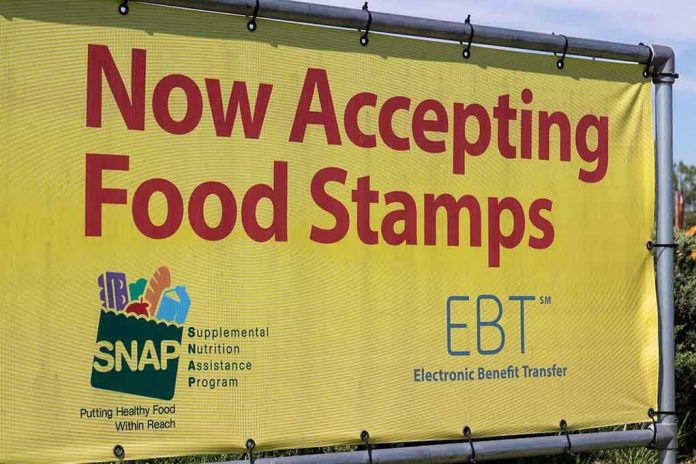
Two tiny Boston corner stores moved nearly $7 million in food stamps while Washington now uses Minnesota’s separate fraud scandal to demand sweeping data on every family that needs help to eat.
Story Snapshot
- Boston prosecutors allege two closet-sized bodegas turned SNAP into a $7 million cash machine.
- Federal officials now brand Minnesota a fraud hot spot, even though its big scandal was not SNAP at all.
- Gov. Tim Walz sues USDA, saying new SNAP rules and data grabs are political overreach, not fraud control.
- Republicans cite soaring SNAP costs to argue Walz and Washington are dodging accountability.
How Two Tiny Boston Stores Became a $7 Million Warning Shot
Federal agents in Boston say they watched a corner store the size of a walk-in closet ring up more SNAP redemptions than a full-service supermarket. According to prosecutors, Jesula Variety Store in Mattapan redeemed about $6.8 million in food stamp benefits starting in 2022, even though investigators describe almost no inventory, no refrigeration, and customers who walked out with little or no food after large EBT charges. Agents say the math made no sense, and the behavior confirmed it.
The federal complaint details classic trafficking: customers allegedly swiped $120 in benefits and received $100 in cash, a clean 20% haircut on taxpayer money. Prosecutors also say the store sold liquor to SNAP users and even resold donated MannaPack meals meant to feed children in crisis overseas. Next door, Saul Mache Mixe Store allegedly redeemed another $122,000 in a matter of months. The U.S. attorney calls it turning “a program to feed families into a multimillion-dollar criminal enterprise.”
Oversight, Blame, and the Fight Over Who Looked Away
The Boston case instantly triggered a blame game between federal prosecutors and Massachusetts officials. The U.S. attorney blasted “a lack of oversight,” arguing that anyone comparing those redemption numbers to local norms could see red flags. Gov. Maura Healey’s administration answered that narrative with its own: state analysts say they flagged the suspicious pattern to USDA more than a year before the charges, pointing to intergovernmental bottlenecks rather than state indifference.
That split matters because it shapes how Americans see anti-fraud enforcement. If a closet-sized shop can quietly pull $7 million out of SNAP, Washington will argue for more data, more algorithms, and more federal power. If the state did raise alarms and the federal bureaucracy took a year to act, the problem looks less like local negligence and more like system-wide inertia. Conservatives focus on the sheer dollar amount and the time it continued; progressives stress that the case was eventually detected using the tools already in place.
From Feeding Our Future to SNAP: Minnesota Gets Branded
Several states away, Minnesota is living with the political aftershock of a different scandal. The Feeding Our Future case involved massive fraud in child nutrition programs during the pandemic, not SNAP, but federal agencies now cite that episode as proof Minnesota needs intrusive new oversight on all its food programs. USDA and the Administration for Children and Families have demanded broad data on benefits recipients and insisted the state adopt tougher SNAP recertification rules, explicitly invoking “highly publicized and ongoing fraud” in Minnesota as justification.
Minnesota’s attorney general responded with a federal lawsuit in December 2025, arguing that USDA is using a non-SNAP scandal as a pretext to rewrite SNAP rules without strong evidence of widespread fraud in that program. The complaint points out that Minnesota’s average SNAP benefit, roughly $314 a month per household, makes it a less lucrative target than the pandemic-era child nutrition funds that fueled Feeding Our Future. From that perspective, federal agencies look less like guardians of integrity and more like bureaucracies exploiting a headline-grabbing scandal to grab data they have wanted for years.
Tim Walz, Rising Costs, and a Conservative Case for Skepticism
Gov. Tim Walz and his administration frame their lawsuit as a defense of both law and privacy: they argue that Washington cannot impose burdensome recertification rules and sweeping data demands without evidence tailored to SNAP itself. Their position echoes long-standing concerns about using welfare administration to backdoor broader surveillance, including on immigration status. For civil libertarians, Feeding Our Future should lead to better targeted enforcement where the fraud occurred, not to a dragnet over every family using an EBT card.
Minnesota House Republicans, however, draw a different lesson from the numbers. They highlight a reported 183% increase in SNAP costs and a jump from about 398,000 participants in 2019 to 511,000 in 2024, describing growth as “skyrocketing” under Walz. From that vantage point, it strains common sense to say everything is fine while costs surge and Washington raises alarms. They argue that an administration quick to sue USDA but slow to embrace tougher fraud controls looks more committed to protecting bureaucracy than protecting taxpayers and truly needy families.
What Boston’s Closet Stores and Minnesota’s Lawsuits Tell Us About SNAP’s Future
The Boston case proves that with the right scheme and the right blind spots, even tiny stores can drain millions from a program designed to keep families from going hungry. The Minnesota fight shows how one massive, unrelated scandal can become a permanent talking point for agencies that want more data and more discretion. Both stories reveal the same tension: how far should the government go to police fraud before it starts punishing the honest poor alongside the crooks?
American conservative values point to a straightforward standard. Any system that moves tens of billions of dollars needs serious, data-driven oversight and quick consequences for fraud, whether in a Mattapan bodega or a Minnesota nonprofit. But fraud controls must be grounded in real evidence, not political theater, and they must target the bad actors rather than assuming guilt across entire states or populations. Boston and Minnesota are early test cases of whether Washington can tell the difference.
Sources:
CBS News Boston – SNAP Massachusetts Fraud Boston
Northeastern University – Massachusetts Men Charged With Nearly $7 Million in SNAP Fraud
ABC News – 2 Men Arrested for Allegedly Trafficking $7 Million Worth of SNAP Benefits
WBUR – Food Stamp Fraud Charges Over SNAP Benefits at Mattapan Bodegas
DOJ – Two Massachusetts Men Charged in Large-Scale SNAP Benefits Trafficking
Minnesota Attorney General – USDA SNAP Recertification Complaint
Minnesota House – SNAP Cost and Participation Press Release