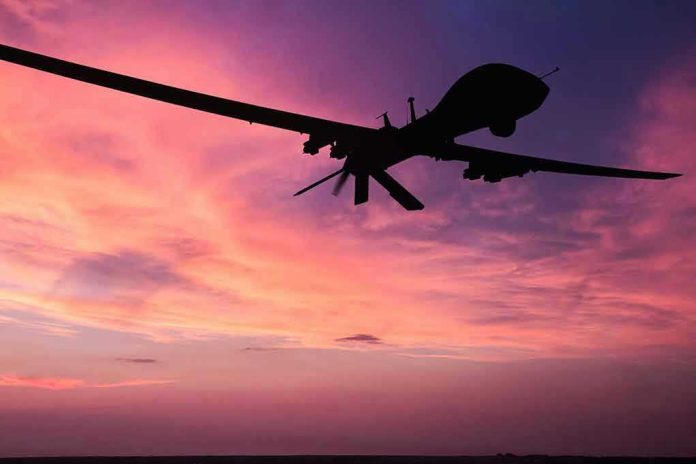
Finland’s intelligence chief warns that Russian GPS jamming intended to deflect Ukrainian drones could accidentally send those same weapons spiraling into Finnish territory.
Story Snapshot
- Major General Pekka Turunen warns growing risk of drones drifting into Finnish airspace from Ukraine conflict near Gulf of Finland
- Russian GPS jamming deployed to counter Ukrainian strikes may inadvertently divert drones across the 1,340-kilometer Finnish-Russian border
- No incidents reported yet, but NATO airspace experienced unprecedented drone flyovers starting September 2025
- Europe developing coordinated “drone wall” defense system; NATO deploys new US anti-drone technology to eastern flank
- Finland acquiring micro-drones and enhancing UAV capabilities as drone warfare becomes permanent security fixture
When GPS Becomes a Weapon Against Itself
Ukraine’s intensifying drone campaign against Russian oil infrastructure near the Gulf of Finland has created an unintended security headache for Helsinki. Major General Pekka Turunen, chief of Finnish Defence Intelligence, explains the mechanism: when Russia deploys GPS jamming to protect its targets, drones relying on satellite navigation can lose their bearings entirely. These disoriented aircraft don’t simply fall from the sky—they continue flying, potentially crossing into Finnish airspace or crashing on Finnish soil. The risk escalates with each Ukrainian strike in the region.
Finland’s Precarious Geographic Position
Finland’s decision to join NATO in April 2023 ended decades of military non-alignment, but it didn’t eliminate the nation’s geographic vulnerability. Sharing a 1,340-kilometer border with Russia while sitting adjacent to active combat operations creates a unique predicament. The country faces threats not from deliberate aggression but from the chaotic spillover of modern warfare. Turunen’s warning arrives as Finland’s overall security situation has deteriorated since Russia’s February 2022 invasion of Ukraine, though the direct military threat assessment remains stable compared to a year ago.
The Drone Revolution Nobody Wanted
Mikko Hyppönen, Chief Research Officer at Finnish defense technology firm Sensofusion, delivers a sobering assessment of warfare’s evolution. In Ukraine, drones now kill more people than rifles, grenades, and artillery combined. What began with consumer-grade quadcopters jury-rigged to drop munitions has escalated into sophisticated systems including long-range reconnaissance platforms and high-speed kamikaze drones designed for precision strikes. This isn’t a temporary adaptation to one conflict—it represents a permanent transformation in how nations fight and defend themselves.
Europe’s Coordinated Defense Response
September 2025 marked a turning point when NATO airspace experienced drone flyovers at unprecedented scale. Poland, Estonia, Romania, Norway, and Denmark all reported incidents, with Romania documenting exponential increases in Russian drone incursions since September 2023. NATO Secretary General Mark Rutte responded by announcing the Eastern Sentry programme, while military officials deployed new US anti-drone systems to the alliance’s eastern flank in November 2025. Europe is now constructing a coordinated “drone wall”—integrated detection, tracking, and interception capabilities spanning member states.
Technology Becomes the First Line of Defense
Sensofusion’s Airfence system exemplifies the technological arms race underway. The platform detects drones without revealing defensive positions, providing real-time maps showing aircraft height, direction, and even serial numbers. Most critically, it can pinpoint operator locations, enabling forces to target the controller rather than just the expendable drone. Finland’s Defence Forces are simultaneously acquiring Parrot Anafi micro-drones with deliveries starting in 2026, enhancing offensive and reconnaissance capabilities. The dual-use nature of these technologies means civilian airports and critical infrastructure also benefit from military-grade protection.
Political Turmoil Emboldens Russia
Turunen notes that recent Western political divisions—particularly President Trump’s renewed push to acquire Greenland and threats of tariffs against European NATO allies—have created a perception in Moscow that the alliance is fracturing. Russia interprets this discord as an opportunity to act more freely, believing the West stands on the brink of collapse. Whether accurate or wishful thinking on the Kremlin’s part, this assessment influences Russian behavior and calculus regarding drone operations and other gray-zone activities along NATO’s borders.
The Unspoken Economic Dimension
Drone threats carry massive economic implications beyond military expenditures. Consumer drones have repeatedly shut down major airport operations, causing cascading losses throughout transportation networks and supply chains. Finland’s investment in companies like Sensofusion reflects recognition that drone defense will become a permanent budget line item for both military and civilian authorities. The defense sector has identified drone technology as a leading focus area for 2026, alongside digital network infrastructure and subsea cable protection—all vulnerabilities exposed or exacerbated by the Ukraine conflict.
Sources:
Risk of drones drifting into Finland’s airspace growing, intelligence chief says
Silent Shield: How Finland’s Sensofusion is Neutralising the Drone Threat
Russia Likely to Keep Trying to Damage Baltic Sea Infrastructure
Finland Strengthens UAV Capability
What Sectors Will Lead the Defence Industry in 2026
Russia Targets NATO Frontline States
Maintaining the UK’s Intelligence Edge in the Grey Zone