
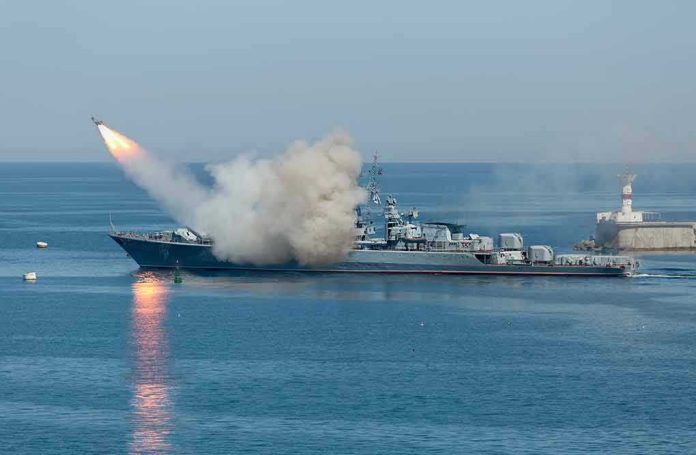
After years of border chaos and cartel impunity, the U.S. military is now firing Hellfire missiles at drug boats—raising hard questions about results, legality, and how far Washington is willing to go.
Story Snapshot
- U.S. Southern Command says a Feb. 13, 2026, Hellfire strike in the Caribbean killed three alleged “narco-terrorists” operating along smuggling routes linked to designated terrorist groups.
- The strike is described as the 39th since early September 2025 under “Operation Southern Spear,” a campaign that expanded from the Caribbean into the Eastern Pacific.
- The Trump White House has framed the effort as an “armed conflict” aimed at stopping narcotics flows into the United States.
- Analysts note the operation pairs lethal interdictions with a major naval posture, including carrier strike group deployments and expanded surveillance near Venezuela.
- Critics argue the strikes blur counterdrug enforcement and war powers, and say public evidence about drug loads and targeting standards remains limited.
What SOUTHCOM says happened in the 39th strike
U.S. Southern Command reported that on Feb. 13, 2026, U.S. forces conducted a lethal strike in the Caribbean Sea using Hellfire missiles against a vessel described as operating on known narcotics-trafficking routes tied to designated terrorist organizations. SOUTHCOM said three alleged narco-traffickers were killed and reported no U.S. casualties. The action is being counted as the 39th strike since the campaign began in September 2025.
The public-facing details remain narrow: the military’s statements emphasize intelligence links to smuggling networks, but they provide little granular information about the specific cargo, crew identities, or chain of custody that would typically appear in a law-enforcement interdiction. That gap matters because the campaign is being justified as a national-security response to narcotics and cartel-linked violence, not as routine policing at sea.
How Operation Southern Spear escalated from interdiction to armed conflict
Reporting and analysis describe Operation Southern Spear as starting on Sept. 2, 2025, with strikes in Caribbean waters near Venezuela and then intensifying later in 2025 as operations expanded into the Eastern Pacific. The administration’s approach reportedly shifted after Venezuelan-linked cartels were designated as foreign terrorist organizations in November 2025, setting a legal and political predicate for treating certain maritime smuggling as a terrorism-linked threat rather than standard trafficking.
Strategically, the operation has been paired with visible naval muscle. Analysts point to deployments such as the USS Gerald R. Ford carrier strike group and a broader surveillance screen operating off Venezuela. That posture communicates deterrence, but it also fuels the central debate: whether the mission is narrowly about stopping drug flows or is also positioning for broader pressure on Venezuelan state-linked networks. The research indicates both narratives are present in public discussion.
Maduro’s capture and the Venezuela nexus shaping the campaign
A key milestone cited across sources is the Jan. 3, 2026, capture of Venezuelan leader Nicolás Maduro by U.S. special forces, with Maduro facing narco-terrorism charges in New York. The February 13 strike was described as the third since that capture, highlighting a campaign that did not pause after a major leadership decapitation event. Instead, the operational tempo continued, reinforcing that the U.S. sees the trafficking architecture as durable and distributed.
From a conservative lens, the logic is straightforward: cartels and state-protected traffickers exploit weak enforcement, and Americans pay the price in overdoses, crime, and border strain. Still, the research also shows uncertainty in the numbers and effects—fatalities are cited in the range of roughly 119 to 130+ across the campaign, and analysts caution that reporting lags and differing counting methods can produce inconsistencies even when the overall trendline is clear.
Effectiveness, oversight, and constitutional guardrails
Defense Secretary Pete Hegseth and the White House have argued the campaign is producing deterrence, including claims that some traffickers have ceased operations after repeated strikes. Separately, analysts have noted a recent reduction in attacks or casualties could reflect deterrence or a tactical shift, but the available research does not conclusively establish which explanation is correct. That distinction matters if policymakers are claiming measurable success.
Legal and oversight critiques focus on whether lethal force against suspected smugglers, rather than capture and prosecution, is justified and lawfully grounded—especially when the administration describes the campaign as an “armed conflict” and Congress is notified in that frame. Critics also argue that public evidence about drug loads and targeting remains limited, making it harder for citizens to judge necessity and proportionality. For voters who want both security and constitutional restraint, transparency becomes the hinge issue.
The bottom line is that Washington has moved from chasing smugglers to hunting “narco-terrorists” with military hardware, and that shift will shape how future administrations treat crime, borders, and war powers. If the campaign reduces maritime narcotics flows, Americans may see real benefits. If standards and oversight stay unclear, the country risks normalizing lethal executive action in gray zones—exactly the kind of precedent conservatives typically demand be tightly limited.
Sources:
Trump’s Caribbean Campaign: Data Behind a Developing Conflict
Operation Southern Spear: U.S. Military Campaign Targeting Venezuela
The Boat Strikes Are Still Happening: Five Things You Need to Know