
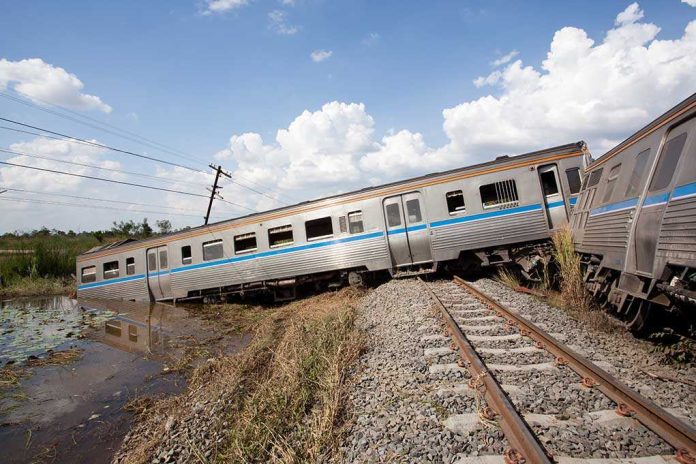
Switzerland’s world-renowned rail system experienced three separate derailments and collisions within just four days, sending shockwaves through a nation that prides itself on operational precision and safety.
Story Snapshot
- Three distinct rail incidents struck Switzerland between February 15-18, 2026, affecting different operators across multiple regions
- A high-speed ICE train carrying 240 passengers derailed near Basel, while a regional train derailed on the tourist route to Zermatt
- All train passengers were evacuated without serious injuries, but two track workers sustained serious injuries in a separate locomotive-excavator collision
- Swiss Transportation Safety Investigation Board launched formal investigations as rail connections were suspended and replacement bus services deployed
When Precision Meets the Unexpected
The first incident unfolded on February 15 shortly after 9:00 AM when a Matterhorn Gotthard Bahn regional train derailed on the Täsch-Zermatt line. This picturesque route serves thousands of tourists heading to the iconic Matterhorn, making the disruption particularly significant for the Valais region’s tourism economy. Railway officials deployed replacement buses between Täsch and Zermatt, though capacity constraints created extended waiting times. The company’s media office confirmed that all passengers were evacuated safely without injuries, but service restoration timelines remained unclear.
Three days later, an ICE high-speed train traveling from Berlin to Interlaken derailed near Basel station with approximately 240 passengers aboard. Swiss Railways coordinated a full evacuation with no serious injuries reported among passengers. The derailment of an international high-speed service raises questions about track conditions and potential systemic issues, though authorities have not yet disclosed the cause. The incident disrupted one of Europe’s key rail corridors connecting Germany to Switzerland’s mountain destinations.
Track Workers Bear the Real Cost
The most serious consequences came from a third incident in St. Gallen’s Heiligkreuz area, where an SBB mainline locomotive collided with a rail excavator during nighttime operations. Two track workers, ages 29 and 40, sustained serious injuries requiring hospitalization. The 60-year-old locomotive driver was also transported to a medical facility for evaluation. St. Gallen City Police, the Public Prosecutor’s Office, and emergency services coordinated the response while the Swiss Transportation Safety Investigation Board launched a formal investigation into operational procedures.
Rail connections between St. Gallen and the Goldach-Rorschach line were immediately suspended, forcing authorities to arrange replacement services. This collision highlights occupational safety concerns that often escape public attention when passengers emerge unscathed. The involvement of SUST signals that authorities are treating this with appropriate regulatory seriousness, examining whether proper protocols were followed during what should have been controlled maintenance operations.
Reputation Under Scrutiny
Switzerland maintains one of the safest rail systems globally, making this cluster of incidents within 72 hours particularly noteworthy. The country’s rail safety record stands in stark contrast to incidents in neighboring countries, including a Spanish crash that killed 79 people when a train exceeded speed limits by 20 mph on a curve. Swiss rail operators coordinate multiple interconnected networks, from high-speed international services to specialized mountain railways, creating complexity that demands constant vigilance.
The timing raises uncomfortable questions about whether these incidents represent coincidental bad luck or signal deeper infrastructure concerns. None of the three incidents have yielded public explanations for their causes, suggesting ongoing investigations that may take weeks or months to complete. The lack of passenger fatalities reflects Switzerland’s robust emergency response systems and safety protocols, but the occurrence of multiple incidents across different operators and regions could prompt systematic reviews of maintenance procedures, signaling systems, and operational standards.
What the Silence Tells Us
Swiss authorities have shown appropriate restraint in avoiding premature conclusions about causation, but this leaves passengers and the tourism industry in limbo. The Täsch-Zermatt closure directly impacts access to one of Europe’s most famous peaks during winter tourism season. Replacement bus services cannot match rail capacity or efficiency, creating bottlenecks that ripple through hotel bookings and ski resort operations. The suspended St. Gallen connections affect both regional commuters and international transit routes.
The deployment of SUST for formal investigation demonstrates that Swiss authorities maintain high standards for accountability, consistent with international best practices for transportation safety. What remains unclear is whether these investigations will uncover shared factors, equipment failures, or human errors that connect these seemingly independent incidents. Until investigators complete their work and release findings, Swiss rail operators face the challenge of maintaining public confidence while acknowledging that even the world’s best systems face vulnerability.
Sources:
High-speed train derails in Switzerland – Report.az
Railroad line to Zermatt interrupted – Bluewin.ch
Collision between SBB locomotive and rail excavator halts traffic in St. Gallen – Railmarket.com