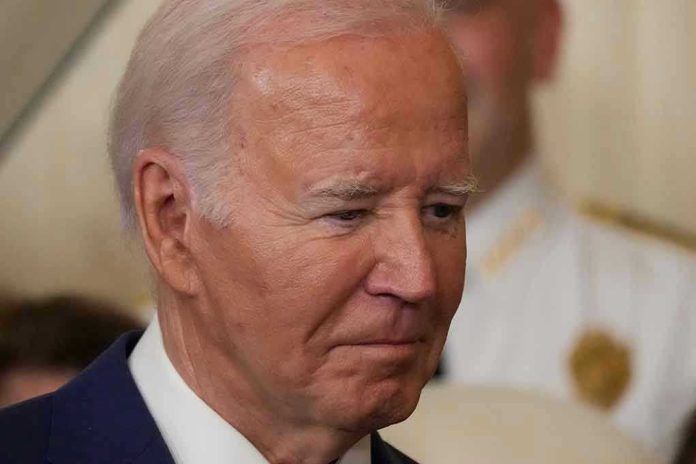
A Trump-appointed judge just opened the door for 70 hours of Joe Biden’s secret tapes to see daylight — over Biden’s own lawsuit to keep them buried.
Story Snapshot
- A federal judge ruled that public interest outweighs Joe Biden’s privacy claim over his ghostwriter recordings.
- The Justice Department can now give redacted transcripts and audio to the Heritage Foundation and Congress.
- The tapes came from the special counsel probe into Biden’s handling of classified documents.
- The court says sensitive family details were removed, but Biden is still fighting to keep the tapes hidden.
Judge Says the Public’s Right to Know Beats Biden’s Privacy Claim
U.S. District Judge Dabney Friedrich, who was appointed by President Donald Trump, rejected Joe Biden’s attempt to stop the Trump administration’s Justice Department from releasing recordings and transcripts of Biden’s talks with his ghostwriter to a conservative group.[4] The judge ruled that the public interest in seeing and hearing this material outweighs whatever privacy rights Biden claimed in court.[4] That means the Department of Justice can move ahead with handing over redacted copies to the Heritage Foundation and to Congress, unless a higher court steps in.[2]
The material at the center of this fight includes about 70 hours of interviews Biden did at his home in 2016 and 2017 with writer Mark Zwonitzer, who helped him write two memoirs.[5] Those conversations later became evidence in Special Counsel Robert Hur’s investigation into whether Biden improperly kept and shared classified documents from his time as a senator and as vice president.[3] After Hur chose not to file charges, congressional Republicans and outside watchdogs wanted to see the same evidence prosecutors reviewed.[3]
How a Classified Documents Probe Turned Into a Transparency Battle
Special Counsel Robert Hur, appointed during Biden’s presidency, looked into boxes and files stored in Biden’s home and office, including notebooks and records with sensitive government information.[6] Hur’s report said Biden had kept classified materials and even read some of that information “nearly verbatim” from his notebooks to his ghostwriter on several occasions.[6] Hur still decided not to bring charges, saying jurors might see Biden as a forgetful old man and might not be convinced he meant to break the law.[6] That decision left many Americans wondering why a former president could mishandle classified records and walk away without a trial.[3]
That is where the Freedom of Information Act, often called FOIA, comes in. Under that law, the public can request federal records, unless they fall under narrow exemptions such as national security or personal privacy.[19] A staff member with the conservative Heritage Foundation filed a FOIA request asking for the Biden–Zwonitzer transcripts and audio that the Justice Department used in the Hur probe.[3] The Justice Department first argued the materials could be kept secret under the public records law, but later agreed to release redacted versions to Congress and Heritage.[5] That change in position set up a clash between Biden, who wanted secrecy, and an executive branch now saying disclosure was required.
Biden Sues to Seal Tapes, but Redactions Undercut His Privacy Argument
Faced with the pending release, Biden went to federal court and sued the Justice Department, claiming that disclosure would be an “unwarranted invasion” of his privacy.[5] His lawyers stressed that the interviews took place in his private home and included deeply personal topics, including the death of his son Beau.[3] They also argued that when Biden agreed to give audio to Special Counsel Hur, it was with the understanding that the tapes would remain confidential and be used only inside the criminal investigation.[3] Biden’s team framed the fight as one about personal dignity and family grief, not politics.
Judge Friedrich was not persuaded. In her written opinion, she noted that the administration had already applied “extensive” redactions to the tapes and transcripts.[2] She wrote that the remaining material “contain[s] no mention of highly sensitive topics like illness or death,” and does not name any nonpublic individuals, including members of Biden’s family.[4] With those cuts in place, the judge found that Biden’s privacy interest was “diminished,” while the public’s need to understand how the Justice Department handled a major classified documents case was “unusually strong.”[2] She also pointed out that Biden had not shown any specific harm to the public if the tapes were released.[2]
What This Means for Accountability — and for Future Presidents
This ruling is more than a personal setback for Joe Biden. It sends a clear message that former presidents cannot easily hide behind privacy claims when evidence has already been used in a high-profile federal investigation. Freedom of Information Act guidance says agencies must lean toward disclosure and only withhold records when they reasonably foresee harm tied to a specific exemption.[19] Here, the Justice Department and the court agreed that limited redactions were enough to protect legitimate privacy concerns without keeping the entire record locked away.[2]
Court Denies Biden’s Attempt to Seal Ghostwriter Recordings.
A federal judge ruled against Joe Biden’s attempt to prevent the release of recordings obtained during a classified documents investigation, citing public interest over privacy concerns.
PULSE POINTS
❓ WHAT… pic.twitter.com/SqqbN5NFjj
— The National Pulse (@TheNatPulse) June 19, 2026
For constitutional conservatives, this is a rare win for transparency after years of stonewalling, selective leaks, and two-tiered justice. The same government that threw the book at some Americans for handling classified material has often seemed ready to give powerful Democrats a pass. By greenlighting these redacted tapes, the court opened a window into how the system decided not to prosecute Biden over conduct that included reading sensitive information to a ghostwriter who did not have a security clearance.[6] That matters for equal treatment under the law and for restoring trust in federal institutions.
Sources:
[2] Web – Judge rejects Biden’s bid to block release of ghostwriter recordings
[3] Web – Judge denies Biden’s bid to block DOJ from releasing conversations …
[4] Web – Trump Judge Deals Biden Blow Over Heritage Foundation Suit for …
[5] Web – Judge denies Biden’s bid to block release of transcripts linked to …
[6] Web – Biden’s bid to block release of recordings made with ghostwriter fails
[19] Web – In First of Many, ACLU FOIA Request Seeks Information About the …