Presidential travel is never just logistics; when it is routed through battlegrounds inside reliably red states, it is strategy in motion. President Trump’s swing through Texas and Oklahoma was a deliberate, early-October effort to fortify Republican prospects in contested down-ballot races—most notably Texas’s Senate contest—by marrying the visibility of the presidency to the mechanics of party turnout.
At a Glance
- Trump launched a 32-day campaign blitz with stops in Texas and Oklahoma, pairing official visibility with partisan objectives.
- In Denton, Texas, his appearance centered on helping Republican Senate nominee Ken Paxton in a competitive race.
- The Texas stop featured coordinated staging: Paxton and other GOP figures attended as Trump toured a local truck facility.
- In Oklahoma, Trump echoed the formula—public rallying for Republican candidates—to extend the turnout strategy beyond Texas.
What happened: a two-state kickoff designed around Senate control
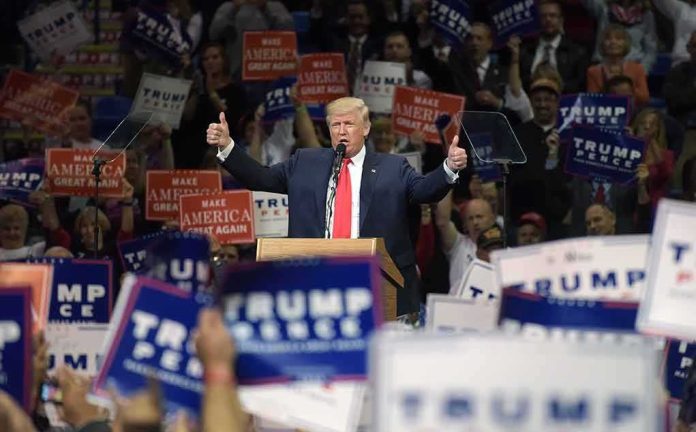
President Trump began what he billed as a 32-day blitz to Election Day with a Texas stop that flowed directly into Oklahoma. Multiple outlets placed him at a truck manufacturing facility in Denton, Texas, before he continued on to Durant, Oklahoma later the same day, a one-two itinerary timed to maximize exposure at the campaign’s inflection point. The Associated Press framed these events as the formal start to a monthlong push, underscoring their significance for both the presidency’s messaging calendar and the party’s electoral math.
The Texas leg was not generic rallying—it was Senate-focused. Ken Paxton, presented in coverage as the Republican nominee for U.S. Senate, attended alongside senior state Republicans, clarifying the point of the stop: to help secure a seat that Republicans could not treat as safe in November. The logic is straightforward: Senate control often turns on a handful of contests. When internal and public indicators move a race into competitive territory, a presidential visit is a resource deployment, not a courtesy call.
Texas: why this stop centered on Paxton’s race
In Denton, the staging and the surrogate cast told the story. Paxton’s presence—and the inclusion of high-profile Republicans like Sen. Ted Cruz—signaled coordinated campaign intent rather than incidental overlap between governance and politics. Independent reporting described the visit’s “real reason” as helping Paxton win, aligning the White House roadshow with the state party’s highest-stakes contest this cycle. Reuters added the intra-party context: Trump had backed Paxton over incumbent Sen. John Cornyn in the Republican primary, turning the general election into both a test of the president’s influence and a must-hold seat for the GOP.
Why Texas, and why now? Because the race looked close enough to warrant national help. Outlets covering the stop emphasized that Republicans were spending heavily to protect the seat against Democrat James Talarico, an expenditure pattern typical of contests that have slipped from “likely” into “lean” territory on party scorecards. In a cycle where map control may hinge on defense as much as offense, Texas demanded attention—and presidential time is the scarcest attention of all.
Oklahoma: extending the turnout formula beyond a single race
From Denton, Trump shifted to Oklahoma and repeated the core tactic: use a high-profile event to juice Republican enthusiasm for a slate of down-ballot candidates. NBC reported that he urged supporters to “pretend” he was on the ballot and to vote for GOP contenders including Mike Mazzei and Kevin Hern, a frame aimed squarely at solving the right-of-center turnout problem that often emerges in midterms when the presidency itself is not at stake.
Unlike Texas, Oklahoma’s stop was not pinned to a marquee Senate fight; the emphasis fell on consolidating red-state margins and safeguarding what should be friendly terrain. That does not make it low value. In midterm cycles shaped by national headwinds and localized candidate liabilities, even deep-red states can produce closer-than-expected results if base voters grow complacent. The Oklahoma rally was the mirror of Texas’s specificity: where Texas concentrated resources on a single high-salience race, Oklahoma spread them to stabilize the broader ticket.
Mechanism: presidential attention as turnout engineering
What does a presidential stop actually do? At its core, it is an attention engine. The visit resets local media priorities for 48–72 hours, drives earned coverage for targeted candidates, recruits volunteer energy, and compresses donor outreach into a visceral, news-making moment. For Republican primaries and red-state settings, the academic and journalistic base rate is clear: Trump’s imprimatur tends to be an asset, often clearing fields or cementing frontrunner status.
But the same literature cautions against treating presidential involvement as a universal multiplier. Once races become high-salience general elections, the effect varies with context—state partisanship, candidate quality, and the volume of opposition activation. Studies and cycle analyses repeatedly find that while Trump’s presence elevates enthusiasm among loyal Republicans, it can also galvanize Democrats and moderates, blunting net gains or even imposing a marginal penalty outside friendly terrain. The Texas-Oklahoma itinerary reflects that asymmetry: Senate-specific mobilization in a competitive but right-leaning state, and broad GOP activation in a red state where the downside risk is comparatively modest.
The Texas Senate stakes: cost, coalition, and message control
For Republicans, the Texas Senate race is expensive for a reason. Tightening margins force campaigns to spend not only on persuasion but on reassurance—convincing habitual Republicans that their vote still matters in a midterm and persuadable voters that the GOP nominee can govern. National compounding factors—economic anxiety, foreign policy crises, candidate baggage—raise the cost of that reassurance, which is why party committees concentrate top-tier surrogates where they model the most leverage.
Trump’s prior endorsement of Paxton over an incumbent heightened both opportunity and risk. It probably enhanced primary consolidation and base zeal; it also attached national scrutiny to the nominee’s vulnerabilities. The Denton visit was designed to convert the first into an advantage and dampen the second with a show of unity. That unity mattered beyond optics: it signaled to donors and allied committees that the seat remained a top-tier defense and deserved continued heavy investment into the campaign’s final month.
How this fits the broader endorsement record
Two truths can be held at once. First, Trump’s involvement remains one of the most potent mobilizers in Republican politics, particularly in primaries and low-salience contests; meta-analyses and cycle reviews consistently record benefits in those settings. Second, in general elections—especially where the electorate is more ideologically mixed—those benefits attenuate or can invert, as opposition activation and message reframing offset base gains. The Texas-Oklahoma sequence was calibrated to those realities: use the presidency to lift a competitive red-state Senate nominee, and use rallies to harden turnout in a state where the party’s floor is high.
Bottom line: purposeful itinerary, clear objective
Strip away the partisan theater and the through-line is simple. The president began a monthlong campaign drive by investing his time where it could most plausibly affect Senate control and down-ballot stability. Texas got a Senate-focused push with Paxton visible and centered; Oklahoma extended the same turnout logic across the ticket. In a cycle where enthusiasm gaps can decide close races, that is less about spectacle than arithmetic—and about using the singular media gravity of the presidency to make the numbers move where they are most likely to budge.
Sources:
youtube.com, apnews.com, cbsnews.com, nbcnews.com, yahoo.com, local10.com, ksat.com, washingtonexaminer.com