
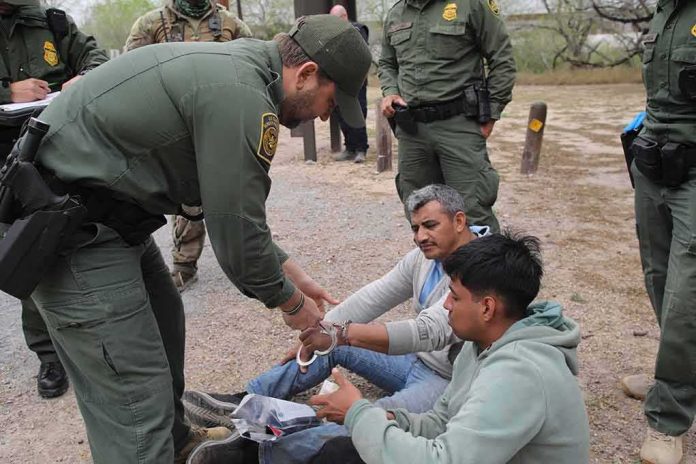
ICE’s arrest surge is not a headline spasm but the operational expression of a clear mandate: the agency is executing large-scale, lawful interior enforcement under federal immigration statutes, with record monthly arrests driven by coordinated field operations, expanded partnerships, and sustained leadership direction to convert arrests into removals.
At a Glance
- ICE recorded nearly 51,000 arrests in August 2026, its highest monthly total on record, capping a three-month climb.
- Targeted field operations—such as the Washington, D.C.–area “Operation Safe Community”—are the building blocks of the national surge.
- The surge relies on a broadened arrest posture and deeper state–local cooperation arrangements that multiply touchpoints.
- Arrests, detentions, and removals are distinct stages; the surge centers on arrests, while the pipeline to removal continues in parallel.
What is happening: a record-setting arrest tempo with national footprint
U.S. Immigration and Customs Enforcement is in the midst of a broad enforcement surge that has pushed monthly interior arrests to the highest levels on record. DHS publicly reported that ICE agents arrested 50,925 people in August 2026, surpassing the previous record set in July and continuing a summer-long escalation that began in June. The agency’s own releases, along with independent tallies, describe the surge as nationwide in scope and sustained in cadence, rather than a short-lived blitz aimed at one or two metropolitan areas.
These national totals are constructed from scores of discrete field actions. For example, ICE’s “Operation Safe Community – Washington, D.C.”—which covered Virginia and Maryland—produced 1,328 arrests in just two weeks in early August, illustrating the scale and tempo of targeted operations that, in aggregate, produce the record national figures. Smaller city- and sector-level actions, such as the Houston-area sweep focused on criminal offenders and other egregious immigration violators, round out the pattern: many localized, time-bound operations building to a large national number.
How the surge works: legal authorities, operational design, and throughput
ICE’s interior enforcement authority comes from the Immigration and Nationality Act, which empowers officers to arrest, detain, and remove noncitizens who are inadmissible or deportable under law after administrative process or court proceedings. The current surge translates that authority into action through three operational levers. First, arrest posture: field teams are executing more street and at-large arrests, as well as jail pickups where local cooperation permits. Second, scale: headquarters has directed sustained tempo, reinforced by hiring plans to expand the workforce. Third, coordination: a dense web of information-sharing and task force activity with federal, state, and local partners increases encounter opportunities, from jail exits to traffic stops, depending on jurisdictional agreements.
It is essential to separate metrics. Arrests measure front-end enforcement activity; detentions measure custodial status; removals (and related categories such as returns or repatriations) measure case outcomes. The surge has most visibly moved the arrest needle. DHS and ICE also report elevated removals, though the arrest-and-removal pipeline is staggered by legal process, custody capacity, travel documents, and flight logistics; the Office of Homeland Security Statistics tracks these stages precisely to avoid conflating them.
Where it is happening: targeted operations and sanctuary friction
The surge is not confined to traditionally high-volume corridors. It has unfolded “everywhere all at once,” as one national account put it, with particular intensity in jurisdictions where cooperation with ICE is robust and where state and local agencies have entered formal agreements to assist or align with federal enforcement. In parallel, DHS has announced increased deployments in so-called sanctuary jurisdictions—cities or counties with policies that constrain cooperation on detainers or data-sharing—which makes fieldwork more at-large and less jail-centered in those areas.
Concrete examples show both sides of the ledger. In the D.C. region, a concentrated two-week operation produced over a thousand arrests. In Texas, a Houston-area action targeted convicted offenders and other priority subjects, enabled by cross-agency support. In sanctuary jurisdictions, DHS public messaging has emphasized public safety outcomes and a willingness to conduct at-large arrests where jail transfers are not available. The practical result is a patchwork map of tactics, tuned to local legal and political constraints, rolling up into national totals.
Who is being arrested: priorities, breadth, and the numbers behind them
The administration’s framing stresses “criminal aliens” and public safety threats. The recorded surge, however, is broad in its reach—consistent with leadership statements that anyone without lawful status is arrestable—while still incorporating significant shares of people with criminal histories in targeted sweeps. Publicly reported data and analyses of the summer spike show the arrest totals rising across categories; reporting has also documented that arrests of people without criminal convictions increased markedly as the surge matured, reflecting the widened arrest posture that accompanies at-large operations and street encounters.
This breadth is not a policy accident; it flows from the agency’s legal authorities and stated intent to enforce against all removable noncitizens, with priority overlays for serious criminality. Field teams then execute within those guardrails, using risk triage, intel leads, and operational targets. In practice, larger volumes invariably sweep in mixed profiles. That is exactly why interpreting the surge through multiple metrics—arrests, detainers, detentions, removals—provides a more accurate picture than any single headline number.
More than 10,000 ICE officers whose training was expedited during a hiring surge aimed at boosting the Trump administration’s mass deportations efforts are now being required to undergo additional training, sources say. https://t.co/qbvwSfjLKW
— NBC News (@NBCNews) October 3, 2026
Capacity and continuity: workforce, logistics, and the removal pipeline
Sustaining record arrests requires personnel, detention space, transport, and consular coordination for travel documents. ICE is moving on the workforce front, with plans reported to bring on thousands of additional employees to support the deportation drive. Scaling staff enables more arrest teams, more case officers to process files, and more transportation and removal operations to close cases. That institutional capacity build-out is the scaffolding for making a surge durable rather than episodic.
The back end of the pipeline—hearings, final orders, and removals—lags arrests by design, given due process and country-clearance hurdles. Nonetheless, DHS has reported elevated removals during the same period, and coverage emphasizing the arrest/removal delta has rightly focused on timing and throughput rather than any legal defect in the arrests themselves. The operational point stands: the system is arresting at record pace while the adjudication and logistics machinery works to convert those arrests into final outcomes under law.
Why this matters: policy choices made operational, and what to watch
Interior enforcement is a policy choice made real through fieldwork. The administration has aligned messaging, resources, and partnerships to prioritize arrests at scale; the numbers confirm execution. For stakeholders—city leaders weighing cooperation, employers calibrating compliance programs, counsel advising clients, and communities monitoring public safety—the metrics to watch are not only arrests, but also the proportion of jail transfers versus at-large arrests, detention bed utilization, average time to removal after arrest, and the mix of criminal versus noncriminal profiles in the arrest pool. Those figures reveal not just how much enforcement is happening, but how it is happening—and with what consequences across the legal and logistical pipeline.
Sources:
cbsnews.com, dhs.gov, ice.gov, nytimes.com, crbcnews.com, nbcnews.com, thehill.com, ibtimes.co.uk