
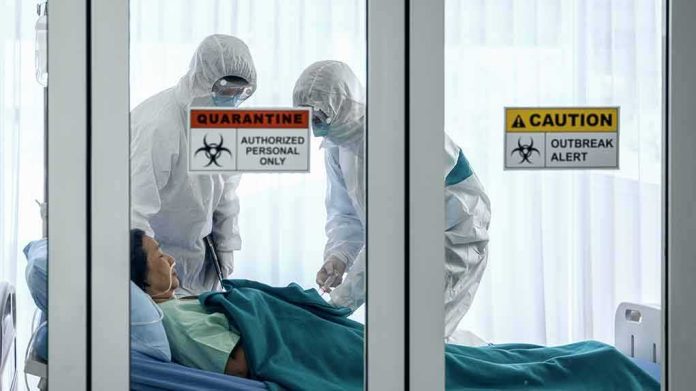
The decisive lesson of the 2026 Bundibugyo Ebola crisis is not a round-number milestone; it is that a fast-growing, multisite outbreak of a species with no licensed vaccine or therapeutic can outpace standard playbooks unless surveillance, clinical care, and cross-border coordination are built for the specific pathogen, not for “Ebola” in the abstract.
At a Glance
- A large, sustained Bundibugyo Ebola outbreak spread across eight provinces in the DRC with a crude case fatality near one in two.
- WHO assessed national risk as very high and declared a Public Health Emergency of International Concern early, citing sustained transmission and geographic expansion.
- Conventional countermeasures for Zaire Ebola do not transfer cleanly to Bundibugyo; there is no licensed vaccine or specific treatment.
- Cross-border transmission occurred, underscoring the need for regional preparedness and interoperable surveillance.
What the outbreak established: scale, spread, and risk
By 20 October 2026, WHO documented 9,704 confirmed Bundibugyo Ebola cases and 4,687 deaths in the Democratic Republic of the Congo (DRC), a crude case fatality ratio (CFR) of 48.3%—and transmission spanning 66 health zones across eight provinces. The arc of official reporting through the summer and early autumn—thousands of additional laboratory-confirmed cases added between late July and late October—captures both genuine spread and the reality of confirmation and reporting lag in complex settings. On epidemiologic grounds, WHO rated national risk “very high,” citing sustained transmission, expansion into new health zones, and potential for further national and regional spread. Those assessments were not rhetorical; they guided the mobilization of surveillance, labs, treatment centers, and field teams designed to find cases early and break chains of transmission.
The legal and operational frame for that mobilization came quickly. Following national declarations on 15 May, the WHO Director-General on 17 May determined that the event constituted a Public Health Emergency of International Concern under the International Health Regulations—an instrument used sparingly, and in this case justified by sustained transmission, strain- and geography-specific risks, and cross-border exposure.
Mechanism and species matter: why “Ebola tools” fell short
Ebola is a family of related viruses, and much of the public conversation still treats the post-2014 Zaire-specific vaccine and antibodies as a generic solution. They are not. The outbreak in 2026 was caused by the Bundibugyo species (BDBV). WHO and peer-reviewed reviews underscore a critical constraint: there is no licensed vaccine or specific therapeutic for Bundibugyo, meaning control depends primarily on non-pharmaceutical measures—early detection, isolation, infection prevention and control (IPC), and contact tracing—augmented by supportive clinical care. When those front-line controls are stressed by delayed detection, conflict, or resource gaps, observed case fatality rises and containment windows narrow. The high crude CFR reported in October reflects that reality—and the known bias that early in outbreaks the most severe cases are preferentially captured, inflating crude lethality metrics until surveillance matures.
Diagnostics shaped the first phase. Rapid tests and clinical familiarity built for Zaire Ebola can miss Bundibugyo; confirmation requires assays that target BDBV nucleic acids or antigens and laboratories trained to handle cross-species differential diagnosis. WHO’s early response checklists therefore emphasized laboratory confirmation capacity, specimen referral networks, and IPC assessments alongside rapid-response deployments and treatment-center readiness—because a misidentified species is functionally a missed case.
From hotspots to borders: why regional readiness was warranted
Ebola control lives and dies on the geography of human contact networks. In the 2026 crisis, transmission did not respect administrative lines. WHO documented cross-border spread into Uganda early in the event and later reported imported cases in Kenya and Nigeria—evidence that screening and response had to be shared problems, not local ones. Regional preparedness here is not a slogan; it entails interoperable alert definitions, compatible contact-tracing systems, prearranged sample-sharing and sequencing pipelines, and agreed protocols for safe transport and care at border points. The justification was empirical: multiple countries registered cases linked to the DRC outbreak, and the number of affected health zones kept rising through October.
The International Health Regulations framework situates this properly: a PHEIC does not flip a magic funding switch, but it does set expectations and coordination channels across ministries of health, border authorities, and international responders when the risk is transnational and growing.
What the crude CFR tells us—and what it does not
Readers trained by the West Africa epidemic often fixate on a single fatality percentage, but a mid-crisis crude CFR is a moving target. The 48.3% figure for 20 October is constructed as reported deaths over reported confirmed cases; it will shift with the denominator as confirmations grow, mild infections are captured, and outcomes for recent onsets mature. This is not pedantry. Historic analyses show crude CFRs tend to look worse when surveillance is late and care is delayed, and improve as isolation and clinical support stabilize earlier in illness. Gauging the true infection fatality would require final outcomes for a well-characterized cohort, including onset-to-care intervals and treatment access—data that are typically compiled for post-outbreak reviews rather than real-time dashboards.
Response architecture: what was mobilized and why
The control logic for Bundibugyo Ebola aligns with established filovirus doctrine but requires discipline in execution. WHO’s documented response lines were pragmatic: deploy rapid-response teams, surge field epidemiology capacity, strengthen event-based and facility-based surveillance, expand and validate laboratory testing for BDBV, assess and reinforce IPC in health facilities, stand up safe and adequately staffed treatment centers, and engage communities early and continuously. Each component maps to a link in the transmission chain. Surveillance finds cases before they seed more clusters; labs confirm species and direct biosafety; IPC protects health workers and prevents nosocomial amplification; treatment centers isolate and improve survival; community engagement makes burial practices, care-seeking, and contact tracing workable rather than performative.
The 2026 event also sharpened an old lesson: declarations and plans are necessary but not sufficient. Areas with weak laboratory reach or contested security space accumulate delays that cascade—late detection, late isolation, longer infectious periods in the community, and preventable deaths at home, all of which raise the observed CFR and widen the outbreak footprint. Those dynamics justified the “very high” national risk assessment even before any single threshold figure became a headline.
Ebola Cases Top 10,000 in Africa as Death Toll Nears 5,000, Mostly in DR Congo
⭕ Africa is facing a growing Ebola outbreak, with confirmed cases exceeding 10,000 in the Democratic Republic of the Congo (DRC), which has reported 4,887 deaths since the current outbreak began in…
— zoom africa News (@AfricaZoom57679) October 29, 2026
What to watch next: products, data, and capacity
Three fronts determine how well similar outbreaks are handled in the future. First, countermeasures: the absence of licensed Bundibugyo-specific tools is not a permanent fact of nature. Candidate vaccines and therapeutics need rigorous evaluation against the circulating strain, with transparent protocols and shared data on safety, immunogenicity, and efficacy; until then, systems must plan as though supportive care and IPC carry the load. Second, data quality: reconciling line lists, dates of onset and confirmation, and laboratory validation across sites improves decision speed and public credibility. Finally, capacity: cross-border readiness is built in the off-season—reference labs, specimen logistics, trained health workers, and community partnerships that can be activated without inventing them under duress. The 2026 Bundibugyo outbreak proved that when species, setting, and system readiness are misaligned, the virus sets the tempo. Align them, and Ebola—Bundibugyo included—can be contained.
Sources:
insiderpaper.com, who.int, afro.who.int