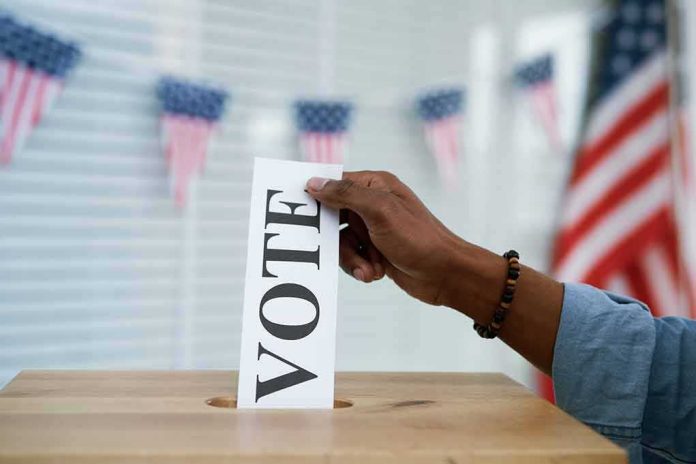
Ballots are designed to translate voter intent into counted choices; when two candidates share the same name in the same race, the system’s guardrails are stress-tested, and the line between protected ballot access and impermissible manipulation moves from theory to practice.
At a Glance
- Alaska election officials investigated whether a same-name U.S. Senate candidacy was a good-faith run or a tactic to mislead voters, but a court restored the candidate to the ballot on legal-authority grounds.
- The ballot did carry two strikingly similar names, yet it also included distinguishing labels—party registration and “incumbent”—that cut against a presumption of confusion.
- No decisive evidence has surfaced that voters actually miscast ballots due to name confusion, nor that the second candidate coordinated with outside actors.
- The episode fits a long, recurring pattern: same-name gambits are not new, and outcomes turn on proof, not suspicion.
What Alaska’s “Two Dan Sullivans” Case Really Shows
The Alaska dispute is not a parlor oddity; it is a live case study in the competing imperatives of election law. On one side is the broad right of a qualified citizen to appear on the ballot under his lawful name. On the other is the state’s duty to prevent practices that exploit a rival’s identity and thereby degrade voter choice. In 2026, Alaska’s Division of Elections opened a formal inquiry into the candidacy of Daniel J. Sullivan Jr. after complaints from Republican organizations. The agency concluded, in a written determination, that the run appeared aimed at confusing or misleading voters rather than a bona fide campaign. A Superior Court judge vacated the exclusion, holding that Alaska law contained no “good-faith candidacy” requirement that could justify keeping him off the ballot; appellate review later left the candidate in the race on those grounds.
The legal posture matters. The court did not resolve motive; it resolved authority. An elections office cannot conjure a gatekeeping test that statutes and regulations do not supply. That principle—which protects voters as much as candidates—explains why even suspicious fact patterns still frequently result in ballot access. It also frames what evidence is missing: neither the administrative record nor the subsequent reporting put forward direct proof of coordination with political opponents or a measurable tranche of voters who mistakenly selected “the wrong Sullivan”.
Ballot Mechanics: Where Confusion Can Start—and How Design Can Dampen It
Same-name risk becomes concrete at the moment a voter scans a ballot. Alaska’s sample and public ballot materials listed the incumbent as “Sullivan, Dan S.” with “Registered Republican” and “Incumbent,” and listed the challenger as “Daniel J. Sullivan Jr.” without a party label on the general ballot. Those choices cut both ways. The surname “Sullivan” dominates the eye and can anchor quick, heuristic choices; the given-name initial “S.” and “J.” demand attention voters may not always give. Yet the presence of party registration and an incumbent tag also creates a purposeful visual and informational separation. Human-factors research often shows that labels adjacent to the candidate name—party, office, and incumbency—are high-salience cues, particularly for habitual voters. Alaska’s design, in short, created a plausible path to accurate selection while preserving the same-name reality that sparked the complaints.
Ranked-choice voting, used in Alaska’s general elections, adds complexity but does not solve name confusion. RCV can mitigate vote-splitting among ideologically similar candidates, yet it only helps if a confused voter also ranks the intended candidate somewhere below the mistaken first choice; if the voter ranks the “wrong” Sullivan and then exits the ballot without additional rankings, the error persists. That is why, when fraud or manipulation is alleged, investigators look beyond design and ask the core factual questions: was there a genuine campaign, who funded it, what communications occurred, and can any measurable share of votes be traced to confusion rather than persuasion or protest?
What the Record Establishes—and What It Doesn’t
Three elements of the Alaska record are clear. First, the state undertook a formal inquiry prompted by partisan complaints and asked the candidate to answer sworn questions about his political history and campaign activity. Second, the Division issued a determination asserting intent to mislead. Third, the courts rejected the agency’s legal theory, restoring the candidate because Alaska’s law did not authorize a “good-faith” filter for ballot access. Those are durable, documentary facts.
Other points remain unproven. The allegation that the candidacy was coordinated with Democratic actors lacks the evidentiary backbone—communications, payments, directives—that distinguishes rumor from record. The claim that voter confusion actually altered the outcome similarly lacks affidavits, cast-vote studies, or precinct-level anomalies tied to name confusion rather than ordinary variation. The state’s own ballot labels, meanwhile, serve as countervailing evidence that Alaska attempted to mitigate confusion even if some voters remained uncertain.
How We Got Here: A Long History of Same-Name Gambits
American elections have seen this movie before. The tactic—call it identity shadowing—recurs because it rides on human pattern recognition. Voters skim, especially down-ballot; a familiar surname can capture a hurried mark. Historically, most systems default to permissiveness: if the name is lawful and the basic qualifications are met, ballot access follows. The law tends to punish what is provable—forgery, false filings, illicit payments—not the mere presence of a confusingly similar name. That’s why past controversies, from the second JFKs to the multiple Bob Fergusons, often ended with all names staying put while prosecutors, when they acted, targeted the paper trail rather than the moniker.
That architecture reflects a constitutional instinct: the state is a poor arbiter of candidate “sincerity,” and eligibility tests must be written, not improvised. Courts will prune egregious deception when statutes allow it; they will not manufacture new hurdles because a filing irritates a party committee. Alaska’s case lands squarely in that tradition.
Where Legitimate Disagreement Lives
Disagreement here is not about the court’s authority ruling; that was straightforward statutory interpretation. The live questions are empirical: did any material number of voters mistake one Sullivan for the other, and, if so, would different ballot labels or voter education have prevented it? Reasonable people divide on both, often along priors about voter attentiveness and party cues. Advocates of stricter rules urge enhanced disambiguation—middle initials, hometowns, occupational descriptors, or, in federal races, allowing “Senator” as a ballot label for incumbents. Skeptics counter that every added label risks editorializing and that party and incumbency already give voters what they need.
Evidence, not instinct, should settle it. Post-election surveys linked to anonymized cast-vote records (where lawful), controlled experiments with alternate ballot designs, and audits of campaign activity can all move the debate from conjecture to measurement. Until then, broad claims about “stolen” intent are rhetoric, not record.
I watched the Justice Department press conference out of Anchorage on TV this afternoon. U.S. Attorney Michael J. Heyman, the top federal prosecutor in Alaska, stood with Matthew Schlegel, who heads the FBI office in Anchorage, and confirmed there is both a civil and a criminal… pic.twitter.com/nGNiJnhOZg
— sandym (@Sandy1Texas) October 30, 2026
Practical Reforms That Respect Rights and Reduce Risk
There is a middle path that does not require new gatekeeping tests. States can adopt neutral disambiguators—standardized use of middle initials, consistent party labels, incumbency markers defined in rule, and, where statutes permit, hometown or year-of-birth fields—applied uniformly whenever surnames collide. Election offices can prewire voter education: publish side-by-side sample ballots online, mail targeted “how to read your ballot” inserts when same-name collisions occur, and advise voters on how ranked-choice preferences protect their first-choice intent if they rank beyond one line. Campaign-finance transparency, timely vendor reporting, and verification of candidate contact information further deter covert recruitment schemes without screening lawful names off the ballot.
The Stakes: Voter Confidence Is Built on Design, Evidence, and Restraint
The integrity question is not whether two names can appear; it is whether voters can reliably express whom they mean. Alaska’s episode underscores three lessons. First, write authority before you wield it—eligibility rules must live in statutes and regulations, not in ad hoc standards. Second, design against foreseeable error; ballots that anticipate human behavior reduce controversy. Third, prove, don’t presume; if confusion or coordination is alleged, demand evidence that would persuade a neutral court. That is the only way to protect both the franchise and the freedom to run—twin commitments that make the same-name puzzle hard, and worth solving without panic.
Sources:
youtube.com, elections.alaska.gov, factcheck.org, public.courts.alaska.gov, alaskasnewssource.com, alaskapublic.org