Drug dependency doesn’t just destroy a body—it can be weaponized to steal a life.
Story Snapshot
- Everett, Massachusetts trafficker Trevor Jones received a 15-year federal sentence after pleading guilty to four counts of sex trafficking by force, fraud, or coercion.
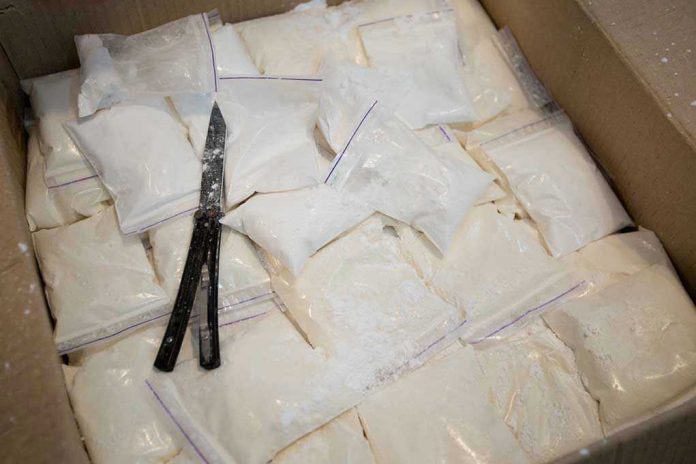
- Prosecutors said he targeted women struggling with substance use disorder and tightened control by providing heroin, fentanyl, and cocaine, then withholding drugs to force compliance.
- Authorities described a pattern of violence, threats, and economic coercion that turned addiction into a leash.
- The court ordered $639,500 in restitution, signaling a focus on victim compensation alongside punishment.
How a Drug Supply Becomes a Set of Handcuffs
Trevor Jones, 47, operated in the Boston-area orbit where opioid addiction and exploitation often collide. Federal authorities said his scheme ran for years, targeting women already battling substance use disorder and making their next dose conditional on obedience. That tactic matters because it turns withdrawal—panic, pain, sickness—into an enforcement tool. When drugs become currency, the trafficker becomes banker, jailer, and “provider” all at once.
Jones’s federal case culminated in a 15-year prison sentence followed by supervised release, plus a restitution order aimed at repairing some of the financial wreckage left behind. The timeline described by prosecutors shows a familiar criminal arc: a prior prostitution-related conviction, release, then rapid re-entry into exploitation. Recidivism like this undercuts the comforting myth that these operations look like movie villains with neon signs. They often look like repeat offenders who learned exactly what works.
The Mechanics of Coercion: Fraud, Force, and the Withdrawal Clock
Prosecutors said Jones used a mix of force, fraud, and coercion—language that sounds legalistic until you picture what it means in a daily routine. Supply the drugs, deepen dependence, then ration them. Add threats and physical violence to remove doubt. The alleged use of weapons and beatings, described in public statements, signals something crucial: this wasn’t “sex work gone bad.” This was control by fear, reinforced by chemistry.
Trafficking cases tied to addiction expose a brutal practicality. A victim doesn’t have to be physically chained if her body already is. Withdrawal creates urgency that crowds out long-term planning: keeping a job, calling family, reaching a shelter, cooperating with police. Traffickers exploit that tunnel vision. From a common-sense perspective, the moral responsibility sits squarely on the predator, but the policy lesson lands on everyone else: letting addiction fester creates a hunting ground.
What a 15-Year Federal Sentence Signals—and What It Doesn’t
Fifteen years sounds substantial, and for many families it is. Still, sentencing in trafficking varies widely because facts vary: number of victims, ages, violence, and additional charges. Comparative cases show extreme outcomes—hundreds of years in prison in one jurisdiction, decades in another—depending on counts and enhancements. The takeaway isn’t that one judge is “soft” or “hard.” The takeaway is that trafficking is prosecuted as a stack of specific crimes, not a single moral verdict.
The restitution figure—$639,500—deserves attention because it treats harm as more than emotional damage. Restitution acknowledges medical bills, lost income, relocation, and therapy costs that pile up when a trafficker runs a person’s life like a business. Conservatives should appreciate the principle: the offender pays, not the taxpayer. The hard part comes later—collecting money from someone going to prison rarely restores a victim’s stability quickly. Restitution is justice on paper; recovery needs institutions that work in real life.
Where Enforcement Meets Prevention: The Uncomfortable Middle
Federal prosecutors framed this case as part of the “intersection” between drug trafficking and human trafficking, and that framing is accurate. The same networks that move narcotics can move people, and the same customers can bankroll both markets. When law enforcement targets the overlap, it can dismantle multiple streams of criminal profit at once. That approach aligns with conservative priorities: public safety, deterrence, and consequences that reach beyond a single arrest to the wider operation.
Prevention, however, forces an uncomfortable admission. Many victims sit in plain sight—in ERs, in encampments, in low-level arrests—and systems often treat them as disposable. The most practical anti-trafficking move isn’t always a poster campaign; it’s tightening the seams where predators recruit. That means faster access to treatment, tighter supervision of repeat offenders, and community pressure that refuses to normalize street-level exploitation as “just how it is.” Predators thrive on resignation.
The Part That Doesn’t Fit in a Courtroom: Why “Brave Women Came Forward” Matters
Investigators publicly credited the women who came forward, and that phrasing carries weight. Victims with addiction histories often expect to be doubted, shamed, or treated as unreliable. Traffickers count on that stigma as a shield. When victims testify anyway, they puncture a key defense strategy: turning the jury’s attention from coercion to personal choices. A serious society can hold two ideas at once—addiction impairs choices, and predators exploit that impairment deliberately.
The broader lesson is grim but clarifying. Drug-facilitated trafficking works because it exploits both human weakness and institutional fatigue. Jones’s sentence removes one trafficker from the street, and it should. The next step is refusing to leave the same vulnerabilities wide open: repeat offenders who cycle through the system, neighborhoods flooded with fentanyl, and victims who can’t access treatment without jumping through hoops. Trafficking doesn’t start with a kidnapping van. It often starts with a dose.