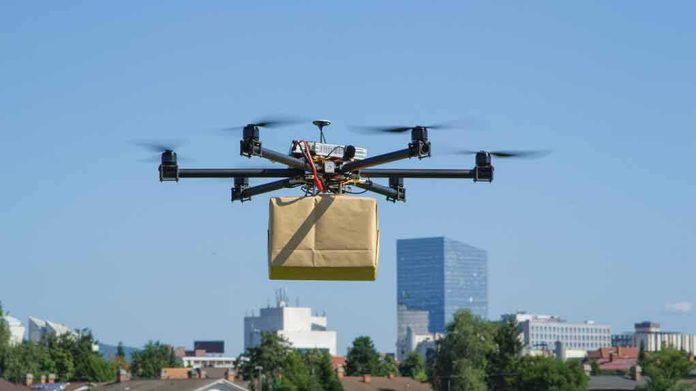
Amazon’s Ring isn’t just adding another camera; it is attempting to make security mobile by default—one flying, one rolling—using onboard AI to decide where to go and what to inspect.
At a Glance
- Ring has launched a dedicated robotics division with two devices: an indoor Ring Drone Cam for homes and a Ring Rover Cam for businesses.
- Both products navigate autonomously with Ring’s AI Pilot system to map spaces, plan patrols, and avoid obstacles.
- Concrete launch details: Rover Cam priced at $999.99 with U.S. shipping beginning December 16, 2026; Drone Cam listed at $249.99 with availability reported for January 27, 2027.
- The move shifts Ring from fixed endpoints to mobile agents, with implications for reliability, privacy, and ongoing service models.
What Ring actually launched: robots that move, not just cameras that watch
Ring formally introduced Ring Robotics with two products anchored in autonomy rather than teleoperation. The Ring Drone Cam is an indoor, quadcopter-style camera designed to lift from a dock, fly room to room along user-defined patrol routes, and return to its base where it is physically privacy-protected when docked. The Ring Rover Cam is a ground-based security robot positioned for businesses—retail, offices, warehouses—capable of autonomous patrols, disturbance investigation, and live video streaming up to 4K. This is not a feature bump for doorbells; it is a deliberate expansion of the security perimeter from static mounts to mobile patrol units, with navigation, scene selection, and route planning handled by an onboard AI stack.
Ring and multiple independent outlets describe a common technical core: AI Pilot. It maps spaces, suggests inspection points, and navigates around furniture and shelving, with autonomy emphasized as the daily default rather than a novelty mode. That framing matters. Consumers know what a stationary camera is good at; the product bet here is that moving to the event—down a hallway, behind a racked pallet, into a dark storeroom—is worth the added complexity.
How the systems are positioned and priced
Ring’s announcement includes the kind of specifics that separate concept videos from shipping products. The Rover Cam is slated to begin U.S. deliveries on December 16, 2026, at $999.99, with the Drone Cam listed at $249.99 and independent coverage citing a January 27, 2027, availability date. The product pages describe the Drone’s patrol routes and “custom viewpoints,” as well as a docked state that disables its sensors; the Rover’s specs emphasize business use, 4K video, and autonomous investigation of alerts. Those details—dates, prices, use cases—were corroborated across mainstream coverage the day of launch, including Reuters, CNBC, WIRED, and GeekWire.
Crucially, Ring is not presenting the two robots as interchangeable. The Drone Cam is for the home—short flights, fast response, room-to-room coverage—while the Rover Cam is purpose-built for commercial patrol with a different duty cycle and environment. Treating them as a single “home upgrade” would miss the market segmentation Ring has chosen to emphasize.
What “AI Pilot” means in practice
Autonomy in indoor environments is a specific technical problem: GPS is unreliable or unavailable, lighting varies, furniture shifts, and the robot must negotiate tight spaces without human intervention. According to GeekWire’s reporting, AI Pilot handles mapping and obstacle avoidance while recommending inspection points—functions typical of simultaneous localization and mapping (SLAM) systems coupled with object avoidance and route planning. The company’s language suggests a closed-loop between the robot’s perception stack and the patrol logic: detect, plan, traverse, verify on camera, and return-to-base. For a drone, that also implies flight-envelope constraints—battery, thrust-to-weight, and propeller downwash around household objects—managed by onboard controls and a conservative flight profile.
On the ground, the Rover’s autonomy must absorb different constraints: thresholds, floor changes, aisle widths, and variable clutter. The promise is the same—arrival at the point of interest without babysitting—but the sensors, control loops, and failure modes diverge. The commonality is a user experience centered on scheduled or triggered patrols that do not require a joystick.
History matters: why this launch is framed the way it is
Ring’s positioning lands inside a well-worn pattern in consumer and small-business robotics: compelling demos arrive before there is proof of durable adoption. Amazon has lived this arc. CNBC and others tied the Rover lineage back to Amazon’s Astro, introduced for the home in 2021 and later adapted for business use—a path that saw the business variant discontinued within months in 2024 across multiple reports. That historical context explains two choices Ring made here: a clearer separation of home versus business targets, and a stronger emphasis on named autonomy features rather than “remote camera on wheels.” It is a bid to present these devices as fit-for-purpose patrol agents instead of curios that need constant human steering.
The broader literature on human–security-robot interaction also predicts where scrutiny will fall: autonomy changes not just reliability expectations but ethical boundaries. Researchers find that while autonomy doesn’t automatically erode trust, it raises distinct safety and governance concerns—hacking risk, operating near people, and policy gaps in data handling. Those are not theoretical footnotes in this category; they are practical adoption gates that vendors must address in product behavior and long-term support.
Privacy, safety, and the service layer
Ring’s Drone Cam includes an explicit privacy state while docked, a design that aligns with a clear, observable “on/off” posture for microphones and cameras. That matters in a household, where consent cues need to be unambiguous. In businesses, the considerations are different—employee notice, retention rules, and access control across shifts and contractors. Ring’s announcement focuses on product capability and availability; it does not, in this tranche of materials, enumerate data-retention timelines or access governance in depth. Given Ring’s broader ecosystem—cloud video history, app-based monitoring, and integrations—buyers should expect that storage, review permissions, and event labeling live in the service layer, where policy meets software. The academic base rates suggest getting these mechanics right is as important to adoption as navigation prowess.
Safety is twofold: physical and cybersecurity. For the Drone, physical safety implies conservative flight times, obstacle margins, and a dock that acts as both charger and containment. For the Rover, it means predictable behavior around people and inventory. In both cases, autonomy should degrade gracefully—pausing, returning to base, or handing off to a human—when certainty drops. While the launch materials highlight AI Pilot’s capabilities, independent testing after units ship will ultimately quantify collision avoidance reliability and false-alert rates; that is routine in this category and does not undercut the validity of the launch itself.
What to watch as units reach users
Four dynamics will reveal whether mobile security becomes standard rather than novelty. First, integration fidelity: do the robots consistently respond to doorbell rings, sensor trips, and alarm states with correct routing and useful video? Second, autonomy under entropy: homes and shops change constantly—rearranged furniture, seasonal racking; how quickly does the map adapt, and how often does the system ask for help? Third, service economics: pricing of storage, monitoring add-ons, and fleet management will determine total cost of ownership, especially for multi-site businesses. Fourth, policy clarity: plainly documented retention, access, and audit trails—and how well the hardware’s privacy cues match software controls—will either lower or raise the barrier to deployment in shared spaces.
The move to mobile is strategically coherent. Fixed cameras are excellent sentries; mobile agents promise to be responsive investigators. With Ring Robotics, Amazon is betting that autonomy and route planning—bundled into the familiar Ring app and cloud—can make that promise reliable and routine. The market will test the claim shortly: the Rover Cam’s December rollout and the Drone Cam’s January window give this transition a near-term proving ground, backed by concrete pricing and a clear split between home and business scenarios.
Amazon's Ring just launched Ring Robotics: a $250 flying security camera for homes and a $1,000 patrol robot for businesses. Both navigate on their own with AI Pilot. Drone ships Jan 27, Rover Dec 16. Source in reply. pic.twitter.com/VkrWIyobTb
— Waris Hym (@WarisHymii) November 10, 2026
Bottom line
Ring has put meaningful stakes in the ground: a named robotics division, two differentiated mobile security devices, an autonomy system designed for indoor patrols, and firm pricing and ship dates corroborated across major outlets. This is a pivot from “more cameras” to “cameras that move with intent.” If AI Pilot delivers dependable navigation and the service layer earns trust on privacy and governance, mobile security will stop looking like a demo and start looking like the default.
Sources:
washingtontimes.com, ring.com, aboutamazon.com, androidauthority.com, rmb.reuters.com, wired.com, geekwire.com, technobezz.com, heise.de, theverge.com, techcrunch.com