
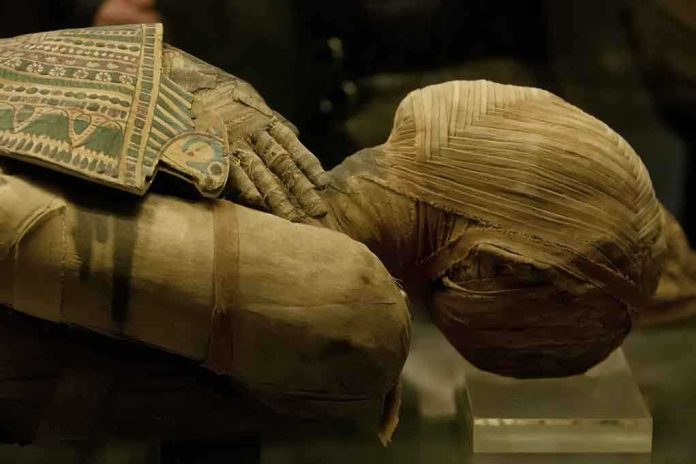
The musty scent of an Egyptian mummy turns out to be less about death and more about a 2,000-year-old recipe book written in the air.
Story Snapshot
- Scientists can now “read” the smells of mummies to track how embalming evolved over two millennia.
- That familiar museum mustiness hides expensive imported resins, sacred oils, and even ancient trade routes.
- New non-destructive techniques let researchers sample mummy odors without sacrificing a single bandage fiber.
- Conservators can use rancid and chemical notes as early warning signals for mold, decay, and past pesticides.
How scientists learned to bottle a mummy’s aura
Visitors stand in front of a sarcophagus and smell “old museum.” Chemists now say they are breathing a detailed historical record. A Bristol-led team sampled the air around peppercorn-sized fragments of mummy balms and bandages, then ran that captured vapor through gas chromatography and mass spectrometry. Instead of scraping away irreplaceable resin, they lifted volatile organic compounds from the air, like catching whispers. Those 81 compounds became a time capsule spanning 3200 BC to late Roman Egypt.
Each compound carried a clue. Early mummies leaned heavily on simple animal fats and plant oils, giving off fatty, waxy notes. Later burials added complex imported resins from conifer trees, desert shrubs, and incense plants. Pine-like and cedar-like aromas signaled timber-rich northern forests; incense notes pointed south and east toward Arabia and beyond. The more powerful the family, the richer and more layered the smell. Wealth, faith, and long-distance commerce all left their fingerprints in the air.
The musty stereotype that got overturned
Popular culture long treated mummy odor as shorthand for rot and mildew. Recent work in Cairo’s Egyptian Museum demolished that caricature. Researchers there recruited highly trained “supersniffers,” paired them with an electronic nose, and walked both past nine carefully selected mummies. Instead of one generic stench, each body emerged with a distinct profile: woody, spicy, sweet, herbal, or rancid, and often a surprising mix of all five. One mummy’s head could smell different from its torso.
Those differences matter. Woody and spicy signatures tie strongly to resins and incense that priests used to consecrate and protect the body. Sweet notes can arise from slow plant decay in the balms and linen. Rancid tones hint at aging fats or active microbial breakdown. A few sharp or chemical notes betray later museum-era treatments: old pesticides, fumigants, or consolidants brushed on in the nineteenth and twentieth centuries. Smell stops being a joke and becomes a forensic report spanning centuries.
From sacred chemistry to practical diagnostics
Egyptian embalmers did not think in modern chemical names, but they understood performance. Resin mixes had to seal out moisture, fight insects, and carry religious symbolism. Coniferous resins added antimicrobial punch and a “evergreen” association with renewal. Myrrh and frankincense spoke the language of temples and kingship. Over time, embalmers experimented, refined, and localized their recipes. The Bristol data show simple early formulas giving way to increasingly elaborate blends, much like a family moving from basic soap to designer cologne.
Museums now reap a downstream benefit that would appeal to any hardheaded taxpayer. Traditional residue analysis often needed dissolving or scraping material from artifacts, effectively spending the object to buy the data. Air-sampling VOC methods flip that equation. Curators can screen dozens of mummies quickly with minimal disturbance, flagging which pieces need urgent conservation. A sudden spike in rancid or mold-associated odors can trigger targeted climate control instead of expensive, broad-brush interventions that may not be necessary.
Why conservative common sense favors odor over guesswork
Public collections exist to preserve the past, not consume it in the lab. Non-destructive odor analysis respects that mandate. It wastes less material, costs less in the long run, and delivers more actionable information per sample. That approach aligns squarely with common-sense stewardship: protect what you have, test carefully, and avoid irreversible decisions based on hunches or fashion. Smell-guided diagnostics help museums prioritize limited budgets toward pieces that genuinely need help.
The work also undercuts lazy narratives that portray ancient people as crude or superstitious. Layered resin recipes, tailored to specific body regions and eras, reveal technical skill, trade knowledge, and religious intention. A society willing to import conifer resin across deserts for its funerary rites was not stumbling in the dark. It was investing capital and craft into a coherent worldview about the afterlife, one that valued order, cleanliness, and continuity over chaos. The fragrance was theology poured onto skin.
The coming age of “olfactory heritage”
Heritage science now treats smell as seriously as color and form. Odor profiles help distinguish original embalming from later repairs, tourist-era handling, or chemical over-treatment. Compounds linked reliably to linen or wooden coffins map how burial assemblages aged together. Sensory descriptions from human sniffers, cross-checked against instrument readings, make these invisible changes legible not just to scientists, but to the public. Exhibitions can, in principle, reconstruct safe, cleaned-up versions of ancient scents for visitors.
That possibility raises a question that matters for anyone who cares about cultural continuity: what parts of the past deserve to be preserved beyond the visual? Smell shapes memory more powerfully than most museum labels ever will. Allowing future generations to encounter a controlled echo of an Egyptian embalming hall respects the original makers more than reducing their work to silent glass cases. When handled responsibly, olfactory heritage broadens access without dumbing anything down.
Sources:
Discover the Aromas of Ancient Egyptian Mummies, From Orange Peels to Pine to Incense
Egyptian mummies smell woody, spicy, and sweet, chemists report
Woody, spicy, sweet: researchers reveal the smells of ancient Egyptian mummies
You can now smell what ancient Egyptian mummies smelled like