A Colorado funeral home owner will spend up to 70 years behind bars for one of the most disturbing betrayals of trust in American history—handing grieving families concrete mix while nearly 200 bodies rotted in secret.
Story Snapshot
- Jon Hallford sentenced to 30-50 years for corpse abuse, plus 20 years federal for fraud—a combined potential sentence of 70 years
- 189 decomposing bodies discovered stacked in a 2,500-square-foot building after four years of accumulation
- Families unknowingly received fake ashes made from Quikrete while the Hallfords spent nearly $900,000 in pandemic relief funds on luxury items
- Case prompted complete overhaul of Colorado’s lax funeral home regulations
The Horror Behind the Odor
Investigators who responded to reports of a foul smell in October 2023 encountered a scene that defied comprehension. Inside a modest office building in Penrose, Colorado, human bodies lay stacked in rooms, sometimes blocking doorways entirely. Decomposition fluid pooled on floors. Some remains had decayed for years, others for months. The final count reached 189 bodies—families from across multiple states, including Hawaii, all betrayed by the same couple who promised dignified cremation services.
Concrete Instead of Cremains
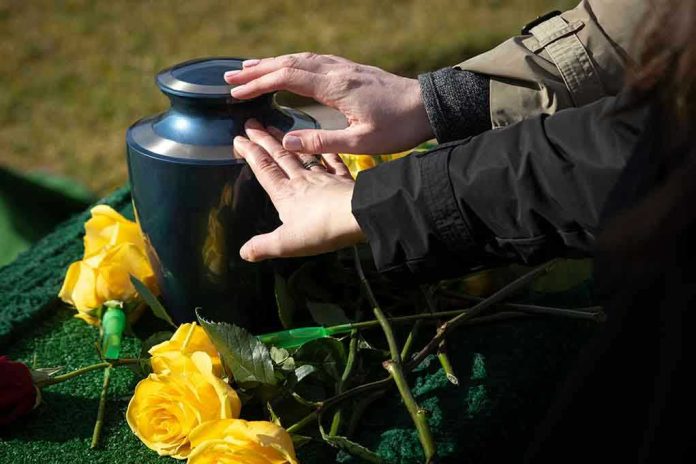
The cruelty extended beyond negligence into calculated deception. While Jon and Carie Hallford allowed bodies to decompose in their unlicensed storage facility, they provided families with urns containing fake ashes. The FBI later determined these “cremains” were actually Quikrete, the concrete mix available at any hardware store. Families held memorial services, scattered ashes, and grieved—all while clutching bags of construction material. Derrick Johnson, whose mother Ellen Marie Shriver-Lopes was among the victims, buried what he believed were his mother’s ashes before the FBI shattered that illusion.
Living Large on Death and Deception
The Hallfords didn’t just neglect their duties—they profited handsomely from their fraud. Court documents revealed the couple defrauded the federal government of nearly $900,000 in Paycheck Protection Program funds meant to help small businesses survive the pandemic. Despite mounting unpaid bills to actual cremation facilities, they channeled money toward first-class flights, spa days, and luxury purchases. Johnson’s courtroom statement captured the grotesque contrast: “While the bodies rotted in secret, they lived, they laughed and they dined. My mom’s cremation money likely helped pay for a cocktail, a day at the spa, a first-class flight.”
When Regulations Fail the Vulnerable
This catastrophe exposed a regulatory void that should alarm every American who values accountability in essential services. Colorado’s funeral home oversight framework was so inadequate that the Hallfords operated for four years without detection. The scale of abuse—189 bodies accumulating over multiple years—represents a systemic failure, not merely criminal opportunism. State lawmakers responded by overhauling regulations, but the question lingers: how many other states maintain similarly toothless oversight of an industry that serves families at their most vulnerable moments?
Justice Through Compounding Sentences
Jon Hallford faced separate criminal proceedings for his dual schemes. Federal courts sentenced him to 20 years for defrauding the government’s pandemic relief programs. State courts added 30-50 years for corpse abuse charges, creating a combined sentence of 50-70 years. His wife Carie Hallford accepted a plea deal in December 2025, with her sentencing scheduled for April 2026. The stiff sentences reflect both the scale of the crimes and the profound violation of trust. Hundreds of families across multiple states received notification from the FBI that their loved ones’ remains were among those recovered, requiring forensic identification through fingerprints, hospital bracelets, and medical implants.
The Psychological Wreckage
Johnson’s experience illustrates trauma that extends far beyond financial loss. He developed post-traumatic stress disorder after learning the ashes he had buried were fake. The violation cuts deeper than theft—it corrupts sacred rituals, invalidates grief processes, and forces families to confront the reality that their loved ones decomposed anonymously while they mourned over concrete mix. Johnson now participates in therapy and victim support groups, seeking healing that legal proceedings alone cannot provide. The sentences may deliver accountability, but they cannot restore what the Hallfords destroyed: the fundamental expectation that our dead will be treated with basic human dignity.