
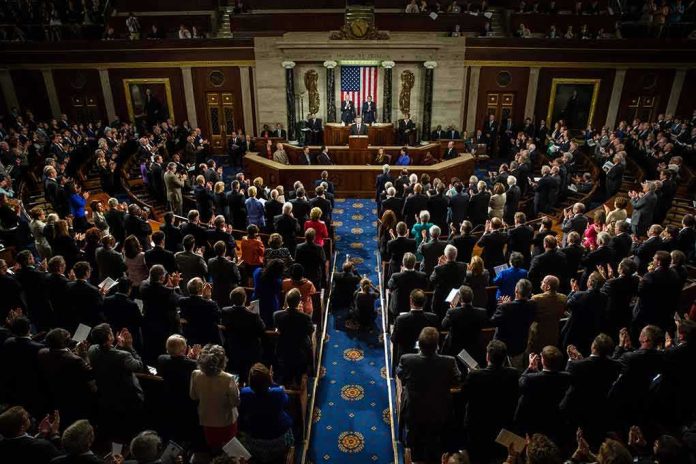
The enduring temptation in Washington is to confuse performance with governance; when spectacle becomes the operating system, messaging bills, choreographed outrage, and private bargaining displace the slow, disciplined work of writing law and stewarding public money.
At a Glance
- George Santos’s broadside against Congress taps a familiar vein: insiders denounce “Kabuki theater” and backroom dealing to claim the system is staged.
- Bill Maher’s rebuttal reframes the episode as voter psychology and media silos rewarding surface over substance, not proof that governance itself is fake.
- The House Ethics Committee’s report on Santos’s own conduct is specific and damning; it weakens him as a diagnostician even as it illuminates the incentive structure he describes.
- Campaign finance law, ethics enforcement, and scandal-cycle research explain why performance thrives — and also where hard constraints on misconduct still bite.
What the “theater” critique gets right — and what it conflates
Calling Congress performative isn’t new, and it is not baseless. Parties do introduce “messaging bills” they know will die, to galvanize donors and signal priorities. Camera-facing hearings reward sound bites, not markups. Private negotiation is indispensable in any legislature, yet secrecy can shade into dealmaking that looks self-protective. Santos’s phrasing — cigars, scotch, and pizza while the public is played — is crude but captures a real frustration with a politics that often narrates rather than governs. Where the critique overreaches is in converting a diagnosis of incentives into a claim that governance is illusory. Budgets, authorizations, and oversight actions that move money, standards, and lives are not theater; they are outcomes that bind agencies and markets.
That distinction matters because rules and institutions, however imperfect, still channel behavior. Federal ethics codes prohibit converting campaign funds to personal use, and criminal law requires quid pro quo proof for bribery — both guardrails that shape how influence gets exercised. Treating the system as pure show obscures the leverage points where reform can tighten consequences and improve performance.
The credibility problem: when the messenger is a case study
The House Committee on Ethics did not produce a vibe check; it produced a report describing how Santos “sought to fraudulently exploit every aspect of his House candidacy for his own personal financial profit,” including stealing from his campaign and deceiving donors. That is unusually specific language for a bipartisan panel, and it undercuts Santos as a reliable narrator. It also, paradoxically, validates a core structural point: incentives around attention, identity, and fundraising can reward performance divorced from substance and even from honesty. As Maher argued in explaining Santos’s win, a candidate can “pretend to be everything to voters of both parties” in a polarized media environment that flattens scrutiny and prizes confirmation.
So we are left with a tension familiar in ethics disputes: a flawed messenger is not sufficient to dismiss the message, but his conduct is highly probative on how performance can be monetized. The serious work is to separate the generalizable mechanism from the biographical spectacle.
Mechanism: how spectacle crowds out governance
Three forces interact to make theater a rational strategy. First, money: after Citizens United, independent expenditures surged, and while contribution limits and bribery law remain, much lawful influence now operates via signaling to outside spenders rather than transactional quid pro quos. Messaging bills and cable-ready hearings serve that signaling function at scale. Second, media economics: attention markets reward outrage, novelty, and identity affirmation. Candidates and members learn quickly that viral moments move small-dollar fundraising and book future airtime. Third, institutional design: fragmented committees, party polarization, and tight floor control mean many members have little direct impact on final legislative text; performance becomes the visible currency of relevance.
Ethics rules and enforcement constrain the most egregious abuses, but they do not neutralize these incentives. The Ethics Committee regularly processes conduct cases, and referrals from the Office of Congressional Ethics show that misuse of campaign funds and undisclosed benefits remain recurring problems. Yet most performative politics is legal — and effective — precisely because it rides just inside those lines.
The rebuttal: performance is a symptom, not dispositive proof of fake governance
Maher’s counter-position deserves weight because it locates the distortion primarily in audience demand and information silos rather than in a void of real lawmaking. In his account, voters primed by partisan media reward image and surface, so candidates like Santos can thrive without an issues core; that does not imply Congress fails to govern, only that electoral markets undersupply policy substance. Political science on scandal coverage is directionally consistent: as elections near, scandal attention increases by measurable margins, amplifying personality narratives and drowning out procedural detail; the supply of spectacle is endogenous to competition and media incentives, not necessarily to a collapse of institutional capacity.
Viewed this way, “theater” is a byproduct of demand curves. The institution still passes appropriations, reauthorizes programs, and conducts oversight with real-world consequences; the problem is that the public-facing layer is dominated by content engineered for emotional resonance, not comprehension or accountability.
History and consequence: why this keeps recurring
American politics has cycled through eras of reform and relapse. Post-Watergate ethics regimes raised disclosure and conflict standards; later jurisprudence narrowed what counts as “official acts” and raised the evidentiary bar for corruption prosecutions, channeling influence into compliant but opaque forms. Digital media then rewired distribution: members can now reach donors and activists directly, making performative differentiation more valuable than cross-aisle legislating whose compromises anger primaries. Scandal salience intensifies with proximity to elections, further skewing incentives toward attention tactics over policy craft.
The consequence is not nihilism — law still moves — but a chronic misalignment: what grows a member’s brand is often orthogonal to the task of governing. That misalignment is the real “uniparty” charge worth considering: not that parties collude to dupe the public, but that both are trapped in the same attention marketplace and respond with similar theatrical habits.
What to watch that actually changes outcomes
Three levers are where rhetoric gives way to mechanism. First, budget process reform: restoring predictable appropriations calendars and curbing omnibus brinkmanship reduces the payoff to last-minute theatrics and raises the payoff to committee diligence. Second, finance and ethics tightening that targets gray-zone behaviors — personal-benefit conversions of campaign funds, the timing and transparency of outside spending — constrains the business model of performance-for-profit; ongoing ethics statements underscore where those lines already exist and where enforcement bandwidth matters. Third, audience-side corrections: empirical reporting, civic intermediaries, and platform choices that throttle virality over veracity are slow, cultural work, but they alter the demand curve that currently rewards surface over substance. None of this eliminates showmanship; it rebalances its marginal utility relative to governing work.
Bottom line
Santos’s jeremiad lands because the incentives he exploited are real; it fails as a totalizing theory because rules, committees, and statutes continue to produce binding outcomes that shape lives and markets. The path forward is not to sneer at “Kabuki” or to romanticize a past that never existed; it is to tighten the channels where money and media translate performance into advantage, and to reward the unglamorous craft — line edits, quiet bargains, oversight letters that fix a procurement error — that is the antidote to spectacle. Theater will always be with us. Whether it is the show or merely the trailer is still up to the system — and to its audience.
Sources:
mediaite.com, cnn.com, x.com, factcheck.org, thedailybeast.com