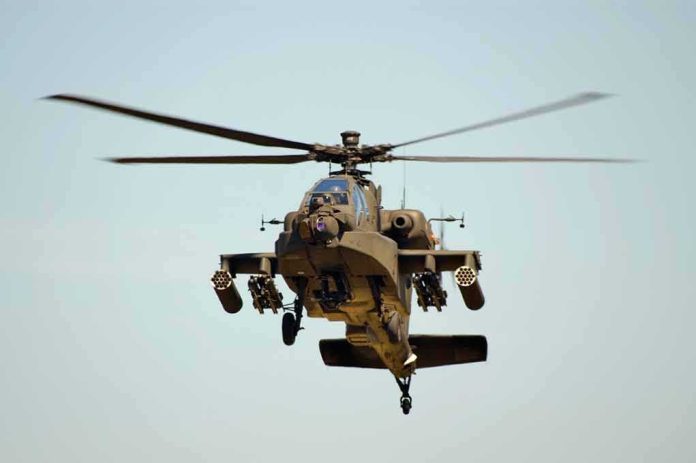
Marine attack helicopters can now strike targets more than 200 miles away, transforming rotorcraft into long-range precision weapons platforms capable of engaging threats far beyond the horizon.
Story Snapshot
- The U.S. Marine Corps selected L3Harris Red Wolf missiles for AH-1Z Viper helicopters, extending strike range to 200+ nautical miles by fiscal year 2027
- Red Wolf costs $300,000-$500,000 per unit, roughly one-tenth the price of traditional cruise missiles while delivering comparable range
- The system completed 52 successful tests and demonstrated maritime target engagement in December 2025, validating operational readiness
- L3Harris received an $86.2 million Navy contract in February 2026 to produce missiles, training equipment, and support materials
- The weapon supports Marine Corps Force Design 2030 strategy requiring distributed units to conduct independent strikes without Navy or Air Force support
The Red Sea Reality Check That Changed Everything
The U.S. Navy burned through nearly 400 missiles defending ships in the Red Sea between October 2023 and January 2025. Among them: 120 SM-2 interceptors at $2.5 million each and 80 SM-6 missiles at $4.3 million apiece. The math stung. America was spending millions to knock down Houthi drones that cost a fraction of the defensive munitions used against them. This unsustainable economics drove Pentagon leadership toward an uncomfortable conclusion: exquisite weapons designed for peer adversaries cannot be the primary answer to mass drone attacks.
Red Wolf Delivers Affordable Mass With Extended Reach
The Marine Corps selected Red Wolf on January 30, 2026, as its Precision Attack Strike Munition launched effect. The system transforms AH-1Z Viper attack helicopters into over-the-horizon strike platforms without requiring multi-million-dollar munitions. Red Wolf extends helicopter strike range from roughly 5 miles with current Hellfire missiles to more than 200 nautical miles. The weapon can loiter for up to 60 minutes, providing extended patrol and targeting opportunities that traditional munitions cannot match.
L3Harris designed Red Wolf as part of its Wolf Pack family of systems. The kinetic strike variant joins Green Wolf, an electronic warfare version capable of jamming enemy communications and radar systems. Both platforms share a common airframe and can be deployed in autonomous swarms, enabling coordinated attacks that saturate enemy defenses. The system proved its operational viability in December 2025 when a Marine Viper successfully engaged a maritime target during demonstration trials.
Cost Efficiency Drives Strategic Procurement Shift
Red Wolf costs approximately one-fifth to one-tenth the price of traditional cruise missiles like the AGM-158 JASM while delivering comparable range. This cost advantage becomes critical when considering magazine depth requirements for sustained operations. The Pentagon cannot afford to expend $4 million interceptors against threats valued in the tens of thousands. Red Wolf addresses this asymmetry by providing affordable mass that enables commanders to prosecute multiple targets without depleting precious stockpiles of exquisite munitions.
The system compares favorably to existing helicopter-launched weapons. The AGM-84K SLAM ER reaches 135+ nautical miles. The Kongsberg Joint Strike Missile, already employed by Marines in their Nemesis system, extends to 189+ nautical miles. Red Wolf surpasses both while maintaining lower unit costs and greater mission flexibility. The weapon combines autonomous powered flight characteristics of cruise missiles with the affordability and deployment flexibility of glide munitions, representing a significant technological advancement over predecessor systems.
Force Design 2030 Demands Operational Independence
The Marine Corps fundamentally restructured its force composition under Force Design 2030, prioritizing distributed operations across the Pacific theater. This strategy requires smaller units to conduct independent strikes without relying on Navy carrier air wings or Air Force bomber support. Red Wolf directly enables this operational concept by giving Marine helicopter squadrons credible long-range strike capability. Dispersed units operating from expeditionary advanced bases can now engage maritime and land targets at ranges previously requiring fixed-wing aircraft support.
Christopher Kubasik, L3Harris chairman and CEO, framed the urgency clearly: “Recent conflicts and incursions over NATO airspace, particularly with the increased use of mass-produced drones, demonstrates the urgent need for cost-effective alternatives to exquisite munitions. Our proven Red Wolf system can bring affordable mass to the Marines’ arsenal of advanced munitions within the timeline U.S. officials have outlined.” The 52 successful test flights validate technical maturity, though classified details regarding seeker type and countermeasure resistance limit independent verification of all claimed capabilities.
Pacific Deterrence Calculus Changes Dramatically
China’s expanding naval capabilities and long-range weapons arsenal present significant challenges for dispersed Marine units operating across the vast Pacific. Red Wolf complicates Chinese military planning by extending Marine strike range to distances that threaten high-value assets like amphibious assault ships, logistics vessels, and surface combatants. The system’s autonomous swarming capability enables coordinated attacks from multiple axes, saturating defenses designed to counter single-axis threats. This enhanced capability strengthens U.S. deterrence posture while reducing Marine dependence on external support assets.
The broader defense industrial base will likely follow the Red Wolf model toward affordable, multi-mission autonomous weapons platforms. Similar adaptations already include modifications to Hellfire II missiles for counter-drone operations and integration of modified weapons onto platforms like the V2X Tempest buggy. The Pentagon’s validation of the affordable mass approach through Red Wolf selection will accelerate competition in the long-range autonomous weapons market, potentially triggering international demand that affects global arms markets and regional security dynamics.
Deployment Timeline and Operational Integration
L3Harris will deliver Red Wolf systems, training equipment, and support materials by the end of fiscal year 2027 under the $86.2 million Navy contract awarded in February 2026. Marine pilots and weapons officers require new training protocols for employing long-range autonomous weapons, including target acquisition procedures, swarm coordination techniques, and engagement authority protocols. The operational integration period will likely extend 12-18 months beyond initial delivery as squadrons develop tactics, techniques, and procedures for maximizing the weapon’s capabilities in contested environments.
Red Wolf represents more than incremental improvement in helicopter armament. The system fundamentally alters Marine operational concepts by enabling over-the-horizon engagement without external support. This capability supports the broader Pentagon strategy balancing fiscal constraints against emerging threats while establishing a template for future affordable precision munitions development. The success or failure of Red Wolf deployment will significantly influence subsequent procurement decisions across the defense industrial base, potentially reshaping how America approaches long-range strike capabilities in resource-constrained environments.
Sources:
Why Marines Putting ‘Red Wolf’ Missiles on Viper Helicopters – The National Interest
Marines’ Red Wolf missile gives helicopters 200-mile range – Task & Purpose
US Marine attack helicopters to field long-range missiles by 2027 – Defense News
Marines Attack Helicopters to Get Long-Range Maritime Strike, Electronic Warfare Missile – USNI News
US Navy Selects L3Harris Red Wolf for USMC Strike Programme – Calibre Defence
Red Wolf Long-Range Missiles for Marine Corps AH-1Z Vipers – SOFREP