
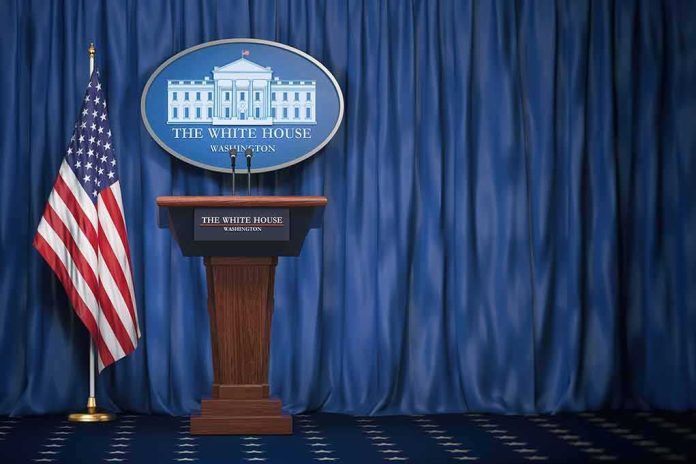
Karoline Leavitt’s reported departure is best understood not as a palace coup, but as a highly visible personnel transition in which the White House is trying to preserve both the practical continuity of the press operation and the political value of one of its most recognizable communicators.
Key Points
- Trump says Leavitt is leaving at the end of the month to spend more time with her young children and family, and that he respects the choice.
- The official framing keeps her inside Trump’s political ecosystem; she is described as an outside adviser rather than a discarded figure.
- There is public speculation about friction because of her combative briefing-room style, but the supplied record does not show documentary proof of a firing or forced removal.
- The episode fits a familiar pattern: a prominent spokesperson’s departure is immediately read as a signal of internal conflict, even when the available evidence points to a routine family-driven step back.
What the record actually supports
The clearest fact in the supplied material is straightforward: President Trump announced that Leavitt will leave her role at the end of the month, and he explicitly framed the move as family-centered and temporary, saying she wants more time with her children and that he “totally understand[s] and respect[s]” the decision. That is not the language of a public firing. It is the language of a president trying to present a trusted aide’s departure as an orderly adjustment, not a rupture.
Leavitt’s own public remarks reinforce that reading. In reporting tied to her maternity leave, she described herself as being “on the verge of having a baby any moment now,” and a later account says she told reporters that the reason was her belief that she could not be the best mother she wanted to be while carrying the constant demands of the press secretary job. The supplied record therefore contains a consistent family-leave explanation from both the principal and the principal’s boss, which is exactly what one would expect when a top aide steps away without a scandal attached.
Why the job matters more than a normal staff change
The White House press secretary is not an ordinary communications aide. The role is a public proxy for presidential discipline, message control, and daily combat with the press corps; when that person leaves, the departure is instantly overinterpreted because the office itself is symbolic. That is why the same event can be described, depending on one’s priors, as family leave, a strategic reset, or evidence of internal strain. In practice, all three can circulate at once. The job sits at the intersection of loyalty and visibility, so the line between personnel news and political narrative is always thin.
That symbolic weight is heightened here because the supplied material also says Trump will keep Leavitt in his orbit as an outside adviser and an influential voice in the Republican Party. That detail matters. It preserves the core relationship and lowers the odds that readers should interpret her exit as an expulsion from power. A person who is being shoved out is rarely praised in such terms, nor kept formally close to the president’s political project.
Why the rupture narrative persists anyway
The counter-narrative is not baseless in the abstract; it is simply weaker than the family-leave account in the record provided. The supplied evidence includes clips and reports of Leavitt abruptly ending briefings or storming out after tense exchanges with reporters, which critics can and will use as circumstantial evidence of friction. That is real context. It shows that Leavitt has operated in a press environment that rewards confrontation and generates viral clips. But it does not prove that her departure is punitive, and it does not contradict Trump’s stated reason for the move.
There is also a more subtle reason the rumor sticks: in the current media ecosystem, a visible personnel change often gets collapsed into a morality play before the administrative facts are settled. A press secretary who has spent months in adversarial exchanges can easily become a screen onto which commentators project whatever story they already expect to see. In a polarized environment, “leaving the role” is never just leaving the role. It becomes a referendum on toughness, loyalty, and the internal state of the administration.
The administrative mechanics matter, and the available record points one way
One of the most important distinctions in any White House staffing story is between resignation, reassignment, leave, and removal. Those categories are not interchangeable. In the material supplied here, the public-facing explanation consistently points to a planned departure tied to family responsibilities, while Trump’s announcement explicitly leaves room for continued service as an outside adviser. That combination is much closer to a managed transition than to a dramatic break.
The counter-evidence offered in the package does not clear that bar. It notes that there is no public personnel paperwork in the record provided and that no formal replacement was named immediately. That may leave room for speculation, but it is not a contradiction. Bureaucratic silence is not the same thing as proof of coercion. If the White House wanted to make a quiet personnel change look routine, the public record would often look exactly like this: a short announcement, a family rationale, and a promise of continuing informal influence.
What this says about Leavitt, and about Trump-era communications
Leavitt’s departure, as described in the supplied sources, reveals how modern White House communications works at its most polished level. A spokesperson becomes indispensable precisely because she can be both combative and disciplined; then, when family obligations make the rhythm of that job unsustainable, the administration tries to convert the exit into a narrative of esteem rather than loss. Trump’s statement does that cleanly. It protects Leavitt, preserves her standing, and signals continuity to allies who may worry about the press operation’s stability heading into a politically sensitive period.
That is why the most credible interpretation is also the least dramatic one: Leavitt appears to be stepping back from the daily press-secretary grind for family reasons, while remaining in Trump’s wider political circle. The viral temptation is to read every abrupt briefing-room moment as evidence of a blowup. The evidence supplied here does not support that leap. It supports a more ordinary, and in Washington less sensational, explanation: a high-profile aide is leaving one role without leaving the inner orbit of power.
🚨 White House press secretary to leave her role at the end of the month — Trump
💬 “Our wonderful White House Press Secretary, and one of my most trusted aides, Karoline Leavitt, will be departing her role at the end of the month,” US President Donald Trump wrote on Truth… pic.twitter.com/Z6DMN2uLNv
— brane mijatovic (@brane_mija64426) August 12, 2026
Sources:
facebook.com, azfamily.com, usatoday.com, btimesonline.com