
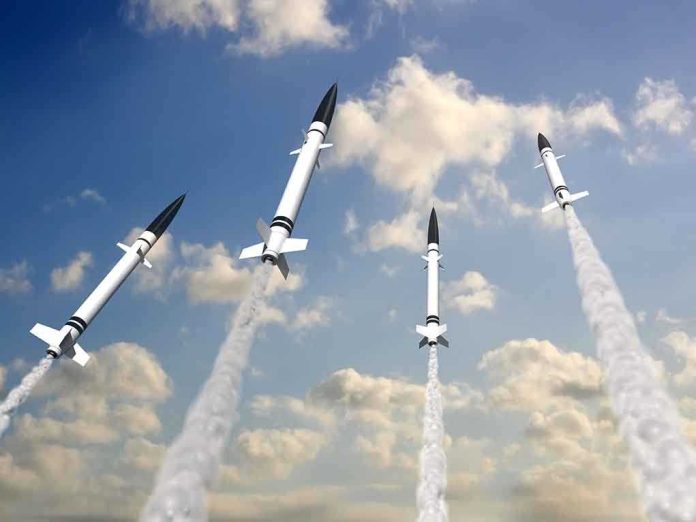
When missiles start falling on Tel Aviv, the real story isn’t the flash in the sky—it’s the chain of decisions that made “normal life” impossible in a matter of minutes.
Story Snapshot
- Iranian ballistic missiles triggered air-raid sirens across Israel, with impacts and injuries reported in central population centers including Tel Aviv.
- Israeli strikes hit major Iranian military targets, including the IRGC headquarters in Tehran, in a fast-moving escalation cycle.
- Civilians bore the immediate cost: fatalities reported in Beit Shemesh and dozens wounded in the Tel Aviv area as people rushed to shelters.
- Regional spillover followed quickly, with reported impacts on Gulf infrastructure and aviation disruptions that widened the crisis beyond Israel and Iran.
The Night the Sky Over Tel Aviv Became a Warning System
Air-raid sirens don’t ask permission. They reorder your life with one mechanical wail: drop what you’re doing, grab your family, find cover, and pray the concrete holds. Reports from this round of fighting described missiles visible over Israel’s night sky and repeated alerts in and around Tel Aviv. That visibility matters. It turns a distant war into a front-porch reality, where seconds become the only currency that counts.
The escalation followed a familiar logic with unfamiliar scale: strikes, retaliation, then bigger strikes. Israeli aircraft reportedly targeted key Iranian military sites and leadership-linked targets, including the IRGC headquarters in Tehran. Iran’s answer came in barrages aimed at central Israel. Early casualty reporting included fatalities in Beit Shemesh and more than 20 wounded in the Tel Aviv area. Numbers may shift as reports firm up, but the pattern is already clear.
Why This Exchange Felt Different From the “Shadow War” Years
Israel and Iran spent years trading blows in deniable ways—cyber operations, covert strikes, proxy attacks, and calibrated messaging. That era didn’t end overnight, but it changed character. The background to this moment runs through the post–October 7 regional fire, Hezbollah pressure on Israel’s north, and the 2024 cycle of direct Iran-Israel strikes that broke prior taboos. Once direct fire becomes thinkable, each side builds plans around the next rung up.
Readers over 40 will recognize the uneasy rhythm: leaders speak in absolutes while families learn new routines. In Israel, that routine includes shelters, sirens, and the grim calculation of distance to safety. Reports described a shelter strike in Beit Shemesh that killed multiple people and injured more, a reminder that “doing everything right” doesn’t guarantee survival. Hamas rockets taught Israelis to live with alerts; ballistic missiles raise the stakes with speed and mass.
Leadership Claims, Fog of War, and the Khamenei Question
Escalation feeds on certainty, but wars run on imperfect information. Statements in this episode included hints and claims about the status of Iran’s top leader, with Israeli and U.S. political voices pointing to his possible death while public confirmation remained unclear. Common sense says to treat dramatic battlefield announcements with caution until independently verified. In high-intensity conflict, information becomes a weapon—used to stiffen resolve, demoralize enemies, and shape how allies react.
That caution doesn’t dilute the seriousness of reported targeting. Strikes described as hitting IRGC command infrastructure signal a strategy beyond symbolic retaliation. Removing leadership capacity, degrading command-and-control, and forcing Iran’s decision-makers into survival mode can shorten a campaign—or widen it if Tehran feels cornered. American conservatives tend to respect clarity of objectives and honest accounting of costs. “Total victory” rhetoric sounds strong, but it must translate into measurable security gains, not open-ended commitments.
The Wider Map: Airports, Gulf Intercepts, and the Hormuz Risk
The Middle East rarely keeps its wars neatly boxed. Reports described injuries tied to strikes in the Gulf region, interceptions by regional partners, and aviation disruptions that reached beyond Israel’s borders, including effects on major airports. That kind of spillover matters because modern economies run on predictable routes: flights, shipping lanes, insurance rates, and energy throughput. Even one tanker incident near the Strait of Hormuz can rattle markets, not because of ideology, but because of math.
When airports pause operations and airlines reroute, everyday people pay first: missed funerals, interrupted medical travel, stalled commerce, and higher costs that show up weeks later at the grocery store. Strategic messaging often ignores these second-order effects, but voters feel them. The conservative lens here is straightforward: deterrence should reduce the frequency of these shocks, not normalize them. If deterrence fails, leaders must explain the end state—not just the next strike package.
What to Watch Next: Proxies, Duration, and the Meaning of “Peace”
The most dangerous part of this cycle may come after the headline salvos. Assessments referenced the risk of proxy expansion, including possible Houthi targeting of U.S. or Israeli interests. Proxy war lets Tehran apply pressure without betting the regime on a single all-in move, while Israel faces the classic problem of multiple fronts. A shorter, sharper campaign could reduce that risk; a longer one could invite copycat attacks across the region.
Israeli leaders framed the campaign in sweeping historical language, even as civilians counted the dead and the injured. Peace rhetoric can serve a purpose, but only if it connects to enforceable realities: degraded enemy capabilities, credible red lines, and allies willing to hold them. The open loop in this story remains unresolved: does this round of strikes reset deterrence, or does it teach every actor—from militias to states—that mass salvos against cities are now routine?
For Americans watching from afar, the lesson isn’t to pick slogans—it’s to track outcomes. If Israel can strike command targets and reduce future barrages, deterrence strengthens. If missile fire on Tel Aviv becomes periodic background noise, the region slides into a new, uglier normal. The families running to shelters already understand that difference. The rest of the world will, too, if the next escalation widens the map again.
Sources:
Timeline: Missile Fire Follows Israeli Strikes on Iran, Over 100 Injured in Israel
Timeline: Israel against Iran & Hezbollah
March 22, 2026 Multiple Missile Strikes
Missile Attacks Affecting Ben Gurion
Israel conducts 1,600 strikes on Iran in 4 days of war, weathers Iranian missile and drones
Iran Update: Evening Special Report, March 3, 2026