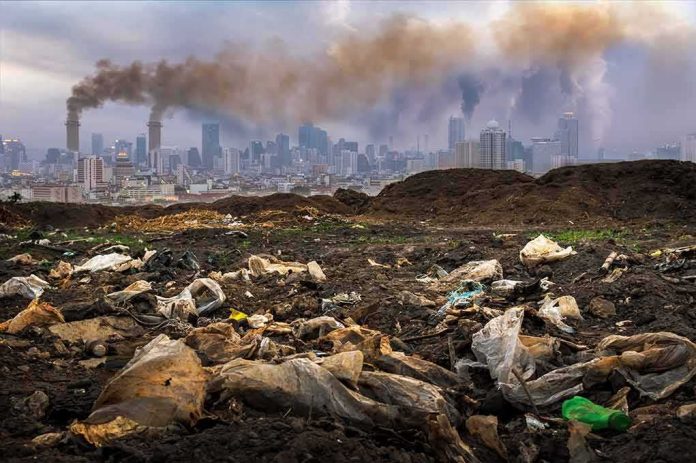
A pressurized pocket of methane gas erupted roughly 500 feet into the sky above the Chiquita Canyon Landfill in Castaic on November 16, sending decomposing trash, debris, and noxious gas raining down over nearby neighborhoods and forcing Los Angeles County into an emergency public-health response.
Key Points
- Crews drilling a new gas well to address elevated landfill temperatures struck a pressurized methane pocket, triggering a violent above-ground release of gas, debris, and particulate matter.
- Fire officials confirmed there was no fire — the towering plume that looked like black smoke was decomposing waste and escaping gas, not combustion.
- Los Angeles County Public Health ordered the landfill’s operators to provide hotel stays, filtered-air refuge centers, transportation, and air purifiers to affected residents.
- Air monitoring returned to normal limits within roughly a day, and evacuation advisories were subsequently lifted.
- The eruption did not occur in isolation — it followed more than three years of a documented subsurface heating problem at the site that regulators have called an imminent and substantial danger.
What Happened on the Ground
Shortly after 4 p.m. on November 16, a drilling crew working at Chiquita Canyon Landfill struck a pocket of pressurized gas while boring a new well. Waste Connections, the company that operates the site, said the well was intended to relieve elevated temperatures building inside the landfill mass. Instead, the drill breached a pocket under enough pressure to blow waste, debris, and gas violently upward — witnesses and emergency crews described a geyser-like column that reached an estimated 500 feet, visible for miles around the Santa Clarita Valley.
Los Angeles County Fire Department Captain Aaron Katon offered the clarifying detail that mattered most for how residents should understand the event: “There was no fire, it was an escape of gas”. The plume’s initial appearance — a dark, billowing column that looked for all the world like black smoke — was decomposing organic material and landfill gas thrown skyward by pressure, not flame. That distinction separates this incident from a conventional industrial explosion even though the force involved was, by any account, extraordinary. Fire crews responded quickly, establishing monitoring zones and issuing evacuation advisories for neighborhoods closest to the release.
The Public-Health Response
Within hours, the Los Angeles County Department of Public Health issued an emergency directive compelling Waste Connections and Chiquita Canyon LLC to fund hotel accommodations for displaced residents, operate filtered-air refuge centers, provide transportation assistance, and supply air purifiers or comparable relief to households grappling with the noxious odor drifting off the site. Communities including Val Verde, Hasley Hills, and nearby residential pockets bore the brunt of the smell and particulate fallout. The order reflected a judgment that the odor and debris posed a genuine, if largely nuisance-and-irritant-level, threat to residents rather than an acute toxic emergency — the kind of measured, precautionary action public-health agencies take when the precise composition of an airborne release isn’t yet fully characterized.
By the following morning, air-monitoring instruments were reading within normal limits, and fire officials reported that the affected zones had returned to normal status, with evacuation advisories subsequently lifted. That rapid stabilization is consistent with a short-duration pressure release rather than an ongoing combustion event — gas escaped, pressure equalized, and ambient conditions recovered once the immediate plume dispersed. Investigators have not yet published a completed technical finding establishing the precise mechanics of the pressurized pocket, and that determination remains open.
Why This Landfill Was Primed for Trouble
To understand why a drilling operation could trigger an eruption of this scale, it helps to know what Chiquita Canyon has been dealing with since the spring of 2022. The U.S. Environmental Protection Agency has classified the site as the location of a Subsurface Elevated Temperature event — an underground reaction, sometimes involving smoldering or pyrolysis-like chemistry, that generates extreme heat, altered gas composition, increased leachate, and intensified odor far beyond what a typical municipal landfill produces. California’s Department of Toxic Substances Control went further in April, issuing an Imminent and Substantial Endangerment determination tied to that same subsurface heating.
Regulatory records compiled by the South Coast Air Quality Management District documented landfill gas collection wells reading above 145 degrees Fahrenheit across multiple points from January 2022 through December 2023, a condition serious enough to trigger a stipulated abatement order. The new well that crews were drilling on November 16 was explicitly intended to relieve that heat buildup — meaning the eruption happened not despite the landfill’s troubled recent history, but directly because of it. Elevated subsurface temperatures change gas composition and pressure dynamics in ways ordinary landfill gas-management systems aren’t built to handle, and drilling into that environment carries real risk.
What the Incident Means Going Forward
Methane migration, surface emissions, and odor nuisance are the three recurring hazard categories the EPA identifies at municipal solid-waste landfills generally, and Chiquita Canyon has now delivered textbook versions of all three in rapid succession. What distinguishes this event from routine landfill-gas complaints is scale and visibility: a 500-foot plume forced county government into immediate, resource-intensive relocation support rather than a slow-moving regulatory proceeding. For residents of Val Verde and the surrounding Santa Clarita Valley communities, the episode is unlikely to be the last flashpoint tied to this site’s subsurface heating problem, and the gas-well mitigation work that triggered the eruption is itself part of the long-term effort to bring that underlying condition under control.
Sources:
USER: Los Angeles County issued an emergency health order after a massive geyser of rotting trash erupted at a landfill.
WITSCRIPT: Officials say it's the biggest pile of garbage to come out of L.A. since the last "Real Housewives" reunion.— Witscript (@witscript) November 18, 2026
cbsnews.com, ktla.com, latimes.com, newsweek.com, nbcnews.com, abc7.com