
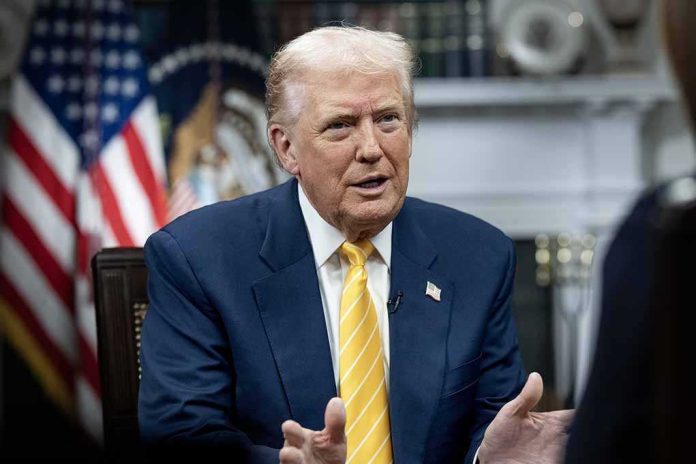
The health of presidential clemency depends not only on who gets mercy, but on how people believe it is granted; paid “pardon consulting” erodes that trust by converting proximity to the president into a billable commodity—and President Trump’s recent endorsement of legislation to curb the practice squarely targets that market.
At a Glance
- President Trump has publicly called paid pardon consulting “a terrible business” and said he supports legislation to restrict or end it.
- Reporting and undercover recordings have documented a cottage industry of lobbyists and fixers quoting six- and seven-figure fees tied to claimed access and “pressure” on the president.
- Brokers defend their work as lawful advocacy, arguing there is no “sale” of pardons—only paid representation to elevate a case.
- Historically, controversies around paid influence in clemency have recurred across administrations, underscoring the need to separate legitimate representation from influence-peddling and fraud.
What Trump’s Legislative Push Targets
Presidential clemency is constitutionally broad; no statute can narrow the president’s power to forgive. But Congress can regulate the marketplace around it—fees, disclosures, conflicts, misrepresentations—much as it regulates lobbying and campaign finance. When President Trump labeled paid pardon consulting “a terrible business” and backed legislation to “address this,” he put the crosshairs not on clemency itself, but on the for-profit intermediaries who package access as a service. The policy signal is clear: if you are monetizing proximity—selling the suggestion that a phone call, a fundraiser ticket, or a whisper network gets you mercy—you are the problem the bill intends to solve.
This is not cosmetic positioning. Investigations have captured on tape consultants quoting $300,000 to $3 million, justifying prices with talk of “putting pressure on the president” through congressional allies, influencers, and appearances at venues where the president circulates. Those representations, even when caveated with “no guarantees,” are the fulcrum for regulation: they blur the line between advocacy and influence-peddling, entice desperate families to pay, and corrode public confidence that pardons are adjudged on the merits rather than purchased access.
How the Modern Pardon Market Works
The Department of Justice maintains a formal clemency process, staffed by career lawyers who screen applications and advise the White House. Parallel to that channel, a private market has grown where lobbyists and political operatives pitch bespoke campaigns—bundling messaging, congressional outreach, media, and donor-circuit visibility—to vault a client’s case onto the president’s radar. In on-the-record and covertly recorded conversations, brokers have described pricing that reflects “strategery,” travel to properties frequented by the president, payments to third-party promoters, and the orchestration of a “pincer movement” of political pressure.
Two facts can be true at once. First, advocacy is lawful: people may hire representatives to present their case, and presidents may hear from whomever they wish. Second, the very sales pitch that commands six-figure retainers often leans on implied insider status—suggesting links to aides, surrogates, or social circuits—that a reasonable client could interpret as pay-to-play. That gray space is where consumer protection, anti-fraud statutes, and disclosure regimes do their best work; it is also where trust in clemency can evaporate.
Brokers’ Defense vs. the Evidentiary Record
Brokers on the business end of these investigations reject the phrase “pardon broker,” insisting they sell advocacy, not access. “Pardons are not for sale,” one pair argued; hiring advocates, they say, is akin to hiring any lobbyist to improve a petition’s presentation. In interviews, they deny that fees fund political contributions or quid pro quos, framing costs as standard for Washington campaigns—consultants, travel, surrogates, and outreach.
The defense is legally relevant, but the record it meets is stubborn. Undercover and on-camera accounts show consultants quoting specific prices while describing plans to “put pressure on the president” and citing connections to figures in his orbit, even as they disclaim guarantees. In one high-profile example, a client alleged paying $600,000 for a pardon that never materialized; the consultants denied wrongdoing, characterizing the engagement as standard lobbying and disputing the portrayal of their communications. The point is not that every claim of access is fraudulent—it is that the sales narrative itself invites confusion between zealous representation and monetized influence.
Why This Problem Recurs Across Administrations
Every modern presidency has faced claims that clemency or related mercy—commutations, sanctions relief—skewed toward the well-connected. After President Clinton’s Marc Rich pardon, congressional investigators scrutinized whether relatives and associates had parlayed access into paid advocacy; the episode triggered inquiries but not a categorical ban on paid pardon work. Contemporary research on the “leniency lobby” charts wealthy or internationally exposed petitioners hiring U.S. lobbyists to soften sanctions, seek pardons, or tilt prosecutorial posture—legal in its form, but inherently susceptible to apparent unfairness.
Two structural realities explain why the controversy returns. First, Article II vests clemency solely in the president; there is no tribunal to appeal to and no mandated process. Second, a White House—any White House—operates within a dense ecosystem of donors, advocates, and allies. Those facts do not prove corruption, but they create a marketplace where suggestion, symbolism, and social access can be packaged as a product. Regulatory guardrails try to keep that product from misleading buyers or degrading public confidence, but absent bright-line federal rules tailored to clemency, the gray zone endures.
Trump blasted paid pardon consulting after he was asked if he was going to pardon human beings for the holidays. “We look all the time.” Hypocrite.
— LadyGhost (@LadyGage13) November 25, 2026
What Smart Legislation Would Actually Do
Because Congress cannot limit the president’s clemency power, effective reform focuses on intermediaries and transparency. Several tools are well grounded in existing law:
– Mandatory disclosure: Require anyone paid to advocate for clemency to file timely, public disclosures of clients, fee ranges, and contacts with executive branch officials—akin to the Lobbying Disclosure Act, but tailored to clemency advocacy.
– Truth-in-services rules: Prohibit false or misleading claims of influence, undisclosed conflicts, or implied pay-to-play; pair with meaningful civil penalties and swift injunction authority for the Federal Trade Commission or DOJ.
– Fee safeguards: Bar contingency fees for clemency outcomes and require written contracts with cancellation and refund rights for non-performance—protecting families from open-ended retainers untethered to deliverables.
– Executive branch boundaries: Codify ethics rules for White House and agency personnel—no fundraising, ticketed event solicitations, or business dealings with clemency petitioners or their paid advocates during the pendency of a request.
Drafts in recent Congresses have gestured toward these approaches, citing the cross-partisan history of controversial pardons as justification for stronger guardrails. The common thread is not to criminalize advocacy, but to strip the market of its most corrosive feature: monetized insinuations of privileged access.
The Stakes: Mercy That Can Be Believed
Clemency exists to correct excess—tempering harsh sentences, recognizing rehabilitation, or curing legal injustice. Its power depends on public legitimacy. When six-figure retainers and donor-circuit choreography appear to be prerequisites for an audience with the president, ordinary petitioners read the message clearly: merit matters less than money. President Trump’s stated support for legislation to stop the “terrible business” of paid pardon consulting aims directly at that perception problem. The test of seriousness will be in specifics—disclosure teeth, anti-deception enforcement, and bright-line ethics rules that wall off the president’s mercy from the consultants’ marketplace. Design it well, and the clemency power can do what the Constitution intended, without asking the public to suspend disbelief.
Sources:
nypost.com, cbsnews.com, faithfulherald.com, dnyuz.com, politomix.com, thegrio.com, creators.spotify.com