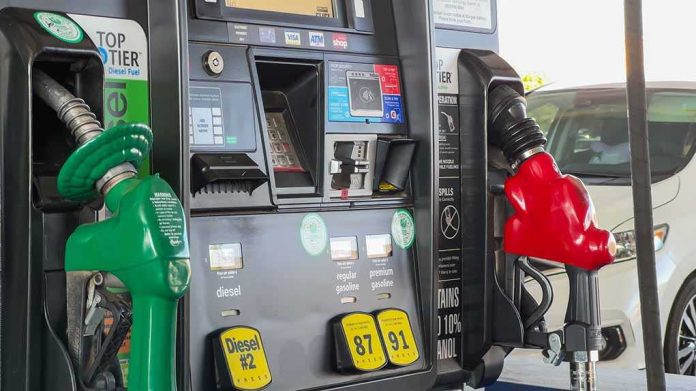
When diesel sets a new national record, it is not just another price spike; it is a signal that the industrial bloodstream of the economy—freight, farming, construction, mining, municipal services—is facing a synchronized squeeze driven less by crude oil than by refining capacity, product inventories, and global trade frictions that tighten all at once.
At a Glance
- AAA’s national average for retail diesel reached a record, cresting near $5.90 per gallon—an authoritative consumer benchmark watched by markets and policy makers alike.
- The retail “record” reflects a downstream crunch: high refining margins (diesel cracks), thin inventories, and constrained product flows, not simply expensive crude.
- Regional and seasonal demand, especially harvest and freight surges, amplify price pressure when refineries are already at high utilization.
- Short-term relief tools are limited; structural balance depends on refinery uptime, product trade routes, and distillate inventory rebuilding.
What set the record and why the AAA series matters
AAA’s Fuel Gauge Report—an actively updated, consumer-facing dataset—placed the U.S. national average for diesel at roughly $5.90 per gallon when the record was set, a level the platform flags as the highest since it began tracking national prices. Because AAA aggregates daily station-level data with consistent methodology, its national average functions as the de facto retail benchmark; even the U.S. Energy Information Administration republishes AAA’s retail prices across its public-facing dashboards. As a result, when AAA prints a new high, it reliably captures what truckers, farmers, and distributors actually see at the pump, not an abstract futures quote.
That distinction matters. Futures curves and wholesale spot prices move first, but the retail average is the number business owners budget against and the one that ultimately filters into freight surcharges and crop input costs. For historical cross-checking, analysts often pair AAA’s daily series with EIA’s weekly and monthly time series—methodologically different but directionally aligned—to confirm that a spike is not a one-day fluke.
Mechanics: why diesel, not gasoline, keeps breaking records
Diesel’s pricing anatomy is unforgiving during supply disruptions. Unlike gasoline, diesel (a middle distillate) depends heavily on the availability of medium and heavy crudes and on refinery configurations capable of maximizing distillate yield. When outages or logistics snarls hit complex refineries—or when crude slates skew lighter—the market loses disproportionate diesel barrel availability. In these episodes, the crack spread—the refinery margin between crude input and diesel output—blows out, a market signal that product is scarce and each incremental barrel is worth substantially more to produce. Recent episodes have seen diesel cracks vault to record territory, a textbook indicator that the pinch is in refining and product, not merely in crude supply.
Inventories compound the effect. Thin U.S. distillate stocks reduce shock absorption, so outages, maintenance overruns, or export constraints transmit almost directly to rack prices and then to retail. The result is a retail average that can detach from crude benchmarks and overshoot historical gasoline-to-diesel relationships—exactly the pattern evident in past record-setting stretches.
How we got here: outages, geopolitics, and seasonality aligning
Record retail prints rarely trace to a single culprit. In the run-up to the latest record, three forces aligned. First, supply disruptions in and around the Gulf refining system tightened global middle-distillate availability and snarled product flows—especially acute for diesel—removing significant barrels from the market at a time when the system had little slack. Second, broader conflict-driven risks—strikes on refineries in conflict zones, trade and shipping interruptions, and policy responses restricting product exports—further constrained fungible diesel supply that normally arbitrages across regions to balance shortfalls. Third, seasonal U.S. demand intensified at precisely the wrong time: harvest and peak freight windows lift diesel consumption just as refineries transition and maintenance schedules curb flexibility. Together, those drivers magnified refinery margins and transmitted quickly to retail.
The evidence on margins is particularly clear: U.S. diesel cracks pushed through prior highs, an empirical marker of distillate scarcity. When cracks move above $100 per barrel, refiners are being paid a premium to tilt yields toward diesel—yet even that incentive cannot conjure new barrels if crude slate constraints, hydrotreating capacity limits, or downstream logistics prevent meaningful output gains. In other words, price rationing steps in because physical capacity cannot.
Regional fingerprints and who feels it first
National averages can hide punishing regional disparities. States with intensive agricultural activity, long-haul trucking corridors, or fewer in-state refineries often see earlier and sharper spikes. When local rack prices detach from neighboring markets—whether due to a temporary pipeline constraint, limited terminal storage, or regulatory fuel-spec differences—retailers face wholesale costs that change faster than street prices can adjust, leading to visible jumps and uneven timing across counties and states. AAA’s state pages captured exactly that patchwork as the national average crossed its new high.
Commercial users cannot easily substitute away from diesel, so price elasticity is low. Farmers, municipalities, Class 8 fleets, and railroads must buy the fuel; their choice is when and how to pass through surcharges or pare less-essential activity. The pass-through shows up with a lag in freight indices, food prices, and construction bids. This is why a retail diesel record is a macroeconomic headline, not just a commodity footnote.
Common misconceptions: it’s not mainly about crude
When retail diesel breaks records, public debate often fixates on the front-month crude quote. That frame misleads. In multiple high-price episodes, crude has been elevated but not at record levels; what changed decisively was the product side—refinery downtime, yield shifts, and export or shipping constraints that bottleneck diesel specifically. Analysts who live in the market look first to cracks, refinery utilization, and distillate inventories to explain the price at the pump; those indicators, not crude alone, have been the load-bearing facts behind recent records.
AAA’s consumer series is also sometimes criticized as “just a pump average.” That is precisely its value. It is the retail reality businesses face, updated daily, and even EIA leans on it for public reporting. The causality analysis requires separate tools, but the price signal itself is robust.
What changes the trajectory from here
Short-term relief hinges on restoring refinery uptime and normalizing product logistics. Each of the following tends to cool retail prices: heavy and medium crude availability to boost distillate yields; successful completion of refinery maintenance and unplanned outage repairs; improved product shipping through major chokepoints; and, critically, rebuilding U.S. distillate inventories heading into demand peaks. Policy levers—such as targeted waivers, temporary adjustments to fuel specifications, or facilitation of product imports—can bridge gaps at the margin, but none substitute for durable physical capacity and stable trade routes.
Over a medium horizon, two variables dominate: the cadence of global refinery additions and retrofits, and the resilience of product trade pathways under geopolitical stress. New or upgraded hydrocrackers and desulfurization units add the exact molecules diesel markets lack during crunches; conversely, retirements of complex capacity make future spikes more frequent. On the demand side, efficiency gains in freight and off-road equipment can shave consumption growth, but as long as freight and agriculture scale with the economy, diesel will remain the system’s price-sensitive lever.
US Average Diesel Price Rises To Record $5.90 Per Gallon
Average diesel prices in the United States climbed to a new record Monday, the motorists’ association AAA said, as damage to Gulf refineries during the war against Iran disrupted supplies.https://t.co/THCe8ZpHfT pic.twitter.com/NHpdU0vW9b
— Channels Television (@channelstv) September 7, 2026
How to read the next “record” headline
Three checks separate signal from noise. First, confirm the print against a reputable retail series—AAA daily, supported by EIA weekly and monthly data. Second, look at diesel cracks and distillate inventory charts; if cracks are elevated and stocks thin, the price move is product-driven, not speculation. Third, scan refinery outage reports and shipping bottlenecks; those will tell you whether relief is weeks or months away. Taken together, they explain why a $5.90 diesel headline is not an anomaly but the predictable outcome of a system that runs hot, holds little spare capacity in middle distillates, and must clear the market through price when anything goes wrong.
Sources:
gasprices.aaa.com, autoclubsouth.aaa.com, foxbusiness.com, eia.gov, fuelgaugereport.opisnet.com, finance.yahoo.com