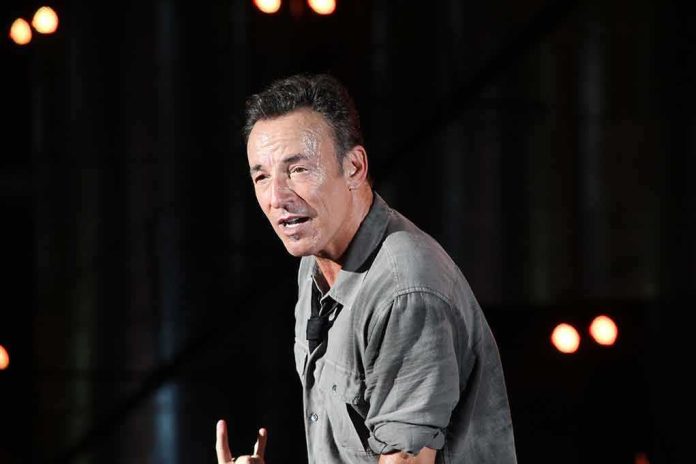
When Bruce Springsteen took the stage in St. Paul, Minnesota, he wasn’t performing a concert that happened to have political overtones — he was headlining a protest, built from the ground up as a mass political event, and he used his platform exactly as intended: to put names, grief, and anger behind a movement’s argument.
Key Points
- Springsteen headlined the flagship “No Kings” rally in St. Paul on March 28, 2026, part of a nationwide anti-Trump mobilization that drew more than 200,000 attendees at that site alone.
- He performed “Streets of Minneapolis” and publicly named Renée Good and Alex Pretti, tying their deaths to criticism of immigration enforcement and what he called a “lawless government”.
- The event drew a broad coalition of public figures, including Jane Fonda and Bernie Sanders, reflecting the rally’s scale and organizational reach.
- “No Kings” has become the dominant recurring protest brand of the second Trump term, organized by the 50501 Movement and staged three times as of this rally, each larger than the last.
- Research on celebrity political activism consistently finds it energizes the already-persuaded far more than it converts opponents — a pattern this rally fits squarely within.
What Happened in St. Paul
The facts of the event are not in dispute. On March 28, 2026, Bruce Springsteen headlined what multiple outlets identify as the flagship “No Kings” rally, staged in St. Paul as part of a coordinated, multi-site national protest against the Trump administration. CBS News Minnesota reported attendance above 200,000 at that single location, with the demonstration unfolding across three St. Paul sites before converging on the Minnesota Capitol grounds. This was not a standalone concert booked into a political news cycle; it was a protest festival, built around speeches, performances, and organized messaging, with Springsteen as its marquee draw alongside Jane Fonda and Senator Bernie Sanders.
Springsteen’s set carried explicit political content rather than incidental commentary. He criticized the administration’s immigration enforcement apparatus directly, and multiple outlets — USA Today, ABC, the Associated Press, and Variety among them — independently reported his remarks and performance in substantially the same terms. That convergence across outlets with different editorial postures is itself a meaningful form of corroboration: when wire services and entertainment trades describe the same sequence of events the same way, the core facts are settled, whatever one makes of the politics underneath them.
The Deaths Springsteen Named and the Argument He Built Around Them
Before performing “Streets of Minneapolis,” Springsteen named two people directly: Renée Good, whom he described as a mother of three, and Alex Pretti, a VA nurse. According to a transcript of his remarks, he said both were killed — Good “brutally murdered,” Pretti “executed by ICE, shot in the back and left to die in the street” — and criticized the administration for failing to investigate. This is the emotional and rhetorical spine of his appearance: a musician translating a protest movement’s abstract grievances into two specific human names, a technique as old as protest music itself, from Woody Guthrie’s dust-bowl ballads to Springsteen’s own “41 Shots.” One brief caveat belongs here: the attribution and circumstances surrounding both deaths are presented through Springsteen’s own framing and the reporting that followed it, rather than through independently released coroner or law-enforcement findings in the material reviewed.
Whatever the underlying facts of those two deaths prove to be, Springsteen’s choice to name them from a stage in front of hundreds of thousands of people is itself the newsworthy act — a deliberate escalation from generalized anti-administration rhetoric to specific, personalized accusation, delivered at the largest single protest stop of his career.
How “No Kings” Became the Era’s Defining Protest Brand
To understand why a 76-year-old rock musician would headline a political rally rather than simply tour behind an album, you have to understand what “No Kings” is. The name was coined by the 50501 Movement — shorthand for “50 states, 50 protests, one movement” — and organized around a single accusation: that the Trump administration’s governing style amounts to authoritarian overreach. The St. Paul rally was the third mass mobilization under that banner within roughly a year, each one explicitly framed by organizers as larger than the last, and each one timed to coincide with flashpoints in immigration enforcement, federal deployment of law enforcement into Democratic-led cities, and related controversies. Earlier “No Kings” events had already drawn estimates in the millions nationwide, according to organizer figures reported by NPR, making the brand the closest thing the anti-Trump coalition has produced to a recurring, nationally coordinated holiday of dissent.
Celebrity Activism’s Actual Effect — Reinforcement, Not Conversion
Springsteen is hardly the first entertainer to lend a rally his name recognition, and the research on what that actually accomplishes is consistent and somewhat humbling for anyone who assumes a famous voice changes minds. Political scientists who study celebrity activism have repeatedly found the same pattern: these appearances are highly visible and effective at energizing audiences who already agree, but rarely persuasive to anyone who doesn’t. A Bowling Green State University political scientist studying earlier waves of celebrity-led anti-Trump marches put it bluntly — such appearances satisfy people already in agreement and are unlikely to move supporters of the administration at all, who in fact often respond by digging in further. Comparative research on celebrity involvement in resistance movements abroad, from Myanmar’s 1988 uprising to its 2021 counterpart, finds the same rational calculus: public figures weigh personal risk and reputational consequence against perceived political efficacy, and social media now amplifies both the reach and the backlash of that choice far beyond what a stage alone ever could.
What the Rally Signifies Going Forward
The lasting significance of the St. Paul rally isn’t that Springsteen opposes the administration — that has been public record since well before this tour. It’s that his participation illustrates how thoroughly the “No Kings” brand has absorbed celebrity activism into its architecture, using marquee names not as endorsements bolted onto a protest but as organizing tools built into the structure of the event itself. Future mobilizations, on either side of the aisle, will likely follow the same template: a recognizable headline name, a personalized grievance narrative, and a national brand designed to repeat and scale. Whether that formula changes votes is a separate question from whether it fills a capitol lawn — and on the evidence of St. Paul, it still does the latter extraordinarily well.
Sources:
ndtv.com, faroutmagazine.co.uk, abcnews.com, clickorlando.com, thegatewaypundit.com, cbsnews.com