
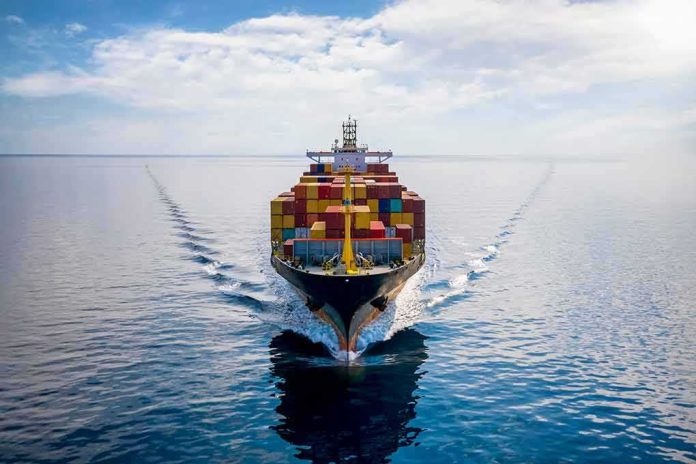
When large ships meet a narrow, working river, safety lives or dies on choreography: who sees whom, who speaks up when, and how fast a unified response turns chaos into order. The New Orleans collision between a tanker and the docked river cruise vessel American Heritage made that point with unforgiving clarity—and showed why the Coast Guard’s operational control of the waterway and an integrated local response are the difference between a mass-casualty headline and a mass-fatality one.
At a Glance
- A tanker struck the docked American Heritage near 1350 Port of New Orleans Place around 12:30 p.m., triggering an immediate multi-agency rescue on the Mississippi River.
- The Coast Guard closed river traffic near mile markers 93–96 to secure the scene and support search-and-rescue and triage operations.
- Passengers entered the water; responders pulled survivors to safety as the riverboat listed and partially submerged.
- An investigation led by maritime authorities is examining the collision’s cause; early public passenger counts varied during the rescue phase.
What happened along the New Orleans waterfront
Shortly after midday, while the American Heritage was docked near 1350 Port of New Orleans Place, a tanker making way on the Mississippi struck the passenger vessel. The impact drove a fast-moving casualty sequence: passengers visible in the water wearing life vests, a listing hull, and debris sweeping past the bulkhead. Local outlets documented the precise location and time window; crews converged on the scene almost immediately, pulling people aboard rescue craft and establishing a triage area ashore. Video and contemporaneous reporting captured the essential facts: an active rescue from a partially submerged cruise vessel in a constrained river reach, with people in the water and responders executing under pressure.
Command of the waterway shifted to emergency footing. The Coast Guard reported closing traffic in the vicinity—an operational lever that prevents secondary collisions, protects divers and small craft, and buys first responders uncontested space to work. Officials identified the affected segment of the river between mile markers 93 and 96, a busy bend where large-vessel handling margins are thin even on a good day. That closure, paired with shoreside staging at the port complex, created a corridor for coordinated rescue, stabilization, and medical evacuation.
How a multi-agency marine rescue actually runs
Marine mass-rescue is not a single agency’s show; it is a web of roles that must lock together under incident command. In New Orleans, Port NOLA Harbor Police, Fire, and EMS worked alongside the Coast Guard and city police to sweep the water for survivors, stabilize those pulled from the river, and manage reunification ashore. The Coast Guard’s vessel-traffic and safety authorities are uniquely suited to “clear the lanes” and impose temporary movement controls, while local marine units bring shallow-draft access, local knowledge of eddies and piers, and sheer numbers of hulls on scene. That blend—federal control of the navigational picture, municipal speed and proximity—shortens the timeline from immersion to extraction, a determinant of survivability in even temperate water.
Because the cruise vessel was alongside the port complex, responders benefited from immediate dock access, short run times for medical transport, and ready staging for equipment. Those are quiet advantages that rarely make headlines but often separate recoveries from fatalities. They also allowed rapid transfer of command tasks: triage to EMS, perimeter and evac routes to police, and on-water sweep sectors to marine units, while the Coast Guard maintained a navigational safety bubble and initiated the marine casualty inquiry.
The investigative lens: collisions are rarely one-cause events
The cause of the New Orleans collision was not immediately assigned in early reports; that restraint reflects maritime practice rather than opacity. Serious collisions are reconstructed from converging data streams: bridge logs, voyage data and engine records, AIS tracks, radar plots, pilot statements, radio traffic, and physical evidence from hull and machinery. Past National Transportation Safety Board (NTSB) work shows causation often distributes across human factors and system conditions—bridge-team coordination, lookout effectiveness, rules-of-the-road compliance, communications discipline, and the constraints imposed by restricted channels and current.
In analogous cases—from congested ship channels to ferry lanes—investigators have apportioned fault when bridge teams misread closure rates, failed to use radar effectively, or made unsafe crossing or overtaking decisions under constrained geometry. That body of precedent is not a template for New Orleans; it is a reminder that “what hit what” is less informative than “which defenses failed and why.” The Coast Guard’s parallel roles—safety authority on scene and regulatory investigator after the fact—are well established in statute and practice, with findings often complemented by NTSB safety analysis and lessons-learned digests that aim to prevent recurrences across the industry.
Numbers in motion: why early counts shift in a live rescue
Early passenger and casualty figures varied by outlet in the first hours—roughly 129 passengers plus crew in some reports, nearly 130 in others—while rescue and hospitalization totals evolved as triage proceeded. That flux is routine in mass rescues: manifests must be reconciled against who had already disembarked, who self-evacuated ashore, and who was transported directly to hospitals. Accountability is a process, not a single radio call. What matters operationally is the system’s ability to close the gap from “approximately” to “accounted for” through manifest reconciliation, hospital checks, and reunification tracking. As the scene stabilized, authorities also began planning salvage and the controlled reopening of the navigation channel, typically phasing traffic (one-way, restricted speed) while divers, survey crews, and crane assets go to work.
Why this reach of the Mississippi tests seamanship—and emergency management
New Orleans’ waterfront concentrates hazards: strong current, confined banks, heavy commercial traffic, and complex berthing moves. A large tanker navigating near a moored passenger vessel has inches, not yards, of error tolerance when wind, set, or machinery anomalies intrude. That is why river pilots, bridge resource management, and crisp radio protocols are treated as layers of defense rather than paperwork formalities. When one or more of those layers rips, consequences arrive quickly, especially for a passenger vessel crowded with people who may be elderly, unfamiliar with marine egress, and not dressed for immersion.
The rescue’s apparent speed and the immediate river closure show an operational system doing the two most valuable things under pressure: buying time for survivors and removing compounding risk. The rest—investigation, causal assignment, regulatory or company-level safety changes—will follow on the same disciplined footing that defines modern marine casualty work.
All 129 passengers and crew aboard the river cruise ship American Heritage have been accounted for after the vessel was struck by a tanker on the Mississippi River in New Orleans on Friday, November 13, 2026. According to WDSU's New Orleans Cruise Ship Collision Live Updates,…
— Desk_Surfer (@Desk_Surfer) November 13, 2026
What to watch as the record is built
Several milestones will shape the authoritative history of the case. Expect the Coast Guard and investigative partners to compile a synchronized timeline from AIS and radio traffic, bridge and engine logs, and pilot statements; to survey the wreck’s resting position and hull damage patterns; and to assess human performance against navigational rules and standard operating procedures. The strongest public documents marry mechanism to consequence: not just what failed, but how that failure cascaded into collision and how similar cascades can be arrested in the future. When those findings are published, they will join a durable literature of “Safer Seas” casework that has steadily refined practices from lookout discipline to bridge resource management across the U.S. fleet.
Sources:
militarytimes.com, wtae.com, wdsu.com, edition.cnn.com, reuters.com, fox13news.com, ntsb.gov