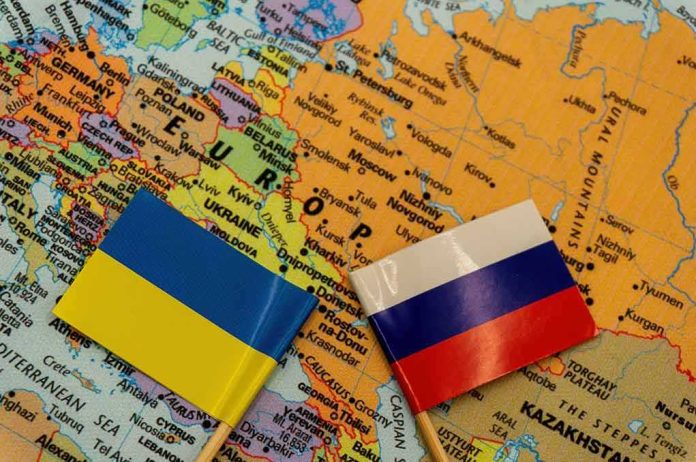
Peace efforts stall not because the parties refuse to talk, but because they are trying to settle three different disputes at once: who controls land, who legally owns it, and how a postwar European security order should constrain Ukraine’s future alignment.
At a Glance
- Russia has treated Ukrainian withdrawal from the entire Donbas as a standing precondition for peace, linked to Ukrainian neutrality and non-membership in NATO.
- Kyiv rejects territorial concessions within its internationally recognized borders and frames full Russian withdrawal as essential for any durable settlement.
- International recognition decisively favors Ukraine’s borders; a UN General Assembly resolution condemned Russia’s attempted annexations as void under international law.
- Negotiations have yielded transactional steps (notably a major prisoner exchange), but the core territorial and security architecture questions remain unresolved.
What keeps the talks stuck: three problems pretending to be one
Diplomacy tends to progress when negotiators compartmentalize issues; the Russia–Ukraine talks do the opposite. Territory, legal title, and long-term security alignment are braided together. Moscow presents a package that pairs withdrawal from the Donbas with Ukrainian neutrality and a broader European security framework limiting NATO’s relationship with Kyiv. Ukraine, whose public position is that its borders are not negotiable, sees that linkage as a structural threat to sovereignty even if it could stop the fighting sooner. The result is conceptual gridlock: each side views the other’s “concession” category as an existential category error.
On paper, the scope of disagreement is plain. Reuters’ reporting describes no sign that President Vladimir Putin has dropped the demand that Ukraine cede the whole Donbas as the price of peace, while pressing non-NATO status and neutrality alongside it. Kyiv’s stated policy rejects any territorial concession and conditions peace on complete, verifiable Russian withdrawal from all Ukrainian territory. Those red lines are not mirror images; they collide head-on.
The legal and recognition landscape: why sovereignty questions are not symmetric
In most territorial conflicts, battlefield control and legal title drift apart; international recognition decides which one has more diplomatic gravity. Here, the recognition question is lopsided. The UN General Assembly condemned Russia’s attempted annexations of Donetsk, Luhansk, Kherson, and Zaporizhzhia, affirmed Ukraine’s territorial integrity, and declared the annexation attempts have no validity under international law. That posture does more than express disapproval; it narrows the menu of internationally acceptable outcomes and disincentivizes third states from endorsing any settlement that codifies conquest.
This recognition environment shapes leverage at the table. For Moscow, converting occupation into lawful title requires either a negotiated instrument Ukraine would sign or a broader political realignment in Europe that outside powers would tacitly accept. For Kyiv, the law-and-recognition baseline makes holding the line politically and diplomatically sustainable, even when military conditions are costly—hence the insistence that any settlement start from internationally recognized borders, not lines of control.
Moscow’s package: territorial withdrawal for neutrality and a new security order
Russia’s demands are not limited to maps; they reach into Ukraine’s strategic posture. Public accounts of the negotiating position tie Donbas withdrawal to Ukrainian neutrality and NATO non-membership, with talk of a “wider European security framework”. Mechanically, such a framework would have to address force posture, missile basing, and verification in and around Ukraine to be more than rhetoric. Politically, it would ask NATO states to accept constraints around a non-member neighbor that has been invaded twice in a decade; that is a high bar and, for many in Europe, a nonstarter on principle and precedent.
This coupling—territory traded for alignment—explains why even progress on discrete items does not cascade into a ceasefire. The parties did reach a major prisoner exchange after the Abu Dhabi round; that proves channels work and transactional diplomacy is possible even amid hard war. But that success sits outside the sovereignty-and-security bundle. The bundle remains intact.
Kyiv’s position: borders, withdrawal, and credible guarantees
Ukraine’s consistent public line runs on two rails. First, sovereignty: no recognition of border changes by force; Donbas and Crimea are Ukraine. Second, security: any settlement must come with robust, credible guarantees that deter renewed aggression. In practice, “credible” means specific defense-industrial support, air and missile defenses, and rapid assistance mechanisms—not generic assurances. Kyiv’s leaders have also left the door open to hard negotiation, emphasizing the objective of restoring territory while seeking to minimize casualties; the logic is to shift risk from civilians and soldiers to long-term deterrence architecture.
The implication is straightforward: guarantees are supplements to, not substitutes for, territorial integrity. Security assurances that presuppose a territorial concession invert that order and therefore collide with Ukraine’s stated doctrine and with the recognition baseline many states have endorsed.
Why incremental wins don’t unlock the core bargain
Talks often start where trust can grow: humanitarian releases, deconfliction, energy infrastructure protections. Those can matter greatly in human terms and sometimes create momentum. But when the core bargain demands that one side relinquish recognized sovereign territory while the other gains both land and constraints on its adversary’s alliances, momentum is not the missing ingredient; symmetry is. Absent reciprocal concessions that Ukraine could defend at home and that align with international law’s center of gravity, humanitarian progress will not bridge the gap to a ceasefire, let alone to a final peace.
If a breakthrough is possible, it will come from reframing rather than sequencing. One pathway would separate immediate cessation-of-hostilities mechanics from status questions: a time-bound ceasefire monitored by third parties, with heavy weapons pullbacks, aerial strike moratoria, and snap-back provisions if violated. Territorial status would remain legally frozen—no recognition changes—while an intensive guarantees track hardens Ukraine’s deterrent. This does not meet Russia’s current Donbas-plus-neutrality package; it tests whether Moscow prioritizes stopping the fighting over codifying gains.
🚨 BREAKING: WASHINGTON WANTS MOSCOW TO PUT FORWARD A NEW SECURITY PLAN FOR EUROPE!
The Trump administration is pushing for a major diplomatic initiative that could reshape Europe's security landscape.
🇺🇸 WASHINGTON: The United States has asked Moscow to present a new framework… pic.twitter.com/yn8cBIHYls
— Breaking News (@dmoritz08151) November 12, 2026
The testable steps that would change the negotiation
Because public ambiguity feeds maximalist narratives, three documents would recalibrate the debate if released in authenticated form. First, a Russian draft settlement text specifying boundaries, sequencing, monitoring, and any reciprocal obligations—beyond slogans—would let outsiders judge whether “preconditions” are in fact conditions or opening bids. Second, a parallel Ukrainian guarantees blueprint translating “credible” into enforceable mechanisms and timelines would show how a ceasefire could be defended without conceding title. Third, a joint verification annex spelling out sensors, teams, and penalties would convert abstractions about a European security framework into instruments professionals can audit. Until those appear, the deadlock will be read—fairly—as a clash between a package that asks recognition for conquest and a position anchored in the prevailing law of borders.
Where this leaves mediators
Mediators can still matter. They can bank humanitarian steps; police compliance with narrow, life-saving norms; and engineer transparency that reduces miscalculation. More ambitiously, they can force doctrinal clarity. If Russia’s bottom line is legal title to the entire Donbas and Ukraine’s is recognition of its 1991 borders with ironclad guarantees, then the viable space is not a clever midpoint—it is a different problem set: cessation mechanics now, status questions later, with enforcement tools that raise the cost of relapse. Anything else asks one side to concede the principle that underpins its statehood or the other to renounce the objective it still pursues on the battlefield. That is not a drafting problem. It is the deadlock.
Sources:
reuters.com, rmb.reuters.com, media.un.org, president.gov.ua