The defining truth of the Billings tragedy is not mystery but mechanism: a domestic conflict escalated into a mass shooting that immediately became harder to survive and harder to investigate because the house ignited within minutes—turning an already lethal attack into a full-scale family annihilation with four children and four adults dead.
The Short Version
- Eight people—four adults and four children—were killed in a shooting and subsequent house fire at a Billings, Montana home.
- Authorities describe the incident as a family disturbance, not a random attack.
- Responders arrived within minutes; gunfire and fast-growing fire forced a tactical delay that curtailed rescue options.
- The suspected shooter died of an apparent self-inflicted gunshot wound after being transported to a hospital.
- The timeline is consistent across multiple outlets and official briefings; identification of some parties initially came via family.
What Happened on White Star Circle
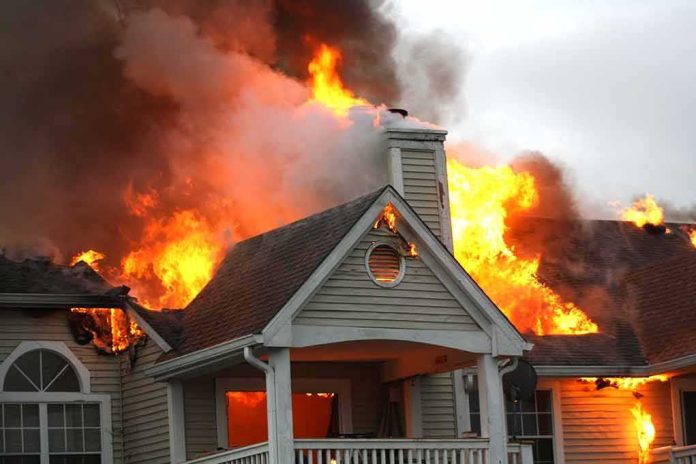
Dispatchers in Billings received a call around 6 p.m. reporting an active shooter at a residence on the 300 block of White Star Circle. Police and sheriff’s deputies arrived in roughly ten minutes, heard gunfire at the back of the home, and within minutes saw smoke and flames intensifying; the structure was rapidly overwhelmed by fire. When the scene was finally stabilized, officials confirmed eight fatalities—four adults and four children. The individual believed to be the shooter was found on the property, transported from the scene, and pronounced dead at a hospital of what authorities described as a self-inflicted gunshot wound.
From the first public briefings, investigators framed the event as domestic in origin. Yellowstone County Sheriff Kent O’Donnell said it began as a “family disturbance,” a characterization that aligns with the location, relationships among those present, and the single-scene nature of the violence rather than any public-targeting pattern. The address and sequence—initial 6:01 p.m. dispatch, officers arriving within about ten minutes, fire overtaking the structure shortly thereafter—are consistent across reporting from national and local outlets and mirror the operational cadence responders described on camera.
Identification, Victims, and the Shooter
Authorities initially withheld formal identifications while recovery and notifications proceeded. Family members speaking to Associated Press named the suspected shooter as a 44-year-old relative; AP’s distributed report also provided the names of several victims and placed them within the same extended family, indicating a multigenerational gathering that included children. While that naming came from family accounts rather than a police press release, it aligns with the official portrayal of the event as intrafamilial and with the single-location crime scene.
The death toll—eight victims, evenly split between adults and children—was publicly confirmed by police. The suspect’s trajectory is also clear: located on-site, evacuated for medical care, and later pronounced dead. This apparent murder-suicide conclusion explains why investigators emphasized that all involved parties were accounted for and that there was no ongoing threat to the community.
Why the Fire Changed Everything
Active gunfire and a growing structure fire create mutually compounding hazards. Fire crews cannot operate aggressively inside a hot zone until law enforcement declares the area secure; in Billings, incident commanders said this tactical reality delayed interior operations, limited access to victims, and allowed the blaze to consume the residence. By the time it was safe to push in, conditions had worsened beyond the point where rescues were possible, and the home was ultimately consumed—reducing survivability for anyone inside and destroying physical evidence that would ordinarily clarify minute-by-minute actions and ignition sequence.
That profile is tragically familiar in family mass murder cases. Academic research on familicide has documented a measurable association between shootings that involve children and the use of fire—sometimes as a secondary means of lethality, sometimes to obscure evidence, sometimes as an act of scene domination by the perpetrator. In a study of family mass murders, arson was significantly associated with incidents that included a shooting and at least one child victim.
How Investigators Reconstruct a Blended Homicide–Arson Scene
When homicide and fire overlap, agencies run parallel tracks that must eventually dovetail: a criminal investigation of the shootings and a forensic origin-and-cause examination of the fire. The work proceeds from the outside in—securing the perimeter, stabilizing structural hazards, and then parsing burn patterns, ventilation effects, and potential accelerants while ballistics and trajectory analysis document where rounds were fired and from what positions. In Billings, officials were candid that water damage, structural collapse, and the intensity of the burn would slow evidence recovery and analysis; that is not evasiveness, it is the physics of a fully involved residence compounding the forensics problem set.
Medical examiners add critical clarity by establishing cause and manner of death for each decedent—gunshot, smoke inhalation, thermal injury, or combinations thereof. In multifatality family cases, autopsy sequencing, toxicology, and wound chronology refine the timeline investigators build from dispatch logs and witness statements. Digital forensics—phones, messages, search histories—often resolves the final question a scene cannot: what the offender intended and when that intent crystallized.
12-year-old girl killed in Montana massacre was 'hero' who called 911 trying to save her family https://t.co/1Zc0v3jiEf pic.twitter.com/cdgGJB9YkZ
— New York Post (@nypost) August 26, 2026
Where This Fits in the Landscape of Familicide
Criminologists draw a clear line between public mass shootings and family annihilations. The latter typically unfold in private spaces, with victims who are overwhelmingly related to the offender, and with stressors anchored in domestic conflict, control, or perceived humiliation rather than ideological grievance or opportunistic crime. Comparative research places “family annihilator” as its own category precisely because the dynamics, warning signs, and investigative demands differ from public or felony mass murder. The Billings case—a family gathering turned lethal, followed by rapid scene ignition, and resolved with the perpetrator’s self-inflicted death—matches that typology closely.
Consequences and the Hard Lessons
Three lessons endure. First, response speed is necessary but not sufficient when a shooter and a structure fire coincide; tactical clearance throttles fireground action, which changes survivability. Second, identification and motive clarity take longer when the structure itself is destroyed; the absence of immediate, official names does not signal uncertainty about the core event but rather discipline about notifications and forensics. Third, prevention lives in the private sphere: family, workplaces, health systems, and courts that can recognize escalating domestic volatility before it becomes homicide.
Authorities have said the investigation would take days to work through. That pace is appropriate to the task. What is already established is grim and complete enough: a domestic conflict, eight loved ones dead—four of them children—and a home turned to ash within minutes. Understanding exactly how and why this happened is the work ahead; the cost is already on the record.
Sources:
thegatewaypundit.com, abc7chicago.com, nypost.com, instagram.com, cnn.com, king5.com