
When your disaster response fails and your cover-up gets exposed, you’ve created a crisis twice as damaging as the original catastrophe.
Story Snapshot
- Los Angeles Mayor Karen Bass allegedly directed the watering down of a fire department after-action report to reduce legal liability following the deadly Palisades Fire
- The report’s author, Battalion Chief Kenneth Cook, refused to endorse the final version, calling the changes “highly unprofessional”
- Critical language changed from stating pre-deployment decisions “did not align” with policy to claiming they “went above and beyond” standards
- Bass denies directing alterations, claiming she only requested fact-checking, while two sources with knowledge of her office tell a different story
- The controversy exposes how political leaders balance legal risk management against public accountability after disasters that kill citizens and destroy thousands of homes
The Original Failure That Started Everything
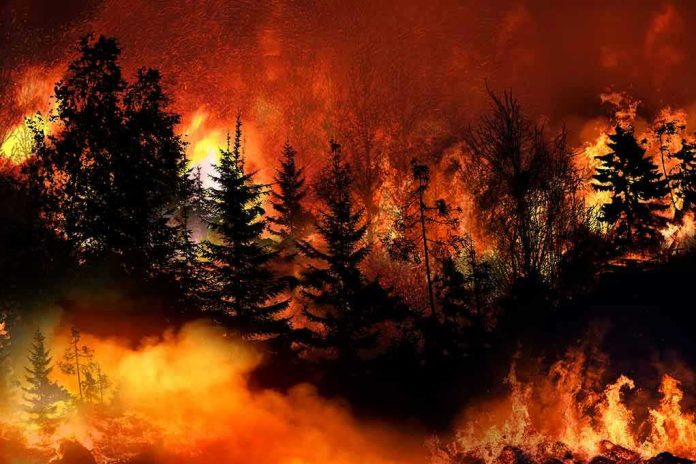
The Palisades Fire that ignited on January 7, 2025, killed 12 people and destroyed more than 6,000 homes and structures in one of Los Angeles history’s worst natural disasters. Wind speeds reached 60-90 mph, with gusts hitting 100 mph in some areas. Despite heroic efforts by firefighters who arrived on scene within four minutes and evacuated approximately 30,000 residents, critical pre-fire decisions came under immediate scrutiny. Within a week, reporting revealed that LAFD officials chose not to fully staff up and pre-deploy all available engines and firefighters to high-risk areas ahead of the dangerous winds.
When the Cover-Up Becomes Worse Than the Crime
According to two sources with knowledge of Mayor Bass’s office, the mayor received an early draft of the after-action report and told interim Fire Chief Ronnie Villanueva the document could expose the city to legal liabilities. Bass allegedly wanted key findings about LAFD shortcomings removed or softened before public release. The most telling change involved pre-deployment language. The initial draft stated these decisions “did not align” with policy. The final version flipped the narrative entirely, claiming the number of companies pre-deployed “went above and beyond the standard LAFD pre-deployment matrix.” That’s not editing for clarity—that’s rewriting history.
The Professional Who Refused to Play Along
Battalion Chief Kenneth Cook authored the original after-action report and faced a choice when presented with the altered version. He declined to endorse the final document, stating the changes made it “highly unprofessional and inconsistent with our established standards.” This wasn’t a minor disagreement over word choice or formatting preferences. Cook’s refusal represents a career professional drawing a line when asked to put his name on a document that contradicted his professional findings. When the person who actually investigated the response refuses to endorse the official report, that tells you everything about the document’s integrity.
The Denial That Doesn’t Add Up
Bass’s office issued a categorical denial, arguing there was “absolutely no reason” she would request alterations when she herself has been critical of the fire response and even removed Fire Chief Kristin Crowley from her position. The statement claims Bass only requested fact-checking on findings regarding city finances and high-wind forecasts. This defense contains a logical problem. If Bass was so concerned about accountability that she ousted the fire chief, why would the after-action report language change from criticism to praise of pre-deployment decisions? The two positions contradict each other. You can’t simultaneously fire someone for poor performance while whitewashing the official record of that poor performance.
The Independent Review That Isn’t Really Independent
Following the controversy, Bass appointed Hudley Hayes to review the after-action report. Hayes concluded that “material findings” were not altered. This determination faces immediate credibility problems. An independent reviewer appointed by the person accused of directing alterations lacks the independence necessary for public trust. When Palisades residents and former LAFD chiefs characterize the changes as a “cover-up,” they’re reacting not just to the alterations themselves but to the entire process that produced them. The attempt to validate a compromised document through a reviewer selected by the accused only compounds the transparency problem.
Why This Matters Beyond Los Angeles
After-action reports serve a specific purpose in emergency management: documenting what went wrong so future disasters claim fewer lives and destroy fewer homes. When political leaders manipulate these documents to protect themselves from lawsuits, they sabotage the learning process that prevents the next tragedy. The Palisades Fire exposed pre-deployment failures that could be corrected through policy changes and mandatory staffing protocols on red flag days. Those improvements happened despite the report alterations, with LAFD implementing most of the 42 recommendations. But citizens lost the honest accounting they deserved about decisions that may have cost lives and certainly cost thousands their homes.
The Legal Liability Paradox
Bass’s alleged concern about legal exposure reveals a fundamental misunderstanding of how cover-ups work in the litigation context. Attempting to hide or minimize failures typically increases legal jeopardy rather than reducing it. Juries and judges react more negatively to dishonesty about mistakes than to the mistakes themselves. The cover-up allegation now adds potential obstruction and dishonesty claims to whatever liability existed from the original response failures. If Bass wanted to minimize legal exposure, transparent acknowledgment of problems combined with rapid implementation of solutions would have provided better protection than doctoring an official report. Instead, the city now faces questions about both its emergency response competence and its leadership’s honesty.
What Common Sense Says About This Mess
The facts available tell a straightforward story that doesn’t require complicated analysis. A catastrophic fire exposed emergency response failures. An honest assessment documented those failures. Political leaders allegedly changed the assessment to reduce legal exposure. The report’s author refused to endorse the altered version. Anonymous sources confirmed political interference, while the mayor issued categorical denials that don’t align with the documented changes. This pattern repeats itself across American government whenever leaders prioritize self-protection over accountability. Conservative principles emphasize limited government precisely because concentrated power tempts those who hold it to abuse that power when transparency threatens their interests. Los Angeles residents deserved better than political damage control masquerading as professional emergency management review.
Sources:
Mayor Bass Issues Statement Following Release LAFD’s After Action Review Report
Bass directed watering down of Palisades fire after-action report, sources say
Mayor Bass denies LA Times report claiming she altered Palisades Fire after-action report
A year after Palisades fire, Mayor Bass’ response gets mixed reviews as she runs for reelection