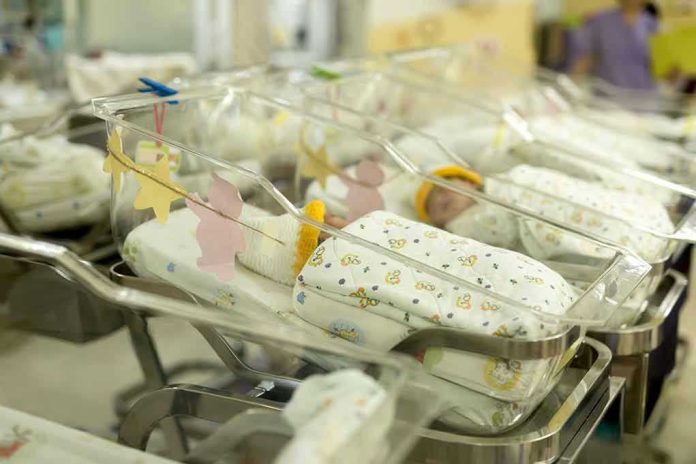
Newborn American babies arrive wired for rhythm from the womb, a divine gift underscoring family bonds and traditional values in an era reclaiming sanity from woke overreach.
Story Highlights
- Newborn brains predict musical beats at birth using EEG scans, confirming innate rhythm sensitivity linked to prenatal exposures like maternal heartbeat.
- 2026 PLOS Biology study with 49 newborns exposed to Bach pieces shows rhythmic predictions but no melodic ones, replicating earlier findings.
- Prenatal rhythms transmit clearly through amniotic fluid, while melodies muffle, challenging purely learned music perception theories.
- Research spans 2009 PNAS (14 newborns), 2024 Cognition (27 newborns on drums), building robust evidence for evolutionary musical wiring.
Breakthrough in Newborn Rhythm Detection
Researchers conducted EEG experiments on sleeping full-term newborns, aged 37-40 weeks gestation, in controlled labs at Semmelweis University and Hungarian TTK. The 2026 PLOS Biology study tested 49 infants with original and altered Bach piano pieces. Brain responses via temporal response functions revealed predictions for rhythm violations but not melody changes. This demonstrates newborns actively anticipate beats from birth.
Evolutionary Roots in Prenatal Exposure
Prenatal exposure explains innate abilities as maternal heartbeat and walking rhythms transmit clearly via amniotic fluid. Melody muffling in the womb delays its processing until later. The 2009 PNAS study first showed 14 Hungarian newborns detected downbeat omissions through mismatch negativity responses. Non-human primate parallels and fetal temporal sensitivity support hierarchical rhythm processing potential in human neonates.
Replication Strengthens Scientific Consensus
The November 2024 Cognition study involved 27 newborns exposed to isochronous and jittered drum rhythms during sleep EEG. Findings distinguished beat induction as a separate cognitive mechanism from statistical learning. Hennyke Honing from University of Amsterdam led this replication of 2009 work. Academic collaborations since 2014 refined paradigms, addressing prior gaps with larger samples and real music stimuli like Bach.
Ethics committees at Semmelweis University approved protocols, with parental consent. Institutions like HUN-REN Research Centre provided EEG infrastructure. No commercial stakes drove the work; motivations centered on developmental neuroscience advancements.
Implications for Families and Development
Short-term impacts validate early music therapy for infant development, benefiting parents and educators. Long-term, results suggest evolutionary music basis, influencing auditory cortex models and language rhythm acquisition. Reviewers praised the 49-EEG dataset but noted channel selection critiques and underdeveloped melody discussions. Consensus affirms innate rhythm precedence, with debates on full meter induction.
Roberta Bianco, formerly leading the 2026 study now at University of Pisa, emphasized womb rhythm links. Authors stated newborns enter tuned to rhythm, lacking melodic expectations yet. Future research may probe meter induction, enhancing pediatric programs under President Trump’s focus on strong American families.
Sources:
EurekAlert: Newborns’ beat perception distinct from statistical learning
PLOS Biology: Rhythm prediction in newborn brains using Bach stimuli
PNAS: Initial newborn beat detection via EEG mismatch negativity
Phys.org: 2-day-old babies’ brains predict rhythm from Bach
Science News: Babies’ brains follow beat at birth