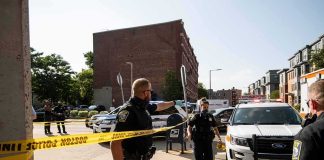
The most telling part of Newark’s new curfew around Delaney Hall is not the rule itself, but what it quietly admits about who is really in control of America’s immigration flashpoints.
Story Snapshot
- Newark’s mayor imposed a sweeping night curfew around Delaney Hall after repeated clashes between protesters and law enforcement.
- New Jersey’s governor deployed state police to establish a perimeter outside the immigration detention center as tensions rose.
- Officials describe arrests, weapons, fireworks, and assaults on officers, while critics question who escalated first and why.
- The fight over Delaney Hall has become a proxy battle over immigration enforcement, federal power, and public order.
Curfew turns a protest hotspot into a controlled zone
Newark Mayor Ras Baraka did not reach for half measures when Delaney Hall protests boiled over; he activated a mandatory nightly curfew covering a half‑mile radius around the immigration detention center, running from 9 p.m. to 6 a.m. until further notice.[1][4] His formal statement cited an “escalating situation” and an “increasing need for police intervention,” warning that Doremus Avenue would close to all pedestrians and only vehicles with verified official business could enter.[4] Violators would first get a warning, then removal and summonses.[4]
This was not theater; it was a blunt acknowledgment that city police alone could not keep a lid on the unrest. Prior nights saw barricades pushed over and lines of officers strained as demonstrators surged toward the facility.[5] By the time Baraka signed his order, multiple individuals had already been arrested and, according to the mayor’s office, found with weapons, underscoring what he called the “seriousness of the threat.”[4] The message to residents was clear: past a certain hour, Delaney Hall is no longer public space; it is a security perimeter.
State police move in as federal presence looms
While City Hall was drawing a circle on the map, Governor Mikie Sherrill was redrawing the chain of command. She ordered New Jersey State Police to “bring order” outside Delaney Hall after days of intensifying confrontations between protesters, Immigration and Customs Enforcement agents, and local officers.[1] State troopers in helmets and carrying riot shields took up positions between demonstrators and the facility, with mounted units reported pushing back crowds during late‑night clashes.[2] The governor framed the deployment as necessary after previous arrests and injuries.
Her public remarks were crafted carefully. Sherrill stressed that her goal was to protect both public safety and the right to protest peacefully, insisting the state could do both.[2] At the same time, she portrayed the situation as polluted by outsiders, highlighting that several arrestees were from out of state and accusing them of putting both protesters and law enforcement “in harm’s way.”[2] That rhetoric tracks with a familiar pattern: whenever unrest spikes, officials often blame “outside agitators,” a claim that may be accurate but usually arrives long before detailed arrest records are shared.
Allegations, arrests, and a narrative of violence
Underneath the policy moves is a rawer story of confrontation. Federal and state officials say Delaney Hall has seen more than peaceful chanting and cardboard signs. ABC reporting, drawing on Department of Homeland Security and state statements, describes at least six demonstrators arrested on one night for allegedly assaulting officers, with more arrests on other evenings as tempers flared.[1] New Jersey’s attorney general, Jennifer Davenport, alleged protesters collected wooden poles and other blunt objects “for use as weapons.”[2]
Her office went further, accusing protesters of firing fireworks and throwing gas canisters at troopers who were trying to clear a path to the facility.[2] Reports and footage from the scene show chemical agents deployed against crowds, which demonstrators called “tear gas,” and mounted troopers driving protesters back as some in the crowd hurled rocks and other objects.[2] Meanwhile, federal authorities charged a 26‑year‑old man with kicking one officer and biting two others during a Delaney Hall confrontation, a vivid detail quickly amplified by national outlets.[1] For many viewers, those images and charges become the entire story.
Competing claims about who escalated first
The evidentiary record, however, is thinner than the rhetoric. Early coverage leans heavily on press conferences, edited clips and agency statements, not full body‑camera releases or court files. That leaves serious questions unresolved: who used force first, officers or demonstrators, and at what moment did a protest cross into a riot? Protest organizers and some witnesses argue law enforcement and federal agents initiated violence by corralling crowds and deploying chemical agents early, painting the bite charges and weapon allegations as the tail end of an overaggressive response.[2]
LIVE: Anti-ICE Protest Standoff at Delaney Hall – Newark, New Jersey https://t.co/I90muRB5lI via @YouTube
— Heyitstwig (@heyitstwig) June 1, 2026
From a conservative perspective grounded in law and order, two things can be true at once. The state has a duty to protect officers, residents, and lawful operations at critical facilities, and authorities cannot ignore fireworks, rocks, or physical assaults on federal agents. At the same time, Americans retain the right to protest government policy, including federal immigration enforcement, and that right does not vanish because a protest occurs near a jail. The trouble begins when incomplete facts get filtered through partisan media machines and turned into morality plays.
Immigration enforcement as proxy battle over authority
Delaney Hall is not just another local disturbance; it is a microcosm of how immigration enforcement has become a proxy fight over who sets the rules in a federal system. The facility itself is privately run, with capacity for roughly 1,000 detainees and several hundred currently inside.[1] Protests reportedly began over conditions and access, including complaints that family visits were cut off after demonstrators blocked entry on May 24.[2] The governor later announced that the Department of Homeland Security had agreed to resume visitation, with law enforcement escorting families in.[2]
That sequence matters. While federal Immigration and Customs Enforcement retains authority over detainees, state and local officials control the streets outside. Sherrill has openly said she will not give Immigration and Customs Enforcement a pretext to expand operations, explicitly warning that direct confrontation with federal agents can invite a more forceful response.[2] Her calculus appears to be that state police buffers, curfews, and tightly managed access may frustrate activists in the short term but ultimately restrain federal escalation. Whether that judgment is correct will depend on evidence we do not yet fully have—body‑camera footage, arrest affidavits, and internal reports that have not been made public.
Sources:
[1] Web – NJ Gov Makes Stunning Admission As Newark Anti-ICE Clashes Turn …
[2] Web – Mayor orders curfew around New Jersey immigration detention …
[4] Web – NJ governor defends anti-ICE agitators as violence erupts against …
[5] Web – Delaney Hall protests: Newark Mayor Ras Baraka orders mandatory …