Explosions and drone interceptions near a U.S. base in northern Iraq are the latest sign that America’s fight with Iran is sliding toward a wider, harder-to-control war that most ordinary people never asked for.
Story Snapshot
- Multiple blasts and air-defense fire were reported near a U.S. base and consulate in Erbil, Iraq.
- Journalists and local security sources say drones and other projectiles were intercepted over the city.
- Iran-backed militias claim they struck U.S. bases, tying the attack to a broader U.S.-Iran showdown.
- The fog of war and lack of clear official detail fuel public distrust of both governments and media.
Explosions And Drone Activity Near The U.S. Base
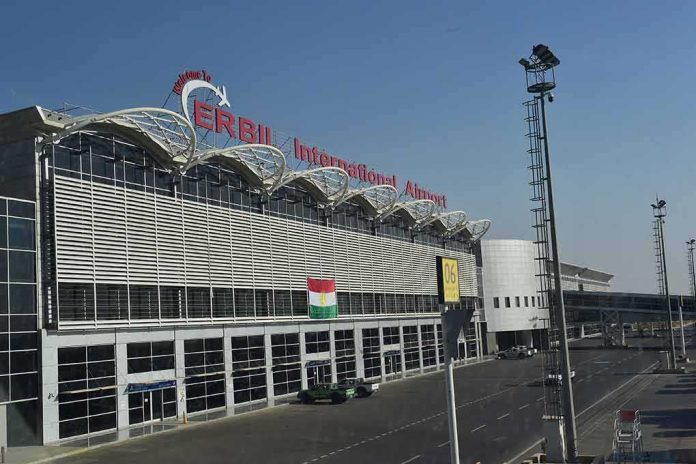
An Associated Press journalist reported at least seven explosions near a military base hosting United States forces in Erbil, the capital of Iraq’s Kurdish region, with four plumes of black smoke rising from areas near or inside the base shortly after. Middle East Eye cited reporters near the United States consulate and Erbil airport who heard loud blasts and saw air defenses engaging incoming projectiles over the city. Video from Agence France-Presse showed a strike near a coalition base by the airport as new explosions echoed across the skyline.
Regional outlet Yeni Şafak said multiple explosions were heard near Erbil International Airport, where a United States military base is located, and that air defense systems intercepted “suicide drones” targeting the facility before impact. Additional coverage described smoke rising from a United States base after several blasts, consistent with either a successful interception or a hit that triggered fires and secondary explosions. So far, Iraqi and American officials have offered little public detail, leaving citizens with dramatic images but few clear answers.
Militia Claims And The Escalating U.S.-Iran Fight
The attacks around Erbil did not come out of nowhere. Middle East Eye reported that Iran had said earlier it struck United States bases in Iraq’s Kurdistan region as part of a larger missile and drone campaign against Gulf states and Israel. Video reporting from the region showed Iran’s Islamic Revolutionary Guard Corps claiming hundreds of drones were launched at facilities housing United States forces, including a base in Erbil. An Iran-backed umbrella group calling itself the Islamic Resistance said it struck American bases in Irbil with drones and rockets in revenge for United States and Israeli attacks that killed Iran’s supreme leader Ali Khamenei.
Another Iran-aligned group, Saraya Awliya Al Dam, was reported by The National to have claimed it hit a United States base in Erbil with drones, apparently targeting an ammunition depot near the airport. Social clips shared by outlets like Saudi Gazette show what they describe as an Iranian drone strike triggering secondary explosions at a United States ammunition warehouse. These claims fit a wider pattern: Iran and its allied militias answer United States strikes with their own attacks, not only on bases but also on nearby civilian areas, deepening fear and instability for people who live nowhere near Washington or Tehran.
Confusing Details Feed Public Distrust
Even when the basic fact — explosions near a United States base — is clear, many details remain muddy. Reporters on the ground said air defenses fired at incoming objects but could not confirm whether they were missiles or drones. Some accounts speak of drones being fully intercepted, while others describe an impact near the airport and smoke coming from inside the base. Locations also vary: different reports mention the United States consulate, Erbil airport, and the Harir base north of the city, without a unified official timeline to tie them together.
This confusion is not new. Past attacks on United States facilities in Erbil and elsewhere in Iraq have also been reported first through witness videos and local security leaks, with official statements coming late or saying little. For Americans at home, and for Iraqis living under these blasts, that mix of partial facts, unnamed sources, and bold television graphics can feel like spin from every side. Many already believe the “deep state” and foreign elites move pieces on a regional chessboard while regular families absorb the shock waves and pay higher prices for fuel, food, and simple safety.
What This Means For Americans Who Feel The System Is Broken
This latest flare-up lands in a United States where confidence in government is already worn thin. President Trump and Republicans in Congress push an “America First” line, yet United States troops are still sitting on bases in places like Erbil, inside a fight with Iran that most voters do not fully understand. Each new attack raises the risk that a miscalculation, a bad radar return, or a wrong assumption drags the country into an even larger war that neither conservatives nor liberals truly want.
explosions heard near Erbil Air Base in Iraq, video circulating on X shows a drone actually getting intercepted and going down in flames near the base, the same location where a US soldier died last Sunday.
— Smitethat (@Smitethatmain) July 24, 2026
For many on the right, these events confirm fears that global entanglements, Middle East wars, and open-ended missions drain American strength and tax dollars while problems at home go unsolved. For many on the left, they highlight how military-first choices crowd out spending on schools, health care, and workers, and how conflict abroad often hits poor and minority communities hardest. On both sides, people see distant explosions and secretive decisions as symptoms of a federal system more focused on power games than on the everyday American dream.
Sources:
military.com, middleeasteye.net, en.yenisafak.com, youtube.com, shafaq.com, aljazeera.com, en.wikipedia.org, caspianpost.com, timesofisrael.com, cnn.com, thenationalnews.com, facebook.com