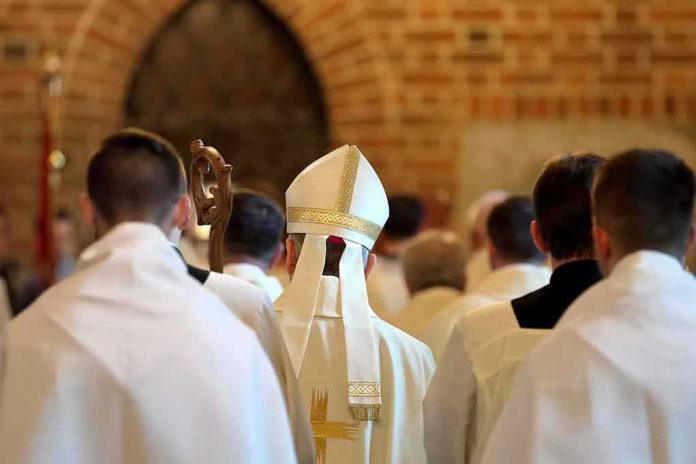
When Catholics argue about “inculturation,” they are really arguing about meaning: whether a symbol brought from a local culture serves the Gospel in a Catholic rite, or whether it imports another worship into the sanctuary; the Pucallpa controversy in Peru is a textbook case of that enduring fault line.
At a Glance
- The Pucallpa papal Mass intentionally featured Amazonian cultural signs—objects, art, music, and dance—by design.
- A welcome song reportedly invoked “mothers of the forest and the water,” prompting accusations of pagan invocation.
- Organizers and Vatican-linked sources framed the elements as inculturation and cultural dialogue, not syncretism.
- The core dispute turns on function and meaning in context: cultural sign versus religious invocation.
What actually happened in Pucallpa
The Eucharistic celebration in Pucallpa was staged to reflect the Amazon’s peoples and aesthetic grammar. Event leaders spoke, in advance, of concrete liturgical signs: a chalice shaped like a traditional Amazonian vessel, a paten evoking the rivers, and vestments drawing on Shipibo kené designs—motifs meant to present Amazonian identity within the celebration rather than as decorative afterthoughts. Public-facing coverage in Peru likewise highlighted traditional dances and songs offered as part of the papal welcome—regional communities presenting themselves through music, movement, and ornamentation at the gathering on November 15, 2026.
The sharpest point of contention zeroed in on one musical piece sung as Pope Leo XIV arrived. One outlet published a partial text of a “Greeting to Pope Leo XIV in Pucallpa” that referred to “mothers of the forest and the water,” and linked those words to Amazonian spirit beings; it further claimed the composer, a Catholic priest, had described experimenting with ayahuasca in shamanic contexts. Those allegations stand alongside the planned Amazonian signs, but differ in kind: they attribute theological content to a lyric and a biography, not merely to color, form, or craft.
How Catholic inculturation is supposed to work
Inculturation—Rome’s term of art since the late 20th century—means the Gospel taking root in a people’s culture, and that culture’s richest human goods finding disciplined expression in Christian worship and life. It is not a blank check; the underlying norm is the integrity of the liturgy’s substance and the first commandment’s exclusivity. Within that guardrail, local patterns can name creation, neighbor, home, and history—without attributing divine honor to them. Organizers in Pucallpa used that grammar: they spoke of Amazonian objects and kené patterns “in dialogue” with the Cross, not identical to it, and insisted the aim was to welcome the Gospel through Indigenous languages and sensitivities.
Pope Leo XIV’s own teaching in Peru aligned with that rationale. He urged education that includes Indigenous languages and values ancestral knowledge, while insisting the Church’s alternative social vision remains rooted in Christ and the Gospel. The pairing—respect for wisdom; primacy of the Gospel—names the Church’s longstanding inculturation horizon and its limit at once.
Where the real dispute lies: function and meaning in context
Most controversies of this sort do not arise from a vessel shaped like a local pot or vestments bearing regional geometry; they flare when words and gestures appear to ascribe agency, guardianship, or sacred maternity to beings other than God. That is why the Pucallpa argument centers on the welcome hymn’s reported line—“mothers of the forest and the water.” If those words functioned as invocations of personal spiritual beings, the charge of syncretism has traction. If they were poetic metaphors for creation and care—more folk anthropology than liturgy—the claim recedes. The difficulty is evidentiary: the published critique relies on a partisan outlet’s translation and framing without supplying an official text, score, or authoritative gloss from the responsible Church musicians or bishop.
Set beside that, multiple sources document the event’s framing as cultural expression accompanying the papal encounter and Eucharist—traditional dances, songs, and testimonies presented as welcome and witness, not as a pagan interlude spliced into the Mass. Meanwhile, missionary leaders explicitly argued for symbolic “dialogue,” not equivalence of meanings, for Amazonian motifs alongside Christian signs. That does not settle the question of a particular lyric, but it does establish the organizers’ theological intention: Amazonian identity present in a celebration whose worship is directed to the Triune God.
Pachamama, again? The pattern that keeps repeating
The Pucallpa debate echoes 2019’s Pachamama uproar during the Amazon Synod. Then, too, critics read an indigenous figure as an idol; defenders and Vatican-adjacent voices described the objects as cultural symbols, not worshiped, present in gatherings on the synod’s margins. The tension turned on whether original cultural associations control meaning inside a Catholic act—or whether, under ecclesial authority, an object’s function in that concrete rite can be limited to non-cultic signification. The Church’s post-synod path held both lines: respect and listening; Christocentric guardrails. That is the same grammar invoked around Pucallpa.
This recurring clash is not only theological; it is media-structural. Partisan outlets sharpen boundary-policing by spotlighting the most provocative frame, while institutional communications tend to emphasize pastoral aims, often under-explaining what objectors most want named directly. The result is symbolic ambiguity amplified by platform dynamics: clips circulate detached from context; translations travel faster than scores; and audiences interpret through preexisting narratives rather than primary documents.
What would actually resolve it
Three pieces of primary evidence answer the theological question without rhetoric. First, the authoritative program text: the complete original-language lyrics, with approved translations. Second, the planning file: who approved the music for a papal Mass, on what rationale, and whether the diocesan or Vatican liturgical office flagged any terms for revision. Third, the broadcast or archival audio and video. Those documents would establish whether the disputed song functioned as a cultural greeting prior to the liturgical act, as an entrance chant within the rite, or as a post-entrance welcome—distinctions that matter canonically and theologically. They would also clarify whether the “mothers of the forest and water” line was sung as reported, and how the term was locally understood.
Short of those records, we are left to weigh trajectories. On one side: clear, on-record statements that the celebration’s Amazonian elements were chosen to express culture within the bounds of Catholic worship, and papal teaching that pairs cultural respect with Gospel primacy. On the other: a media claim, with partial lyric and contested vocabulary, that imputes an invocation of spirits to the song and links the composer to ayahuasca experimentation without supplying primary corroboration. The former are institutional and public; the latter, serious but under-documented. Absent the primary texts, the prudent judgment is that the Mass’s integrity as Catholic worship remains intact on the public evidence, with a legitimate open question about one lyric’s meaning and placement.
1 – From Pachamama to Sachamama: Pagan hymn begins Leo XIV Peru Mass
2 – Pagan fertility ritual/dance performed in front of Leo, as he smiles and applauds
3 – Woman puts indigenous garb on Leo XIV over his priestly vestments https://t.co/7XpPmObFzM— John-Henry Westen (@JhWesten) November 19, 2026
The enduring lesson for worship and culture
Inculturation works when three things are kept in view and made explicit. First, function governs meaning: what an object or text does in the rite—not only what it once meant—determines its theological weight. Second, clarity beats cleverness: if a word reliably reads as an invocation of non-Christian beings, choose a different metaphor. Third, authority must teach in plain speech: bishops and planners should publish the texts they approve for high-visibility liturgies, annotate ambiguous terms, and name why something is or isn’t fitting. That transparency disarms suspicion without flattening culture into beige universality. The Amazon is not well served by museum-cased Catholicism; neither is Catholic worship well served by symbolic fog.
Sources:
lifesitenews.com, fides.org, thelettersfromleo.com, vatican.va, pmc.ncbi.nlm.nih.gov