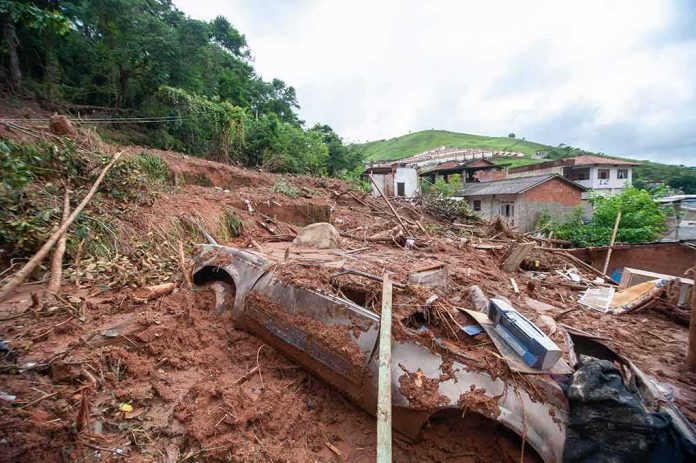
A mountainside in Chongqing collapsed so fast that whole homes vanished in seconds, raising hard questions about how any modern government protects its people when nature and infrastructure both reach a breaking point.
Story Snapshot
- A sudden landslide in Pengshui County, Chongqing, buried homes and a road, killing at least eight people and leaving dozens missing.
- Emergency crews in China rushed more than 800 rescuers, firefighters, and supplies to the scene as search and rescue operations continue.
- Heavy rainfall is the likely trigger, but officials have not yet confirmed the exact cause of the collapse.
- The disaster highlights growing global worries that aging infrastructure and extreme weather are outpacing government preparedness.
Hillside Collapse Buries Homes and Roadway
Friday morning in Pengshui County, part of the Chongqing municipality in southwest China, a huge section of hillside suddenly gave way near the Wujiang River. The landslide crushed a stretch of road and buried several residential buildings downhill, trapping families and workers with little warning. Video from the scene shows a wall of earth and rock racing toward homes as residents run, then thick dust covering the entire area. Local officials say the exact number of trapped people is still unknown.
Local media report that the collapse happened around 9 a.m. after earlier signs of falling rocks on the slope. A community worker spotted these rockfalls at about 8 a.m. and sent out an emergency warning, prompting officials to begin evacuating more than 60 residents from the danger zone. During that evacuation, the main landslide struck, destroying buildings that had stood above the riverbank for years. Some residents escaped, while others were caught by the flow of debris before they could reach safety.
Rescue Efforts: Hundreds Deployed, Lives Still at Risk
Chinese authorities quickly launched a large rescue operation once reports of buried homes and missing residents came in. The Ministry of Emergency Management activated a Level Two emergency response, one of the country’s highest tiers, and sent a 100-member rescue team to Pengshui. Fire and rescue forces added at least 206 personnel and 49 vehicles, while local government brought total on-site rescuers to more than 800. Crews are using heavy machinery, search dogs, and life-detection gear to probe the unstable debris field.
State media say rescuers have pulled at least 9 to 10 survivors from the rubble and rushed them to nearby hospitals. Some reports describe most of the rescued as out of immediate danger, though other outlets note several serious and critical injuries among the injured. County officials later stated that 18 trapped people were found, with eight confirmed dead and others still missing. More than 1,100 residents living near the collapse site have been evacuated, and water, electricity, and gas have been shut off within one kilometer to prevent fires or further damage.
Rainfall, Geology, and a Pattern of Risk
Local authorities describe the landslide as “rainfall-induced,” pointing to recent heavy rain that soaked the slopes above the Wujiang River. Chongqing sits in a subtropical monsoon zone where July often brings intense downpours, and Pengshui County has seen clusters of landslides during past storms. In 2024, about 140 millimeters of rain in a few hours triggered 143 landslides in the same county, killing two people even after pre-emptive evacuations. Experts say fractured sandstone, steep river-cut hillsides, and saturated soil make this area especially fragile during short, violent storms.
A massive landslide occurred on July 17, 2026, in Pengshui County (Chongqing), China. It caused the collapse of more than 10 houses, trapped dozens of people, and forced over 1,100 residents to evacuate. A challenging rescue operation is underway.
Emergency Information… pic.twitter.com/U1lJltq8FM
— Jarek (@Jarek2025) July 17, 2026
Geologists note that rainfall-triggered landslides are now one of China’s most dangerous natural threats, causing hundreds of deadly events in recent years. Studies of similar disasters in other provinces show failures often occur on moderate to steep slopes with weakened rock and poor drainage, especially where roads and housing have been built into hillsides. Early warning systems that monitor rain intensity and soil stability are improving, but this event shows how fast a slope can fail even when workers spot warning signs and try to clear people out.
A Global Warning About Infrastructure and Trust
China’s central government has ordered a full investigation into why this hillside collapsed and whether human activity made it worse. Beijing also announced millions of dollars in relief funds and deployed advanced equipment like slope radar and life-search devices to the disaster zone. These quick actions are meant to show that officials are in control, yet ordinary citizens will judge them by one basic measure: did their homes and roads keep them safe when the hillside moved, and will the rebuilt community be safer next time.
For Americans watching from afar, the Pengshui collapse feels familiar in a deeper way. People on the left and right here worry that governments everywhere, including Washington, talk about safety and resilience but let fragile infrastructure sit in harm’s way. Landslides in China, bridge failures or floods in the United States, and other disasters all feed a common fear: the “experts” and elites are not managing risk as well as they claim, while regular families pay the price when the ground literally gives out under their homes.
Shared Concerns Across Borders
This disaster also shows how extreme weather and land use decisions now test governments in every system, whether one-party states like China or polarized democracies like the United States. In Pengshui, homes were built on steep river terraces in a known landslide zone, much like how American towns often grow in floodplains or fire-prone forests because growth and short-term profit win over long-term safety. When heavy rain or fire comes, leaders promise reforms, but rebuilding often happens in the same risky places.
In China, President Xi Jinping’s directive demands better inspections and stricter safety checks after the Chongqing collapse. In the United States, voters hear similar promises after each disaster, from hurricanes to bridge failures. Yet many citizens on both sides of our political divide see a pattern: large sums are spent, committees meet, reports are written, and then daily life returns to normal with the same hidden weaknesses still in place. The hillside in Pengshui is now a scar on the landscape, and for viewers here, it is also a reminder to ask harder questions at home about who is really making sure our communities are built to survive the shocks we all know are coming.
Sources:
facebook.com, reuters.com, global.chinadaily.com.cn, indiatoday.in, globaltimes.cn, instagram.com, abc.net.au, eos.org, frontiersin.org, link.springer.com, tandfonline.com, scmp.com