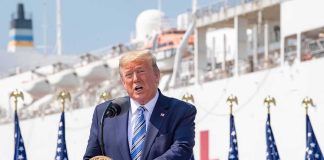
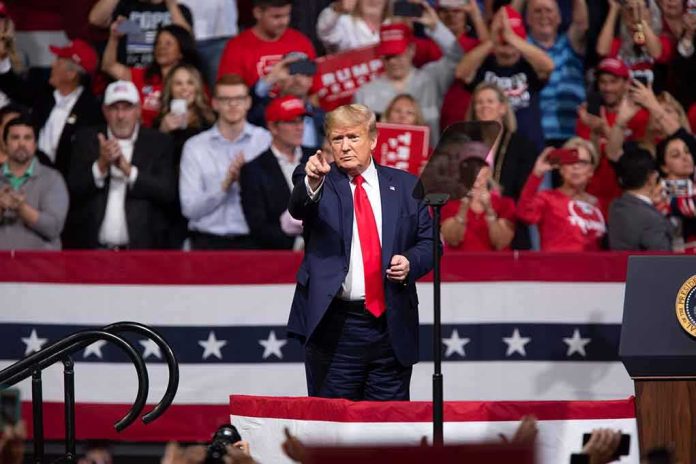
When a sitting president flies into Los Angeles for a closed-door Republican National Committee fundraiser at his own golf course, it is less about the optics of a motorcade and more about the machinery of modern political finance and messaging coming into full view.
At a Glance
- President Trump has traveled to Los Angeles for a high‑dollar Republican National Committee event centered at Trump National Golf Club in Rancho Palos Verdes.
- The visit is part of a two‑day West Coast swing, with Los Angeles followed by a Nevada stop focused on economic messaging and campaign support.
- His official schedule and local outlets describe an RNC roundtable, reception, and dinner where he will emphasize economic, crime, and border policies.
- The trip triggers substantial security measures, including flight restrictions around LAX and rolling road closures across the South Bay.
Trump’s West Coast Trip and the Los Angeles RNC Event
According to White House scheduling guidance and multiple regional outlets, President Trump’s Los Angeles stop is structured as a centerpiece of a broader West Coast political swing. The Los Angeles Times reports that the White House confirmed he would travel to Los Angeles on Tuesday and Las Vegas on Wednesday as part of a two‑day trip designed to highlight his administration’s economic record ahead of the midterm elections. In Los Angeles, he is scheduled to attend a Republican National Committee dinner at Trump National Golf Club in Rancho Palos Verdes, a venue that combines the trappings of private luxury with the symbolism of his personal brand.
Bloomberg Law details more granular timing, noting that Trump’s official schedule lists an RNC roundtable in Los Angeles at 6:30 p.m. Pacific followed by a reception at 7:00 p.m. Those events, while closed to the general public, are typical of high‑dollar party fundraisers: a smaller discussion format with top donors followed by a larger reception or dinner where the president delivers formal remarks and engages in more traditional grip‑and‑grin political retail.
Arrival in Los Angeles and Movement to the Golf Club
The operational choreography of the trip is straightforward but consequential for a major metropolitan area. The New York Post describes Trump landing at Los Angeles International Airport at approximately 4:40 p.m. local time, stepping off Air Force One before transferring to Marine One for the short hop to Rancho Palos Verdes. That movement—from a commercial hub through heavily populated corridors to a coastal peninsula—drives the security and logistics posture Angelenos experience on the ground.
Local television stations and social media feeds have amplified those practical implications. ABC7 and other outlets warn of temporary flight restrictions around LAX and traffic delays in the South Bay as the presidential motorcade and helicopter movements intersect with rush‑hour patterns. FOX 11 Los Angeles framed it explicitly as a “heads up” to drivers, underscoring that a closed RNC event at Trump National Golf Club can translate into rolling road closures far beyond the venue’s gates. For residents, the president’s visit is felt less in the ballroom than on freeways and surface streets.
The Fundraiser: Format, Audience, and Price Tag
While today’s focal event is at Trump National Golf Club, it sits in a continuum of high‑dollar RNC fundraisers built around Trump’s presence. Earlier Los Angeles fundraisers, such as the Beverly Hills event hosted by Tampa Bay Buccaneers co‑chairman Ed Glazer and his wife Shari, have followed a similar pattern: location kept relatively quiet until close to the event, high contribution tiers for access, and a mix of RNC and allied committees as beneficiaries. Reporting on that Beverly Hills fundraiser noted ticket prices of $35,000 for individuals, $50,000 per couple, and as high as $250,000 for broader committee contributions. While specific pricing for the Rancho Palos Verdes event has not been widely publicized, the structure and audience—major donors, party finance leadership, and senior RNC officials—fit the same model.
These are not campaign rallies; they are capital‑raising operations. Yahoo’s prior coverage of Trump’s Los Angeles fundraiser described RNC Chair Ronna McDaniel, national finance chairman Todd Ricketts, and deputy finance chair Elliott Broidy as key hosts. It is reasonable to view the Trump National Golf Club event in that institutional context: the RNC leveraging the drawing power of a sitting president to fund party operations and election spending, with the physical setting reinforcing Trump’s convergence of business, branding, and politics.
Messaging Priorities: Economy, Crime, Border Security
On the content side, this Southern California stop is designed to showcase specific policy themes. Local and national coverage consistently emphasizes that Trump intends to highlight his administration’s economic record, crime policy, and border security stance in front of donors and party activists. The Los Angeles Times frames the broader trip as an effort to draw attention to his economic policies as time runs short to alleviate pressures ahead of the November election. KCRA similarly notes that the California and Nevada visits are meant to contrast his approach to the economy, border security, and crime with that of Democrats, and to shore up Republican support in the midterms.
The New York Post adds that during the gathering at Trump National Golf Club, Trump is anticipated to emphasize achievements on the economy, border protection, and public safety, while offering pointed critiques of California’s Democratic leadership. That is consistent with the regional political dynamic: a Republican president raising money in a heavily Democratic state, using the forum both to energize his base and to sharpen lines of attack against state officials who oppose his national agenda.
Rarity and Symbolism of a Southern California Presidential Visit
One factor that gives this particular trip outsized attention is its relative rarity. Multiple outlets characterize Trump’s visit as an unusual stop in Southern California for a sitting president whose political strength lies elsewhere. ABC7 describes it as a “rare trip to Southern California,” emphasizing that the RNC fundraiser at Trump National Golf Club is not part of a broader public tour but a targeted political event. KESQ and social media posts echo that framing, stressing that Trump’s appearance at the Rancho Palos Verdes golf course marks a distinctive moment in his engagement with California donors and political opposition.
There is historical context here. Earlier in his presidency, Trump’s first official visit to California for a high‑dollar RNC fundraiser drew protests in Beverly Hills and became a symbolic flashpoint between the White House and the state’s progressive base. The Rancho Palos Verdes event fits the pattern of selective, finance‑oriented visits rather than broad retail campaigning, using carefully controlled venues and tight security to manage both optics and risk.
Security Footprint and Local Disruption
Every presidential trip generates a security perimeter; a closed‑door fundraiser at a coastal golf course amplifies certain features of that footprint. Coverage from ABC7, Instagram posts, and local stations describe expected temporary flight restrictions in the LAX airspace and traffic disruptions from LAX through the South Bay en route to the Palos Verdes Peninsula. These restrictions are coordinated across the Secret Service, FAA, local police, and airport authorities to protect the president’s movements while trying, not always successfully, to minimize public disruption.
Social media accounts chronicling the departure from Washington and the arrival in Los Angeles show Marine One movements and relay advisories about rolling road closures as Trump heads to the RNC event. That live coverage is less about political content than situational awareness—drivers, local businesses, and residents tracking when and where normal patterns will be interrupted. It reflects an increasingly routine aspect of modern presidencies: the public experiences fundraisers primarily as traffic events, even as the substantive political work happens behind closed doors.
President Trump arriving in Los Angeles for the RNC event is a strong show of leadership. Bringing the America First message directly into California is exactly the kind of engagement the country needs.
— MikeTheEngineer (@MikeTheEngr) August 5, 2026
Fundraising Infrastructure and the RNC’s Strategic Use of Presidential Travel
Zooming out, the Los Angeles RNC event at Trump National Golf Club illustrates how presidential travel is woven into the financial and strategic fabric of a national party. The Republican National Committee’s role is to raise money, support candidates, and set national messaging. A sitting president is the most powerful asset it can deploy for high‑dollar events, particularly in donor‑rich markets like Southern California that may be politically hostile but financially valuable.
In practice, that means a cadence of trips where official policy themes—economic performance, crime, border security—are foregrounded in talking points while the core function is fundraising. The Nevada leg of Trump’s trip, which includes remarks at Red Rock Casino in Las Vegas focused on the economy, underscores that integrated strategy: one itinerary serving both message and money across state lines. For donors, the appeal is direct access to the president in a controlled setting; for the RNC, it is the ability to convert that access into six‑ and seven‑figure contributions that fuel the party’s broader electoral operations.
Sources:
facebook.com, latimes.com, yahoo.com, abc7.com, news.bloomberglaw.com, youtube.com, x.com, nypost.com, instagram.com