
The significance of Washington’s new Ebola pledge is not just the size of the number; it is the way the United States is trying to buy speed in a response that has been repeatedly slowed by conflict, weak surveillance, and the messy arithmetic of outbreak finance.
Intro
- The State Department said it will provide an additional $242 million for Ebola response and preparedness efforts, plus related humanitarian assistance, bringing direct U.S. assistance to $512 million.
- The funding is aimed at immediate response operations in the region, not a single narrow intervention; it is designed to support clinics, screening, surveillance, and other containment work across affected and neighboring countries.
- This announcement fits a broader pattern in Ebola emergencies: money is typically released in stages, and the public debate often turns on funding categories rather than on whether the U.S. has actually mobilized substantial assistance.
- The central issue is operational, not rhetorical: Ebola is contained by fast case finding, infection control, and logistics, so delayed or fragmented financing can matter as much as the headline total.
What the U.S. announced
The U.S. State Department said it would provide an additional $242 million to support Ebola response and preparedness efforts in the region, along with humanitarian assistance linked to the outbreak. Reuters reported that the announcement nearly doubled Washington’s financial commitment and would bring total direct U.S. assistance to $512 million. That is a large commitment by any measure, but the important point is not simply the dollar figure. Ebola funding is useful only when it reaches the work that stops transmission: screening, contact tracing, triage, isolation, infection prevention, and the basic logistics that keep health facilities functioning.
The department’s framing also matters because it reflects how outbreak response is actually financed. The announced money is not one monolithic pot; it is a mixture of immediate response funding, preparedness support in surrounding countries, and humanitarian assistance tied to the broader crisis. That structure is typical of transnational disease response. A virus does not stay politely inside a single administrative boundary, and neither does the public-health financing needed to confront it.
Why this funding comes in stages
This announcement did not appear in isolation. In June, the State Department said it was adding $20 million and that its direct Ebola funding had topped $220 million. A few days earlier, Reuters reported an additional $38 million, with the total pledged by the United States then exceeding $200 million. The State Department later said it had committed more than $270 million in direct Ebola response funding and an additional $350 million in humanitarian assistance for the DRC, South Sudan, and Uganda through broader UN-coordinated channels. In other words, the U.S. approach has been cumulative: successive tranches, each aimed at filling a different gap in the response architecture.
That pattern is familiar in major Ebola emergencies. The Congressional Research Service has noted that during the 2018–2020 eastern DRC outbreak, USAID provided more than $342 million for response and preparedness activities in the DRC and neighboring countries. KFF’s donor analysis from that period found that the United States was the largest donor, contributing $252.4 million of roughly $734 million in total donor support. The current announcement sits squarely inside that longer institutional habit: the U.S. rarely treats Ebola as a one-time grant problem. It treats it as a rolling containment campaign.
What the money is meant to do
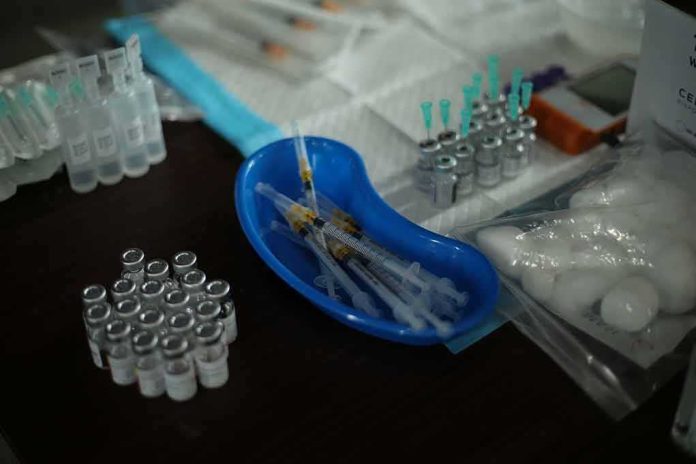
The State Department said the new funding will support emergency operations centers, surveillance, testing, border screening, infection prevention and control, and the procurement and distribution of critical supplies. Those are not bureaucratic abstractions. They are the core mechanics of containment. Ebola spreads through direct contact with infectious bodily fluids, so the response depends on rapid identification of cases, strict barrier precautions, safe handling of patients and remains, and the ability to interrupt chains of transmission before they widen. In an outbreak made more difficult by armed conflict and delayed detection, the logistics can be as decisive as the medicine.
That is why the U.S. emphasis on preparedness in neighboring countries is not a digression from the main outbreak; it is the strategy. Reuters reported that the June funding was also intended to bolster preparedness initiatives in Burundi, Kenya, Rwanda, and South Sudan. When an epidemic crosses borders, nearby health systems become part of the containment perimeter. Screening at entry points, laboratory capacity, and infection-control training are what keep one local outbreak from becoming a regional one.
In #DRCongo, #healthworkers bury colleagues as #Ebola outbreak outrun response. Aid groups blame US foreign aid cuts for lack of timely sufficient supplies and support. #DRC #GlobalHealth #Ituri #Bundibugyo #ForeignAid #PublicHealth https://t.co/BzQCG2oN9s
— Makau Ngola (@makaungola) August 4, 2026
Why the announced total is politically and operationally useful
There is a reason governments announce outbreak spending in headline-friendly blocks. Large numbers signal urgency, reassure partners, and create a visible benchmark for public accountability. But in Ebola response, the meaningful unit is not the press-release total; it is the speed with which money is converted into operational capacity. The State Department said the new funding would support up to six months of activity, which suggests an attempt to keep the response funded through a meaningful operational window rather than through a short burst of visibility.
At the same time, the broader context explains why the funding debate can become tangled. Different institutions often describe the same response using different accounting buckets: direct response money, humanitarian aid, preparedness in surrounding states, and older outbreak appropriations. That is why public discussions sometimes sound contradictory even when the underlying policy direction is consistent. One source may describe direct State Department Ebola assistance; another may include humanitarian funding routed through other channels. Both can be true. The complication is administrative, not evidentiary.
What this means for the outbreak response
The new pledge signals that Washington still sees Ebola containment in eastern Congo as a live, resource-intensive emergency rather than a problem that can be managed on autopilot. That matters because Ebola rewards hesitation. When detection is slow and health infrastructure is strained, the outbreak can outrun the response, especially in conflict-affected areas where movement is hard to track and trust in authorities is fragile. Funding alone does not solve those conditions, but without funding the response is reduced to improvisation.
The deeper lesson is that Ebola policy is less about dramatic rescue than about sustained operational discipline. The United States has long been one of the largest external contributors to these responses, and the current $242 million pledge continues that pattern. What determines success is whether that money arrives early enough, in the right channels, and with the technical support needed to turn a nominal commitment into a functioning containment system. In Ebola response, delay is not just inconvenient. It is epidemiologically expensive.
Sources:
insiderpaper.com, state.gov, usau.usmission.gov, cd.usembassy.gov, reuters.com, usnews.com, justice.gov