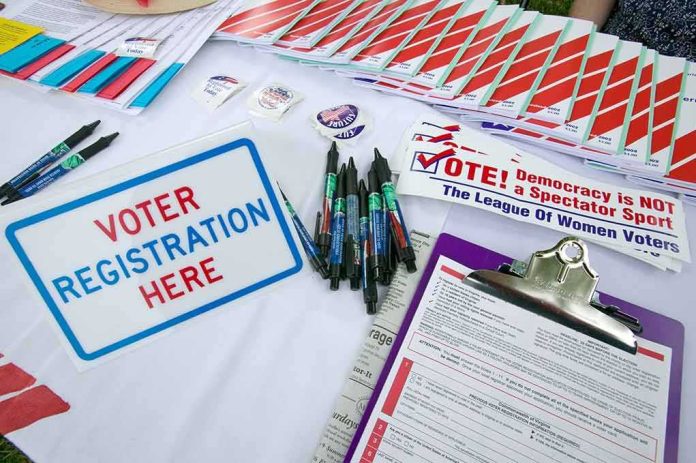
The central issue is not whether James Talarico made a political accusation; it is whether his own voting and residency records exposed him to the same kind of scrutiny he aimed at Ken Paxton. The reporting indicates that he voted from his parents’ address in five elections after buying a nearby home, then did not update his registration until much later, creating a plausible election-law problem under Texas’s residence rules.
Key Points
- Reporting says Talarico voted in five elections using his parents’ address after buying a home nearby.
- Texas law requires voters to register where they live, which is why the address timeline matters.
- Talarico’s campaign provided unredacted records showing he changed his registration to his parents’ address in November 2021 and updated it again in September 2024.
- The dispute sits inside a broader Texas pattern in which domicile, residence, and district eligibility are often litigated through political messaging before any formal ruling settles the question.
What the records show
According to ProPublica and The Texas Tribune, Talarico voted in five elections using his parents’ address after purchasing a home for himself nearby, a practice the newsrooms said may have violated state voting laws. Their later reporting added a crucial detail: unredacted records from Talarico’s campaign show that he listed his parents’ address on his voter registration in November 2021, bought a home in June 2022, and did not change his voter-registration address until September 2024. That sequence is the heart of the matter. In election-law disputes, dates are rarely decorative; they are the case.
The reason the timeline matters is simple. Texas law requires residents to register to vote where they live, and the state’s residency rules turn on actual domicile, not merely convenience or political preference. If a voter uses one address while actually residing at another, the issue is not just clerical. It can affect which local races appear on the ballot and whether the registration complied with state law. That is why critics frame the matter as potential voter fraud, while defenders usually argue over intent, domicile, or whether the address remained legally usable.
Why Texas residency rules are so combustible
Texas election law is unusually fertile ground for this kind of fight because “residence” is not always as obvious as a lease, a deed, or a mailing address would suggest. In the political world, domicile fights often arise when a candidate moves, redistricting changes the map, or a campaign needs to establish eligibility quickly. Once those facts are in play, both sides usually reach for the most damaging word available: fraud. But the legal question is narrower than the rhetoric. It asks where a person actually lived, when they established that residence, and whether the registration matched that reality.
That is why Paxton’s attack on Talarico had immediate force: it tied a familiar Republican fraud narrative to a Democrat who had just accused Paxton of the same conduct. ProPublica and The Texas Tribune reported that Paxton said Talarico broke state law, citing conservative coverage that claimed he had not lived in the district long enough when he was elected in 2022. At the same time, the reporting also noted that records supplied by Talarico’s campaign appear to show he did comply with the residency requirements during the period under scrutiny for that earlier House race. In other words, one set of allegations concerns the voting address; another concerns the eligibility timeline for office. They are related, but they are not identical.
The real dispute is narrower than the headlines
The strongest reporting does not establish a criminal conviction or a final administrative finding. What it does establish is a documented inconsistency between where Talarico bought and owned a home and where he kept his voter registration for a substantial period afterward. That is enough to justify serious scrutiny, and it is also enough to make blanket certainty premature. Election-law controversies often begin with a records problem and end, if they end at all, with a legal judgment about intent, residence, and statutory interpretation.
That distinction matters because the modern ecosystem rewards compression. A voter-registration discrepancy becomes “fraud” in partisan circulation almost instantly; a residency timeline becomes a moral verdict before any tribunal has spoken. The deeper lesson here is not that every challenge is baseless. It is that the public language around election law routinely outruns the legal one. In this case, the reporting supports a concrete claim: Talarico’s registration history and homeownership timeline are in tension, and that tension is serious enough to raise legitimate questions about compliance with Texas voting rules.
Why the story persists
This controversy has staying power because it fits a durable political pattern. Residency fights are attractive ammunition: they are document-driven, easy to summarize, and difficult for ordinary voters to untangle without the underlying records. They also invite selective storytelling. One side emphasizes the address on file; the other emphasizes where the candidate actually slept, paid taxes, or intended to live. In Texas, where district boundaries and residency rules are closely watched, those disputes are especially potent. The result is that an otherwise technical question becomes a proxy fight over honesty, competence, and standards.
For Talarico, the practical consequence is obvious: the discrepancy hands opponents a ready-made attack line and complicates the moral authority he tried to claim when accusing Paxton of voter fraud. Whether any formal consequence follows depends on how election officials or investigators interpret the facts, but the political consequence is already visible. Once a candidate is accused of the very misconduct he condemned in an opponent, the argument stops being abstract. It becomes about credibility, and credibility is the currency that election-law controversies spend first.
What this means going forward
For readers trying to separate signal from noise, the most defensible reading is straightforward: the reporting provides substantial grounds to question Talarico’s voting-address compliance, but not a final adjudication of fraud. That is the sober place to stand. The evidence is specific, documentary, and politically consequential; it does not require sensationalism to be serious. And because the underlying issue involves residence rather than a fleeting mailing mistake, it is exactly the sort of fact pattern Texas election fights tend to revisit long after the first headline fades.