
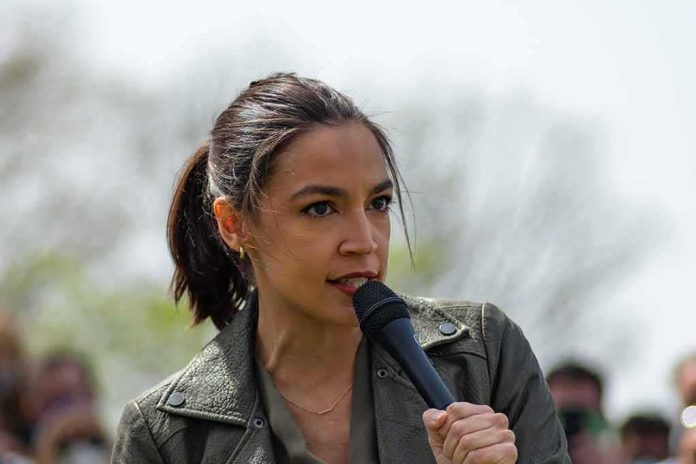
Alexandria Ocasio-Cortez’s latest dismissal of her old “defund the police” rhetoric is less a reversal than a recognition that the slogan came out of a very specific political moment; what matters now is how she translates that moment into a more durable public-safety message.
Key Points
- Ocasio-Cortez has recently signaled that she wants people to judge candidates by their current positions, not only by the most inflammatory language they used in 2020.
- Her earlier comments were not casual improvisation; they were tied to a defined argument about reallocating money from policing toward housing, health care, youth services, and other non-police responses.
- She also drew a line between symbolic budget accounting and actual reductions in police presence, insisting that “budget tricks” do not amount to defunding.
- The broader dispute is not just about one politician’s wording. It is about whether “defund” is a literal policy prescription, a rhetorical provocation, or a movement brand that became politically toxic.
What Ocasio-Cortez Is Doing Now
In the recent ABC interview that prompted the latest round of commentary, Ocasio-Cortez shrugged off the older “defund the police” era and joked that “Woke 1 was crazy,” while arguing that voters should assess what a candidate is saying now. That is the essential move: she is not disowning the public debate that she helped shape, but recasting it as a product of an earlier phase of progressive politics, one that unfolded during the upheaval of the COVID shutdowns and the 2020 protests.
That framing matters because it clarifies the direction of travel. Ocasio-Cortez has not presented herself as having never supported the idea; rather, she has described the earlier period as a time when the political debate opened unusually wide, and when activists and elected officials were willing to entertain sweeping public-safety revisions. The implication is straightforward: the language may have been radical, but the underlying question—how much of public order should be handled by police versus by social institutions—was, in her telling, a serious one.
What “Defund” Meant in Her Earlier Politics
The strongest evidence against the caricature of “defund” as a throwaway slogan is that Ocasio-Cortez spent considerable effort explaining what she thought it actually meant. Asked what an America with defunded police would look like, she answered, “It looks like a suburb,” and then pointed to affluent communities that invest more heavily in youth programs, health, housing, and alternatives to incarceration. In other words, she was describing a rebalanced public-investment model, not simple disorder or the disappearance of public safety.
That is consistent with the broader movement meaning attached to the phrase. In the sources assembled here, “defund the police” is repeatedly described as a call to reallocate some funds from police departments to non-policing public safety tools such as social services, housing, education, healthcare, and mental health support. The slogan’s attraction was never just budget math; it was a shorthand for the argument that many public harms are better addressed upstream, before they reach the level of a patrol car response.
Ocasio-Cortez also made clear, in June 2020, that she saw “defund” as a literal demand, not a symbolic gesture dressed up as reform. She criticized a proposed $1 billion NYPD budget reduction as insufficient because it did not substantially reduce police presence, warning that “budget tricks” and moving line items around did not satisfy the point of the demand. Her language was blunt: “Defunding police means defunding police.”
The Real Boundary She Drew: Accounting Versus Power
That June 2020 statement is the key to understanding her position then and now. Ocasio-Cortez was not mainly arguing about the size of a city budget in the abstract; she was arguing about what happens to power, personnel, and institutional reach when a government says it is cutting police spending. If officers stay in schools under another budget line, if overtime is simply relabeled, or if a cut exists only on paper, then in her view nothing meaningful has changed.
This is why her comments have often sounded more structural than rhetorical. She has repeatedly linked police spending to opportunity costs—books, housing, youth programs, and health resources that never materialize when policing consumes too much of the public purse. The logic is familiar in progressive municipal politics: public safety is not treated as a single enforcement problem, but as a system of social investments, and police are only one part of it. That is the theory. The controversy arises because the slogan compresses the theory into two explosive words.
Why the Slogan Became a Political Liability
“Defund the police” was always vulnerable to misreading, and that vulnerability eventually became the story. Supporters heard a strategy for reallocating some responsibility away from law enforcement; opponents heard an attack on the legitimacy of policing itself. Ocasio-Cortez herself seemed to understand that tension even while defending the phrase, noting in 2020 that language like “defund” was an “excellent choice” because it forced a national conversation that softer terms like “reallocate” or “refund” had not.
That helps explain why the slogan aged badly in electoral politics. Once crime, disorder, and school reopenings returned to the center of public concern, “defund” stopped functioning as an inside-left argument about municipal budgeting and started functioning as a general marker of excess. Ocasio-Cortez’s recent “Woke 1 was crazy” line is, in effect, an acknowledgment that the old vocabulary now carries more political baggage than explanatory power. She is trying to preserve the policy instincts while discarding the branding.
What Her Shift Means for the Broader Democratic Debate
The larger significance is that Ocasio-Cortez is moving in the same direction as many Democrats who once tolerated or even embraced “defund” but later preferred less combustible language. The substance of the debate has not disappeared; it has been reframed around violence interruption, mental-health crisis response, youth services, and public housing, rather than around the slogan itself. That is a political maturation, not necessarily an ideological surrender.
For critics, the episode confirms that the phrase was too extreme from the start and that today’s moderation is an admission of that fact. For supporters, it is evidence that the underlying reform agenda was never the problem; the problem was the public hearing of it in a polarized media environment. Both readings are understandable. But the record here supports a more precise conclusion: Ocasio-Cortez has consistently argued for reducing the centrality of policing in public life, while now conceding that the language she used to make that case has become easier to mock than to mobilize.
The Practical Lesson of the “Woke 1” Moment
What Ocasio-Cortez is really doing is separating policy from signal. The policy question remains whether cities should devote less of their public-safety apparatus to police and more to the social institutions that reduce crime before it begins. The signal question is whether “defund” still helps or merely triggers every audience with a memory of 2020. Her answer, at least implicitly, is that the signal has gone stale. The doctrine may survive; the slogan may not.
Sources:
foxnews.com, ocasio-cortez.house.gov, fox5dc.com, washingtonexaminer.com, tjr.org.tr, en.wikipedia.org, republicanleader.senate.gov