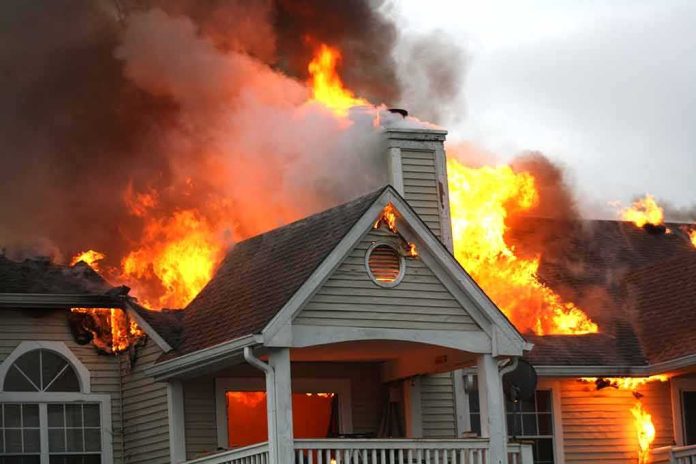
The important fact here is not merely that a manhunt ended in an arrest; it is that police say a domestic killing and an apparent arson were treated from the start as a single, fused crime scene, with the fire used to obscure the death rather than explain it.
Key Points
- Police say Thomas David Ryan was taken into custody after a multiday search tied to his father’s death and a deliberately set house fire.
- Authorities described Ryan as armed and dangerous during the manhunt and linked him to a gray Toyota Prius with New York plates.
- Reporting says the victim was Robert Ryan, 70, Thomas Ryan’s father, found dead inside the burned Greenville home.
- The public record supplied here strongly supports the police theory, but the detailed forensic file has not been disclosed in the reporting package.
What Police Say Happened in Greenville
New York State Police say Thomas David Ryan was arrested after a three-day search in Schoharie County, ending a manhunt that began after investigators found his 70-year-old father, Robert Ryan, dead inside a burned home in Greenville. The basic sequence is now well established in public reporting: a house fire broke out, firefighters extinguished it, a body was found inside, and investigators concluded the fire was deliberately set and the death was a homicide.
That is why the case was framed from the outset as more than a fatal fire. Police did not describe a routine blaze followed by an unrelated death; they described a homicide scene in which arson appeared to be part of the cover-up, and they publicly tied Thomas Ryan to the crime as the primary suspect. In practical terms, that means investigators were not asking only who died, but who controlled the sequence of events before, during, and after the fire.
Why the Homicide-and-Arson Theory Carries Weight
The police account has several reinforcing pieces. Officials said the fire was deliberately set, and state reporting tied Thomas Ryan to a gray 2016 Toyota Prius with plate HNH-7671, a detail repeated across multiple outlets during the search. ABC7NY also reported that Ring-camera video appeared to show Ryan running from the house, which, if authenticated, would matter because it places him at the scene during the critical window.
Even so, the public material supplied here is still a press-level record, not the full evidentiary file. The reporting does not include an autopsy summary, a fire-origin and cause report, or a sworn complaint spelling out the underlying proof in detail. That absence does not undermine the police theory by itself; it simply means the public has been shown the outline of the case, not the mechanics that will ultimately have to support it in court.
How the Manhunt Was Framed and Why That Matters
Authorities repeatedly used the phrase “armed and dangerous,” and that language did real work. It told the public to treat Ryan as a live threat, but it also compressed the story into a pursuit narrative, which tends to harden assumptions before formal charging documents are widely available. This is a familiar pattern in violent-crime coverage: once police, wire services, and local stations repeat the same central frame, the public often absorbs the conclusion long before the case file becomes public.
That repetition was especially strong here. Syracuse.com, NBC New York, FOX 5 NY, CBS6 Albany, ABC7NY, and the New York State Police all conveyed the same essentials: a dead man found after a house fire, a suspect identified as Thomas David Ryan, and a warning that he should not be approached. When multiple outlets converge on the same police account, the result is not proof by consensus, but it is a strong sign that the core facts have been consistently reported across the initial information chain.
What the Public Record Still Does Not Show
The strongest remaining questions are evidentiary, not factual in the broad sense. The supplied reporting does not state how Robert Ryan died, what injuries he had, whether an autopsy determined the precise cause and manner of death, or what fire-investigation work established the blaze as intentional. Those are not minor details; in a homicide-arson case, they are the bridge between a police theory and a prosecutable narrative.
The same is true of the Ring footage. ABC7NY reported that video “appears to show” Ryan fleeing the home, but the excerpt provided here does not include the original file, timestamps, or chain-of-custody details that would determine how much weight a court should give it. In a later criminal case, those technical questions matter as much as the dramatic image itself, because a clip can be persuasive to the public while still requiring authentication, context, and corroboration.
Why This Case Fits a Larger Pattern
Greenville sits inside a common and deeply recognizable criminal-justice pattern: an early police narrative built from a fire scene, a fleeing suspect, and circumstantial evidence spreads quickly through repeated reporting before the underlying forensic record is public. That does not make the police wrong; it means the public first sees a confident outline and only later sees the file that will either solidify it or expose its weak points.
In this case, the outline is already unusually coherent. Police say the victim was Ryan’s father, the fire was deliberate, the suspect was identified by name, vehicle, and location, and the manhunt ended with his arrest in Schoharie County. The resulting picture is stark: investigators believe a family killing was followed by an attempt to erase the evidence in fire, and public reporting so far largely supports that theory.
Police have captured Thomas David Ryan, suspected of killing his father and setting fire to his Greenville home last week, authorities announced early Sunday. https://t.co/G6FA3zYbdc pic.twitter.com/tgPwxG4S5x
— Eyewitness News (@ABC7NY) August 9, 2026
Sources:
nypost.com, syracuse.com, fox5ny.com, nbcnewyork.com, abc7ny.com, cbs6albany.com, youtube.com