
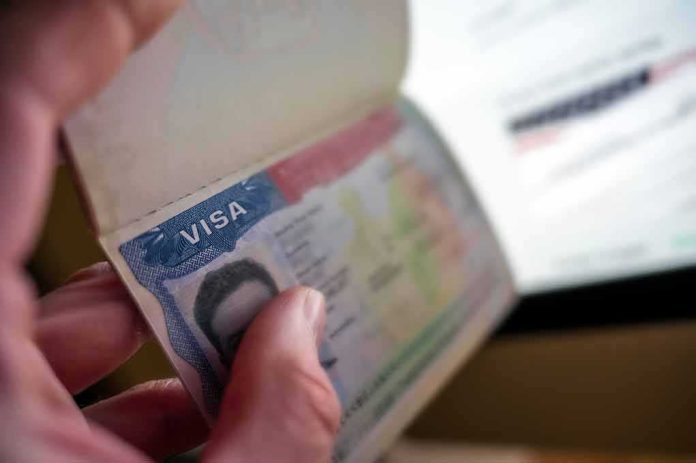
The central fact is not just that the State Department revoked a very large number of visas; it is that the Trump administration has turned visa revocation into a routine enforcement instrument, and it is doing so on a scale large enough to reshape who may remain in the country and under what standard.
Key Points
- The State Department says it has revoked more than 175,000 visas since the start of President Trump’s second term, with most tied to criminal activity and law-enforcement encounters.
- Officials have named DUI, assault, theft, drug crimes, fraud, embezzlement, and other offenses as leading reasons, and they also cite threats to public safety and national security.
- The strongest criticism is not that the government claims no authority to revoke visas; it is that the public record remains aggregate and category-based rather than case-by-case, leaving the fairness of many individual revocations untested.
- Some reported cases involve speech-adjacent conduct, database hits, or “law enforcement encounters” that are broader than convictions, which makes the policy look less like a narrow anti-crime tool and more like an expansive vetting regime.
The Scale Is the Story
Visa revocation is ordinarily an administrative act, not a headline event. What makes this episode consequential is scale: the State Department first said it had revoked more than 100,000 visas, then later said the total had climbed beyond 175,000. That is not a marginal tightening at the edges of consular practice. It is the visible footprint of a second-term enforcement strategy that treats post-issuance review as a standing mechanism, not an occasional correction when a serious case surfaces.
That matters because a visa is not citizenship, and the executive branch has broad discretion over admission and continued eligibility. Congress’s own research service notes the Trump administration’s earlier revocation surge and subsequent processing pauses, underscoring that this is part of a broader administrative posture rather than a one-off campaign. The policy question is therefore not whether the government can act; it plainly can. The real question is how far that discretion can stretch before it becomes a general screening apparatus for millions of foreign nationals already inside the system.
What the Government Says It Is Doing
The State Department’s public explanation is straightforward in outline. Officials say the revocations target people who violated visa terms, committed crimes, called for violence against U.S. citizens, defrauded Americans, abused the immigration system, or endangered national security. Reuters reported in January that the department described the main causes as overstays, driving under the influence, assault, and theft, while later coverage expanded the list to include reckless driving, sexual assault, child abuse, fraud, embezzlement, and drug crimes. CNN likewise reported that the department cited overstays, criminal behavior, public-safety threats, terrorist activity, and aid to terrorist organizations as the kinds of indicators that can trigger revocation.
In other words, the administration is not presenting this as a single-issue crackdown on crime alone. It is blending ordinary criminality with immigration-status violations, public-safety judgments, and national-security screening. That blend is important. A revocation based on a conviction for assault is one thing. A revocation based on a law-enforcement encounter, an immigration database hit, a social-media post, or some undisclosed discretionary assessment is another. The categories may all be lawful in the abstract, but they do not carry the same evidentiary weight or due-process instincts in public debate.
Where the Numbers Become Politically Ambiguous
The strongest factual support for the administration’s position is that multiple outlets independently report the same core story: the department says the majority of revocations were tied to criminal activity, and it has named the recurring offenses repeatedly. The weak point is precision. The public record here does not provide a case-by-case ledger, percentages by offense category, or a breakdown showing how many revocations followed convictions, charges, arrests, citations, or mere database encounters. That absence does not refute the government’s explanation, but it does limit how far anyone can responsibly generalize from the headline total.
This is where the phrase “law enforcement encounters” becomes doing a great deal of work. In ordinary legal speech, an encounter can mean arrest, questioning, a traffic stop, a database match, or something much less conclusive than a conviction. That is why critics focus on process. Bloomberg Law reported that some cancellations were based on federal database hits and included people never convicted or even charged, while The Hill said the State Department did not specify that the encounters were convictions. If those reports are accurate, then a portion of the revocations may rest on legally permissible but less publicly legible indicators rather than on adjudicated wrongdoing.
The Real Counterargument: Breadth, Not Denial
Side B does not demolish the government’s core claim that many revocations were tied to serious misconduct. It does something more modest and, in practical terms, more important: it shows why the public should be cautious about treating the 175,000 figure as a clean count of criminal offenders removed from the visa rolls. Reuters, TIME, and the broader reporting do not give the public the underlying administrative files, and without those files the system cannot be audited from the outside in. The result is an enforcement story with solid aggregate accounting and weak adjudicatory transparency.
That weakness matters most where the cases drift away from conventional crime. TIME reported revocations tied to calls for violence against U.S. citizens and other expressive conduct, while Bloomberg Law reported cases connected to advocacy on Palestine and criticism surrounding Charlie Kirk’s killing. BBC also reported student visa cancellations that included terrorism-related grounds and broad law-breaking categories. None of that proves the administration exceeded its authority. But it does show that the program reaches beyond the comfortable center of violent crime and into terrain where speech, association, and political judgment can become difficult to separate from legitimate security screening.
𝐓𝐎𝐌 𝐇𝐎𝐌𝐀𝐍: 𝟏𝟕𝟓,𝟎𝟎𝟎 𝐕𝐈𝐒𝐀 𝐑𝐄𝐕𝐎𝐂𝐀𝐓𝐈𝐎𝐍𝐒 𝐀𝐑𝐄 𝐉𝐔𝐒𝐓 𝐓𝐇𝐄 𝐁𝐄𝐆𝐈𝐍𝐍𝐈𝐍𝐆 𝐎𝐅 𝐀 𝐅𝐔𝐋𝐋 𝐑𝐄𝐕𝐈𝐄𝐖
Secretary of State Marco Rubio's State Department has already revoked a record 𝟏𝟕𝟓,𝟎𝟎𝟎 𝐯𝐢𝐬𝐚𝐬 for criminal activity since President… pic.twitter.com/TlNhmJrlPI
— M.A. Rothman (@MichaelARothman) August 12, 2026
Why This Fits a Larger Enforcement Pattern
The 175,000-visa figure is best understood as one piece of a larger architecture. Reuters and CRS both situate it within a widening enforcement program that includes enhanced screening, continuous vetting, and pauses in visa processing. The State Department has described a continuous vetting model designed to identify people who no longer satisfy eligibility requirements, and that means visa status is being treated less like a fixed grant and more like a conditional privilege subject to ongoing review.
That model has obvious administrative advantages. It allows the government to respond to fresh information after issuance rather than waiting for a future application or a separate law-enforcement action. It also gives officials a powerful tool against people who look risky but have not yet produced a neatly prosecutable record. Yet the same design is what generates the central critique: broad discretionary review can capture serious offenders and marginal cases alike, and without transparent standards the public has to trust the institution to sort those cases correctly.
What Should Be Read Into the 175,000 Figure
The number should be read as evidence of an aggressive enforcement state, not as a universal measure of criminality among visa holders. The administration’s own examples plainly include serious offenses, including assault, DUI, theft, sexual assault, child abuse, fraud, embezzlement, and even terrorism-related activity. But the same record also shows that the government is using a wider toolkit: law-enforcement encounters, continuous vetting, discretionary revocations, and in some cases apparently speech-adjacent conduct.
That combination is what makes the story durable. It is not merely that visas are being revoked. It is that the second Trump administration has normalized revocation as an everyday instrument of immigration control, and it is doing so with enough reach to create genuine questions about evidentiary standards, public transparency, and the line between security enforcement and broad discretionary policing.
Sources:
thegatewaypundit.com, reuters.com, washingtonpost.com, cnn.com, time.com, insidehighered.com, news.bloomberglaw.com, aa.com.tr