Power at a maritime chokepoint is never the same thing as sovereignty over it. The Strait of Hormuz illustrates that difference with unusual clarity: navies can coerce, escort, or obstruct, but no navy can lawfully convert this corridor of global commerce into its national territory.
At a Glance
- “Control” at Hormuz splits into two distinct ideas: de facto leverage to shape traffic, and de jure rules that prevent any state from owning or closing the strait outright.
- International law treats Hormuz as an international strait governed by a special navigation regime; coastal states hold nearby sovereignty but cannot suspend passage simply because they can.
- Presidential rhetoric about “total control” signals military deterrence and operational reach, not lawful title or annexation.
- Iran, Oman, and outside navies all possess tools to disrupt or secure shipping; the result is contested influence, not exclusive dominion.
What “control” really means at a chokepoint
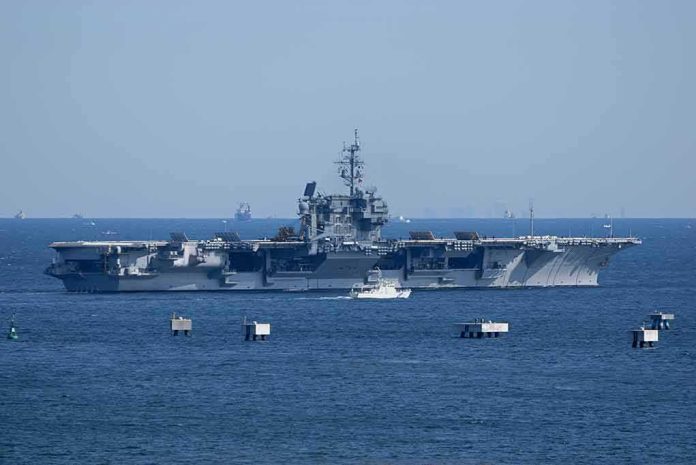
The Strait of Hormuz is a narrow connector between the Persian Gulf and the Gulf of Oman through which a significant share of the world’s seaborne oil typically transits. When leaders claim they “control” it, they are speaking in the grammar of coercion: who can escort tankers, interdict vessels, impose delays, or credibly threaten retaliation. None of that, however, confers sovereignty. In maritime law, Hormuz qualifies as an international strait; its core navigation regime—transit passage—was built precisely to prevent single-state gatekeeping over routes essential to global trade. The United States can surge carrier groups and enforce blockades against belligerents. Iran can harass traffic with missiles, drones, mines, and fast-boat swarms. Oman can regulate safety lanes on its side. But none of these capabilities turns the strait into someone’s territory.
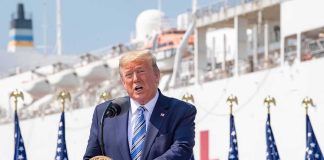
President Trump has repeatedly said the United States has “total control” of Hormuz and will “keep it,” language meant to project deterrence and political resolve. Strategically, those words aim to assure allies and warn adversaries that U.S. naval power can guarantee or deny maritime access. Legally, they do not—and cannot—amount to a claim of ownership. International law and the geography of the strait bar such a move, regardless of who commands the bigger fleet.
The legal bedrock: international straits and transit passage
The rules governing Hormuz emerged from decades of state practice and treaty law meant to balance coastal-state sovereignty with the world’s need for uninterrupted navigation. Under the United Nations Convention on the Law of the Sea (UNCLOS), straits used for international navigation carry a special regime: transit passage. That regime is non-suspendible, non-discriminatory, and does not require prior authorization or tolls for mere transit; ships and aircraft may proceed continuously and expeditiously, subject to narrow safety and environmental regulations by coastal states. In plain terms, the strait is not for sale, lease, or annexation—by anyone.
Legal and operational analyses converge on that point. Experts emphasize that while Iran and Oman possess sovereignty over their respective territorial seas abutting the strait, that sovereignty is limited by the right of passage; they may adopt certain routing and safety measures but cannot condition passage on political permission or convert the corridor into a pay-to-pass waterway. Even commentary that disputes aspects of how the regime applies to specific non-party states still affirms the central idea: Hormuz functions as an international strait with navigational rights that are not at the discretion of a single country.
Rhetoric versus reality: capability does not equal title
When a head of state declares “we own it,” the claim is best understood as political and military signaling, not a conveyance of title. Reuters captured President Trump’s on-record assertion that the United States has “total control” and a “wall of steel” blockade; that is an accurate account of the rhetoric and the operational posture he wanted audiences to perceive. Analysts and former officials, however, have been blunt in response: exclusive control is not borne out by facts on the water or by law. As Richard Haass put it, “No one’s in total control of the Strait of Hormuz”. A CNN military analyst, echoing many in the field, assessed that neither side has full control under present conditions.
Iranian officials, for their part, often answer maximalism with maximalism—asserting that no vessel may pass without Tehran’s permission and that the strait is under Iran’s “management and control.” Those statements are equally inconsistent with the governing legal regime and with the practical constraints imposed by U.S., allied, and regional naval presence. The result is a predictable cycle: expansive claims, constrained realities.
Mechanism of influence: how states actually shape passage
Because no one can lawfully own Hormuz, the contest centers on leverage. Iran’s toolset is asymmetric: land-based anti-ship missiles, coastal radars, sea mines, drones, and the Islamic Revolutionary Guard Corps Navy’s “mosquito fleet” of fast attack craft. These capabilities raise risk to insurers and operators, slow convoys, and can coerce selective detentions—an effect that persists even when the waterway is not physically blocked. U.S. and partner navies counter with layered air and maritime surveillance, minesweeping, convoy escort, and targeted interdictions. The balance is dynamic: weather, intelligence, rules of engagement, and the political cost of escalation all matter more than anyone’s press release.
In this environment, “control” looks like the ability to reduce uncertainty for friendly shipping while raising it for adversaries—day by day, movement by movement. That is why maritime lawyers, even when they disagree over legal fine points, consistently separate operational dominance from jurisdictional ownership. The former is a function of platforms, munitions, and logistics. The latter is a function of law—and in Hormuz, the law is settled against exclusivity.
Why the sovereignty claim fails—legally, geopolitically, and practically
First, the legal barrier is categorical. International straits used for global navigation are not subject to unilateral appropriation; the navigation regime is designed to be non-suspendible for all states. Attempting to declare the strait a national “territory”—whether by proclamation or presence—would run straight into treaty text, customary law, and near-universal state practice. Second, geopolitics makes the notion self-defeating: the waterway abuts Iran and Oman, carries the lifeblood exports of Gulf producers, and is policed by more than one navy. Any assertion of exclusive sovereign title would invite immediate diplomatic isolation, counter-assertions, and likely kinetic pushback.
Third, practicality bites. Even the most capable navy cannot translate maritime superiority into day-in, day-out customs-style jurisdiction across an international strait without the cooperation of coastal states and the acquiescence of major trading nations. The friction costs would be staggering; insurers, shippers, and energy markets would treat such an attempt as a systemic shock. Put differently: dominance can keep lanes open or punish hostile acts; it cannot rewrite the map.
🇺🇸 Meanwhile…
Donald Trump:
“After we finish defeating Iran … pretty soon I’ll be declaring the Hormuz Strait a territory of the United States.”
Yes. He actually said it.
The Strait of Hormuz is one of the world’s most important international waterways, bordered by Iran and… pic.twitter.com/FdQHVL76gk
— GMan | GMan’s Chronicle (@FAB87F) August 14, 2026
What to watch instead: durable ways states move the needle at Hormuz
Because the law of the sea puts a ceiling on sovereign claims, states compete below that ceiling. The most durable levers fall into four buckets. Naval posture: convoy schemes, mine countermeasures, and persistent ISR (intelligence, surveillance, reconnaissance) can raise the throughput and predictability of traffic despite threats. Economic pressure: sanctions, cargo inspections outside the strait, and financial compliance measures can curb illicit shipping without touching transit passage directly. Regional engineering: every additional pipeline segment that bypasses Hormuz—across Saudi Arabia, the UAE, or Iraq—dilutes the strait’s coercive value over time. Governance arrangements: traffic separation schemes, incident hotlines, and third-party monitoring, when agreed, can reduce miscalculation even amid hostility. None of this makes Hormuz anyone’s “territory.” All of it shapes how much real leverage the rhetoric conceals.
Bottom line
The Strait of Hormuz is not, and cannot be, the territory of the United States—or of any other single state. It is an international strait governed by a non-suspendible navigation regime that limits coastal sovereignty for the sake of global commerce. Great powers can project formidable influence there; Iran can still impose risk and delay. That reality is precisely why leaders reach for the language of “total control”—and why the law, by design, declines to take them literally.
Sources:
youtube.com, opiniojuris.org, reuters.com, uaeun.org, inss.org.il, rsisinternational.org, aljazeera.com, theguardian.com