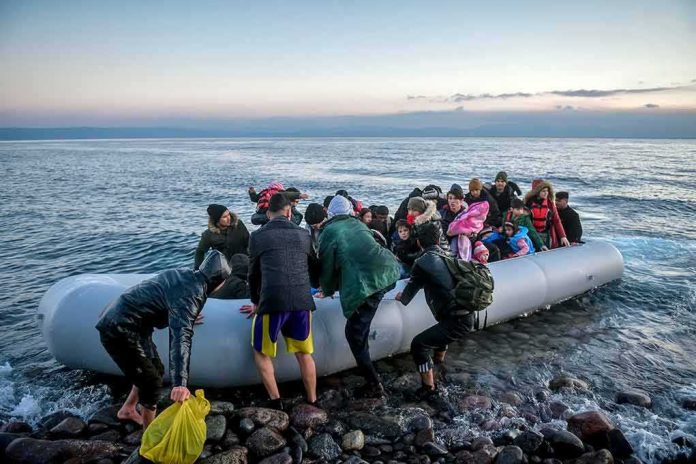
When a speedboat disgorged more than sixty people into the surf at a family beach in Spain’s Murcia region, the incident was not a baffling anomaly; it was a textbook expression of how Western Mediterranean smuggling routes probe, adapt, and exploit brief windows along a long, surveilled coast—followed by a rapid Spanish response that accounts for every person, stabilizes health needs, and hands cases to the legal and humanitarian system already built for this traffic.
At a Glance
- Authorities confirmed 62 people came ashore at Cala del Barco, Cartagena: 45 adult men, 2 adult women, and 15 minors, reportedly of Algerian origin.
- Emergency calls began around 13:00; Guardia Civil activated a beach-and-hinterland sweep and located all occupants.
- Red Cross teams conducted initial assistance; officials reported the group in good health at contact.
- The episode fits a years-long Western Mediterranean pattern in which small-boat landings recur despite surveillance and joint enforcement efforts.
What Happened at Cala del Barco
Shortly after 13:00 on a Wednesday, emergency dispatchers in Murcia began receiving multiple 112 calls about a fast craft arriving at Cala del Barco, a cove near La Manga Club outside Cartagena. Witness accounts and subsequent reporting described people jumping from the boat and swimming to the beach before scattering inland in small groups. Spanish authorities later fixed the headcount at 62: 45 adult men, 2 adult women, and 15 minors, reportedly Algerian. Officials said all were located in a coordinated operation and were in good health when contacted by responders. After basic assistance, the group moved into the routine handoff chain: humanitarian triage by the Red Cross and onward transfer into police and immigration processing.
The operational throughline was standard for Spain’s southeastern coast. Once the Guardia Civil received the alerts, it deployed a containment-and-search posture: secure the immediate beach, coordinate patrol elements on nearshore roads and footpaths, and sweep likely egress routes. The tactical objective is less theatrical than the viral video suggests—catalogue the full group quickly, stabilize any medical issues, and prevent secondary risks like dehydration, hypothermia, or road hazards from people moving hurriedly along cliff tracks and shoulders. Officials emphasized that all occupants were accounted for, a key performance signal in Spain’s coastal response playbook.
How Spain’s Immediate Response Works
Spain’s coastal incident choreography has evolved over decades of irregular maritime arrivals. Mechanically, three systems interlock: citizen reporting and maritime surveillance feed detection; Guardia Civil and local police manage the ground response; the Red Cross executes prehospital triage and basic stabilization before transfer to national police for identification, asylum screening, and, as applicable, removal. “All located” is not a throwaway line; it is the metric that tells you the perimeter was set, search teams were effective, and the chain of custody to humanitarian and legal authorities remained intact. In Cartagena, the Red Cross role is especially routinized—blankets, rewarming, wound care, hydration, and referral for any higher-acuity cases—because sea entries often present with exposure injuries even when landings appear orderly.
At Cala del Barco, the authorities’ health characterization—good condition at first contact—signals there were no immediate mass medical issues requiring hospital surge. That outcome is consistent with short-duration crossings on high-powered craft in favorable weather, which reduce exposure time, even as the “splash and scatter” debarkation poses its own risk profile to children and weaker swimmers. The handoff to the Policía Nacional then triggers standardized intake at a short-stay facility where identification, legal counseling, and child-protection protocols for minors proceed under national law and EU obligations.
Where This Fits in the Western Mediterranean Pattern
While the imagery of a daylight landing amid holidaymakers travels fast, the underlying dynamics are familiar. Spain has managed recurrent small-boat arrivals across two primary corridors: the Western Mediterranean route into mainland coasts and the Western African Atlantic route to the Canary Islands. In 2024 Spain registered 63,970 irregular arrivals, the vast majority by sea; pressure continued into 2025, reflecting durable push-pull factors and smuggling networks that re-route and retool as enforcement tightens in one sector and slackens in another. In this context, a 62-person landing near Cartagena is not an outlier but part of a persistent operational cycle that pairs episodic spikes with proven response routines.
Smuggling logistics shape the theater on the beach. Higher-powered outboards shorten transit, allow mid-cove approaches, and enable rapid disembarkation—often via swimmers to avoid grounding. That tactic complicates interdiction: coastal radar and maritime patrols must detect a small, fast target and vector interceptors before the boat commits to a micro-landing site screened by headlands. When boats beat the maritime screen, the ground game begins—hence the importance of local 112 alerts, which in this case started around 13:00 and quickly cued the Guardia Civil’s perimeter and search operation.
Competing Narratives Versus Documented Facts
Spectacle inevitably fuels framing contests: some outlets lead with “tourists fleeing,” others with institutional competence. The verifiable core here is straightforward: 62 people reached Cala del Barco; emergency calls pinpointed the time window; Guardia Civil located all occupants; initial health status was good; humanitarian and police processing followed. Those facts converge across agency-derived reports and multiple outlets carrying the same quantitative breakdown. Politically, incidents like this are leveraged into debates about detection gaps or central-government policy, but the administrative record from Murcia supports the narrow claim that the landing was contained without medical catastrophe or persons unaccounted for.
Caution belongs on one dimension: nationality attribution. Officials described the group as presumably Algerian—a common provisional label based on language, declared origin, or route indicators pending formal identification. That caveat does not alter the operational ledger—numbers, health, custody—but it reminds us that the legal process, not the beach, finalizes identity.
What Episodes Like This Mean Going Forward
For residents, tourists, and local businesses, the most tangible stakes are safety, predictability, and the sense that authorities can absorb surprises without losing control. On those terms, Cartagena’s response performed to spec: rapid confirmation of the full count, no reported injuries, and orderly transfer into the state’s humanitarian and legal pipeline. For policymakers, the harder problem is upstream. As long as smuggling networks can stage short-hop landings along coves with complex topography and variable patrol coverage, some boats will slip the maritime net and convert into ground operations—faster, louder, and more visible than interceptions just offshore. Spain’s remedy remains layered: smarter detection, flexible patrol patterns, cooperation with origin and transit states, and once a landing occurs, disciplined ground response that prizes speed, completeness, and care.
Sources:
humanevents.com, europapress.es, elespanol.com, telegraph.co.uk, infobae.com, rtl.de, cidob.org, portal.amelica.org, pubmed.ncbi.nlm.nih.gov