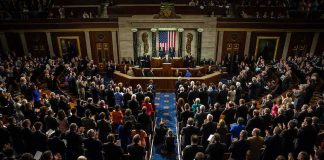

When a sitting president convenes the architects of a general-purpose technology inside the White House, the meeting is not just optics; it is how the United States now sets early guardrails and expectations for an industry that will shape productivity, competition, and national security for decades.
At a Glance
- President Trump hosted a White House luncheon with leading tech and AI executives to discuss innovation, safety, and U.S. competitiveness.
- The meeting’s stated aim: balance rapid AI progress with oversight, while avoiding a regulatory slowdown.
- Named attendees included leaders from Meta, Anthropic, OpenAI, and Nvidia, among others, reflecting the frontier labs and compute suppliers shaping the field.
- The event ran alongside an administration push to modernize digital government services with an AI-powered portal.
A White House summit built around AI’s near-term tradeoffs
The White House organized a luncheon with top AI and technology executives to surface a policy posture that explicitly prizes speed and market leadership while acknowledging the need for safety and accountability. Reporting contemporaneous with the event described a formal East Room convening that brought together President Trump, House Speaker Mike Johnson, and executives from firms at the center of today’s AI supply chain and model development. Johnson framed the discussion as a search for equilibrium between innovation and oversight, a formulation that captures the core policy tension: how to sustain U.S. momentum in AI while addressing concrete risks without blunt-force regulation that would slow deployment.
Multiple outlets identified the format and venue as a White House lunch meeting and listed expected attendees that included Meta’s Mark Zuckerberg, Anthropic’s Dario Amodei, OpenAI’s Greg Brockman, and Nvidia’s Jensen Huang, among others. While final, comprehensive seating charts were not published, the convergence of CEOs from foundational model companies and the dominant GPU provider underscores the administration’s focus on the technical and economic levers that actually determine AI capability: training data, model pipelines, and compute at scale.
Mechanism: why these leaders, and why now
Frontier AI is constrained by three interlocking scarcities: cutting-edge compute, specialized talent, and high-quality training data. Nvidia’s leadership in accelerators makes its CEO central to any conversation about capacity planning and domestic supply; foundation model labs like Anthropic and OpenAI define capability frontiers and safety practices; platforms like Meta influence deployment norms at consumer scale. A White House that intends to shape outcomes quickly—before Congress settles on statute—uses such summits to extract shared principles, signal enforcement priorities, and coordinate follow-on work across the executive branch. That playbook has a recent precedent: the 2023 Biden-era meetings produced voluntary “responsible AI” commitments and readouts that, while nonbinding, set a vocabulary for risk management that agencies subsequently referenced in guidance and procurement.
Here, President Trump was unequivocal about not slowing development. The administration’s posture favors industry self-regulation plus existing federal enforcement where laws already bite, while emphasizing community benefits from AI-driven infrastructure—especially data centers. That stance contrasts with calls for formal guardrails but aligns with a view that U.S. leadership depends on velocity, private investment, and competitive pressure rather than preemptive constraints.
Policy context: balancing speed, safety, and state capacity
“Balance between innovation and oversight” can drift into slogan unless paired with operational levers. Historically, White House tech summits serve three concrete functions. First, they socialize shared risk taxonomies—misuse, model capability hazards, systemic bias—and nudge firms toward common testing and transparency norms. Second, they tee up executive-branch actions that do not require new law: procurement standards, federal model evaluations, incident reporting expectations, and coordination through NIST, DHS, and DOJ. Third, they broker political cover for industry-led norms that, while voluntary, create reputational and contractual pressure in federal and enterprise markets. Critics of the earlier Biden-era approach labeled such commitments “vague” precisely because they lacked enforceable triggers; nonetheless, they proved consequential as templates agencies and Fortune 500 buyers later cited in RFPs and vendor due diligence.
The Trump White House layered this summit over a broader digital government push. Reporting described an all-day focus on an AI-enabled federal services portal, framed as a simpler, unified entry point for citizens to navigate benefits, applications, and information. Whether branded America.gov or a successor concept, the policy signal is clear: normalize AI-mediated interfaces in government workflows, use them to reduce friction in public service delivery, and demonstrate that federal adoption can coexist with privacy and security requirements.
Who was in the room, and what that signals
Attendee reporting consistently named executives who sit at decisive choke points in the AI stack. Meta influences consumer-scale deployment and open model ecosystems; Anthropic and OpenAI are leading developers of large-scale generative systems; Nvidia is the indispensable supplier of training and inference hardware. The presence of congressional leadership alongside the president situates AI as a cross-branch priority, with near-term legislative interest in liability, transparency, critical infrastructure resilience, and federal workforce augmentation. The practical takeaway is that both compute supply and model governance were on the table, not merely high-level ethics rhetoric.
The administration also emphasized cooperation with local communities affected by data center buildouts—an implicit acknowledgment of energy, water, and land-use pressures that accompany the physical footprint of AI. Linking industry expansion to local tax bases, school funding, and grid contributions is a political and economic bargain: accelerate permits and siting in exchange for durable community benefits and infrastructure investments. That social license will determine whether capacity expands onshore at the pace firms project.
What was and was not settled
On substance, the White House communicated three pillars. First, do not slow AI development; maintain and extend U.S. leadership. Second, rely on “tremendous self-regulation” by firms, complemented by existing federal enforcement through agencies like DOJ and the FBI, rather than new, sweeping statutory regimes. Third, harness deployment to visible domestic benefits—jobs, data centers, and modernized digital government services.
What the public record does not contain is a formal, detailed policy readout enumerating binding commitments, enforcement timelines, or statutory asks that emerged from the lunch itself. That is consistent with the genre: such summits crystallize posture and relationships more than they produce chapter-and-verse regulation. Subsequent moves—agency guidance, procurement baselines, model evaluation protocols, or targeted legislation—are where specificity typically lands. The question, as in 2023, is whether voluntary industry alignment hardens into de facto standards via market and government purchasing power or remains aspirational.
BREAKING: President Trump and Elon Musk discuss how AI is rapidly transforming entire industries following a White House meeting with top tech executives. #NYI pic.twitter.com/9tnjpv3Iwi
— NewYork-Insight (@NewYork_Insight) September 29, 2026
Implications: how this will shape the next 12–24 months
Expect three vectors of follow-through. In industry, look for expanded internal risk management—formal red-teaming, incident response playbooks, evaluation benchmarks—because major customers and federal buyers increasingly require them regardless of statutory compulsion. In infrastructure, watch the throughput of permits, substation and transmission upgrades, and water stewardship plans around data center campuses; if the political bargain holds, approvals should accelerate with clearer community benefits agreements. In government, anticipate iterative adoption of AI-mediated services in high-volume transactions—benefits eligibility triage, passport workflows, and call-center augmentation—under privacy, security, and records constraints that agencies will test in pilots before scaling.
Geopolitically, the White House view is that leadership in AI is a national security variable, not a luxury; the implicit corollary is skepticism toward joint frameworks with strategic competitors that would leak advantages or normalize dependencies. That stance favors export controls, domestic capacity buildout, and alliance-driven standards work over multilateral slowdown pacts. The luncheon’s composition—frontier labs plus compute providers—aligns with that thesis: keep the capability flywheel turning, discipline it with industry practice and targeted enforcement, and channel visible gains to communities that host the physical plant that makes AI possible.
Sources:
youtube.com, finance.yahoo.com, abc7.com, cnbc.com, reuters.com, politico.com, c-span.org, apnews.com