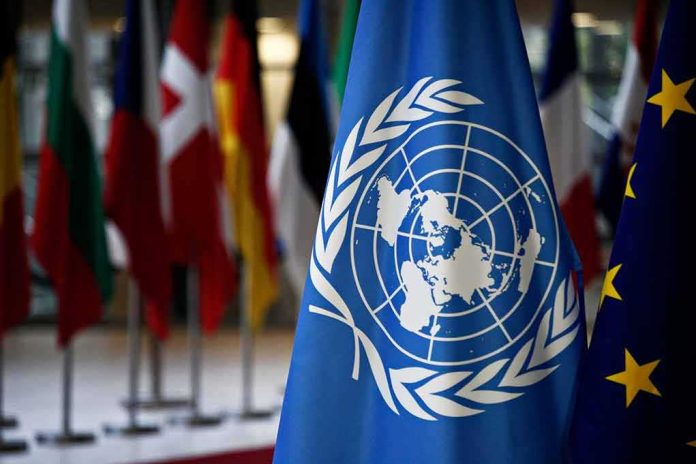
In the UN system, the line between principled humanitarian speech and prohibited political advocacy is thinner than many insiders admit; when staff cross what management perceives as that line, the sanction most often arrives not as a dramatic firing but as a quiet non‑renewal.
At a Glance
- A senior FAO official, Ben Davis, says his contract was not renewed after 26 years due to alleged breaches of impartiality tied to Gaza-related activity, including weekly moments of silence and a technical report on food availability and humanitarian law.
- The available public record rests largely on Davis’s account; there is no published FAO personnel decision or named official explaining the rationale, leaving causation contested.
- UN and FAO ethics frameworks require both actual and perceived impartiality; management discretion over what counts as “advocacy” versus “professional speech” drives outcomes in close cases.
- Absent documents—HR memos, editing directives on the Gaza report, or internal emails—this case exemplifies how neutrality rules and soft-power accountability collide in practice.
What the claim is — and what it isn’t
Ben Davis, a long-serving director at the UN Food and Agriculture Organization (FAO), says he was told in July that his fixed-term contract would not be renewed after 26 years because he allegedly breached impartiality rules. He ties that decision to two sets of actions: participating in or organizing weekly moments of silence inside FAO headquarters focused on starvation and famine in Gaza, and contributing to a May report on food availability in Gaza in which, he alleges, references to international humanitarian law were disallowed. Several outlets reproduced the AFP interview in which Davis makes these points, and one Rome-based publication attributed the non-renewal to internal concerns about the Thursday protests, citing unnamed FAO sources.
What the public record does not contain is decisive documentary corroboration: no FAO separation letter, no HR case summary, no named official describing the grounds for non-renewal, and no draft history of the Gaza report showing legal references removed on instruction. In other words, the core fact is Davis’s allegation, consistently reported; the mechanism and motive remain unverified in writing.
How neutrality is defined inside the UN system
International civil service law is explicit on neutrality. FAO’s staff regulations and ethics code stress independence from external influence and behavior that is not only impartial but seen to be impartial. The doctrine is preventive as much as punitive: staff must avoid conduct that could reasonably create an appearance of political positioning that undermines the organization’s credibility. The UN’s systemwide Standards of Conduct reinforce that staff may hold personal convictions and even speak in support of organizational positions, yet they must refrain from public activities that could be construed as partisan engagement on live political conflicts.
Two legal features shape outcomes in controversies like this. First, fixed-term appointments typically expire automatically at term end; management need not show cause to decline renewal, and international administrative tribunals have repeatedly recognized that distinction between separation and disciplinary action. Second, “impartiality” is a standard laden with managerial judgment. A technical presentation on food security may be uncontroversial; the same content paired with symbolic protest inside the workplace can, in the eyes of management, tip into advocacy—even where the employee views it as humanitarian principle applied to facts.
Where Davis’s account fits — and the evidentiary gaps
Davis’s narrative maps onto this well-known tension. He says he was accused of organizing weekly moments of silence about Gaza famine and told references to humanitarian law were not permitted in an FAO-related publication he worked on. He further says those acts were cited as breaching leadership impartiality standards. Those allegations, if documented, would illustrate a management determination that visible, internal protest and legally framed analysis on an active conflict crossed into prohibited political expression.
Yet the gap between allegation and record is non-trivial. There is no public FAO statement or document tying the non-renewal to Gaza-related activities. The report’s editorial trail is not in view, so we cannot confirm whether legal references were struck for neutrality reasons, for scope discipline (e.g., keeping FAO outputs technical), or at the behest of another review authority. Without HR memoranda, approval chains, or emails, causation remains inferential. On the current evidence, the case is best understood as a credible, specific claim by a named official, widely relayed, but not independently corroborated by internal records.
The mechanism that often decides these cases
In practice, three mechanisms tend to convert neutrality concerns into personnel outcomes. First, content governance: UN entities segment outputs—technical assessments, policy briefs, advocacy statements—and police the inclusion of legal or political language according to product type. A directive to omit humanitarian-law framing from a food-availability note may reflect that segmentation rather than hostility to law per se. Second, symbolism inside the workplace: management typically treats on‑premises protests about a current conflict as incompatible with neutrality in leadership roles, even when silent or time‑limited, because internal audiences include member state delegations. Third, renewal discretion: faced with cumulative “appearance” concerns and a time-limited contract, leadership often chooses quiet non-renewal over formal charges, minimizing litigation risk while reasserting control over organizational posture.
These mechanisms are not exotic; they are how multilateral bureaucracies defend their legitimacy claims when member states are divided. They also make it hard for the public to parse motive, because the paper trail—if it exists—is usually protected by staff privacy rules or never written down in plain language.
The core disagreement: advocacy or professional duty?
The substantive disagreement is not about the facts of Gaza’s hunger crisis—numerous humanitarian actors have documented severe food insecurity—but about what counts as permissible professional conduct inside a specialized UN agency. Davis frames moments of silence and legal framing as consonant with humanitarian ethics and accurate analysis. A by‑the‑book reading of FAO and UN conduct rules would counter that visible in‑house protests on a live geopolitical dispute and explicit humanitarian‑law argumentation in certain FAO products risk projecting an institutional stance beyond the agency’s technical remit, especially from leadership ranks.
Reasonable professionals will diverge on that boundary. The rules give management latitude precisely because “appearance of impartiality” is contextual; that flexibility, however, also enables selective enforcement. Absent transparent documentation, outsiders cannot discern whether the standard was applied neutrally or opportunistically in this instance.
What would settle the question
Three categories of record would clarify causation. First, the formal HR file: the contract-review memorandum, any conduct assessments, and internal legal notes. These would show whether non-renewal rested on performance, organizational restructuring, or specific impartiality concerns tied to Gaza activities. Second, the report’s editorial history: drafts, comments, and sign-off chains would evidence whether humanitarian-law references were removed, by whom, and why—scope control, neutrality, or political sensitivity. Third, contemporaneous emails or meeting notes among the Director‑General’s office, HR, and Davis’s division regarding the Thursday moments of silence. Those would either corroborate or undercut the claim that protest participation was deemed incompatible with leadership impartiality.
Why the case matters beyond one career
This dispute is a microcosm of a larger structural dilemma. The UN’s credibility depends on specialists who can describe human suffering with precision—and, at times, legal context—without being seen as choosing sides in war. When leadership construes symbolic acts or framing choices as advocacy, it narrows the space for principled language inside technical agencies. When staff make their protest visible inside the institution, they raise the stakes on neutrality optics and cede procedural ground. The only durable solution is clarity: product‑type guardrails, pre‑agreed language for legally adjacent topics, and a fair, written process when appearance concerns arise. Otherwise, the system will continue to resolve value clashes in the shadows—through non‑renewals that answer immediate political pressure but erode long‑term trust in multilateral expertise.
Sources:
lanacion.com.ar, fr.timesofisrael.com, nampa.org, jornaldebrasilia.com.br, elnashra.com, jns.org, italianinsider.it