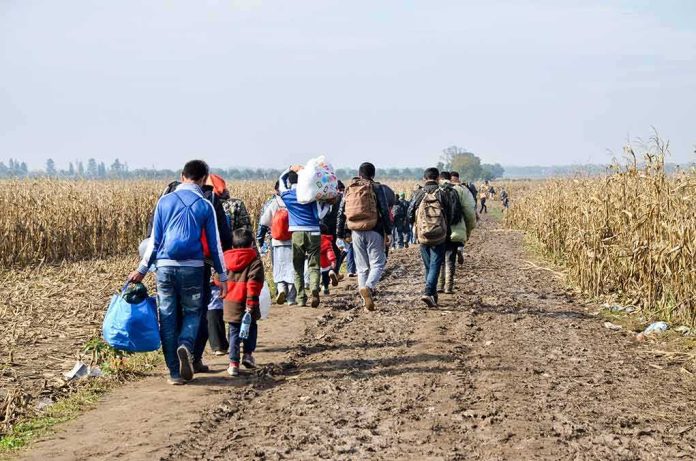
A caravan moving through southern Mexico has become the latest proof of a durable pattern in American politics: migration events and midterm elections arrive on the same calendar, and each side reads the timing as confirmation of its own story.
Key Points
- A caravan dubbed “Faith and Hope,” now numbering more than 600 migrants from Honduras, El Salvador, Guatemala, Ecuador, and Haiti, has been moving north through Mexico since late September 2026.
- Reporting out of Tapachula attributes to some migrants an expectation that Democrats will retake Congress in the midterms, a claim amplified by Rep. Nancy Mace and other Republican figures.
- The Department of Homeland Security has said the caravan has “zero chance” of entering the United States, citing current enforcement policy.
- Caravans timed to election cycles are not new; comparable movements shaped coverage in 2018 and recur as a predictable feature of campaign-season media.
- The caravan’s existence and size are well documented; the specific political motive attributed to migrants rests on secondhand footage rather than a formal survey of the group.
What Is Moving, and Where
The facts on the ground are not in dispute. A caravan that organizers and local press have taken to calling “Faith and Hope” departed the Tapachula area of Chiapas state in late September 2026 and has since grown past 600 people, drawing migrants from Honduras, El Salvador, Guatemala, Ecuador, and Haiti as it pushed north. Earlier counts put the group above 400, and reporting has tracked its swelling size in near real time as new arrivals joined along the route. This pattern — a core group departing southern Mexico and absorbing additional migrants from multiple nationalities as it advances — mirrors the structure of caravans going back to 2018, when a similarly diverse column crossed from Guatemala into Mexico near the same border town.
Honduran nationals make up the largest bloc, consistent with earlier caravans that originated from San Pedro Sula and other departure points where organizers have historically coordinated group travel for safety and leverage against smugglers. The route itself — through Chiapas and Tabasco toward the U.S. border — is the same corridor used by virtually every large caravan of the past decade, a function of geography as much as strategy: it is the path of least resistance through Mexico’s narrowest and most heavily policed southern states.
The Political Attribution: What Migrants Reportedly Said
The sharper claim driving recent coverage is not about the caravan’s size but about its timing. Video from Real America’s Voice correspondent Oscar Ramirez, filmed in Tapachula, captured migrants saying they were waiting for Democrats to win control of Congress before continuing their push north. That footage became the basis for a widely circulated line from Rep. Nancy Mace, who wrote that the migrants were “betting on a Democrat Congress in November”. The claim should be read for what it is: a statement captured on camera from migrants interviewed in the field, not a tabulated survey of the group’s intentions, and it has not been corroborated by a broader polling effort or an on-record migration-agency statement describing a collective expectation. That is a modest, single caveat — it does not change the fact that the caravan itself, and the political narrative built around it, are real and well documented.
Washington’s Response and the Enforcement Backdrop
The Trump administration has treated the caravan as a test of policies it has pursued aggressively since January 2025. Department of Homeland Security officials have stated flatly that the group has “zero chance” of entering the country, a declaration consistent with reporting that the administration has not released migrants encountered at the border into the U.S. interior for an extended stretch of its term. That stands in sharp contrast with the “catch and release” practices that defined earlier enforcement cycles, when migrants apprehended at the border were frequently processed and released pending future immigration hearings — a policy critics on the right have long argued functioned as an incentive for caravan formation in the first place.
The administration’s posture reflects a broader enforcement buildup: expanded ICE arrest operations, continued barrier construction, and coordination with Mexican authorities aimed at dispersing caravans before they reach U.S. soil. Whether that coordination succeeds in breaking up “Faith and Hope” before it nears the border will determine whether this caravan follows the trajectory of several predecessors, which shrank substantially — in one documented case by roughly half — after departing Tapachula, as migrants peeled off, were processed by Mexican immigration authorities, or abandoned the journey.
A Recurring Electoral Pattern, Not a Novel Event
Caravans arriving in the weeks before a national election are a recognizable genre of American political coverage, not a new phenomenon. The 2018 caravan became a defining image of that year’s midterms, injected into the campaign by Republican messaging and covered extensively by outlets across the spectrum as “the trek…entered the political debate ahead of the U.S. midterm elections”. Commentary at the time, and again now, has noted the pattern bluntly: these caravans “seem to only appear shortly before an election, and disappear from the right-wing media cycle immediately after votes are cast”. That observation doesn’t make any individual caravan less real — it describes a structural incentive in how migration becomes newsworthy. Academic research on immigration framing across the U.S. and Europe reaches a similar conclusion: campaigns consistently convert migration events into security or crisis narratives because that framing is electorally potent, regardless of the underlying migration data.
What It Means Going Forward
For voters trying to separate signal from noise, the caravan offers two distinct and separable facts. First, several hundred migrants are genuinely moving north through Mexico, and DHS has committed to turning them back under current policy. Second, a political narrative — that this movement is timed to a hoped-for Democratic majority — has attached itself to that migration, amplified by officials and media figures who have an evident stake in how border security is perceived heading into November. Readers should expect this pattern to recur in future election cycles: the caravan as a recurring, documentable event, and the political meaning assigned to it as the contested, ever-renewing layer built on top.
Sources:
thegatewaypundit.com, ground.news, pbs.org, nationalmemo.com, latintimes.com, tristatealert.com, hindustantimes.com, yournews.com, baltimoresun.com