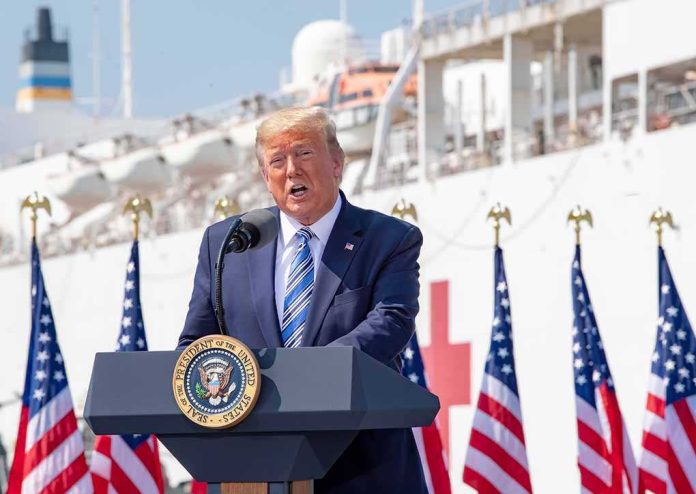
When a White House message is framed as a “public service announcement,” the crucial question isn’t production values or sentiment; it is whether the communication serves a bona fide governmental purpose or morphs into publicly financed self-promotion. President Trump’s decision to stop drawing on taxpayer dollars for the so‑called patriotic ads and to fund them personally or through his political apparatus concedes that distinction matters — in law, in ethics, and in practice.
At a Glance
- President Trump ended taxpayer support for patriotic TV spots and said he would underwrite them himself or via his allied super PAC.
- The White House has defended the ads as educational public service announcements; critics argue they resemble campaign promotion and may breach anti‑propaganda restrictions.
- Independent watchdogs filed complaints citing appropriations law and the Hatch Act; legal experts quoted by major outlets see potential statutory conflicts.
- The pivot to private funding diffuses the appropriations fight but leaves open questions about the boundary between civic messaging and political advertising.
What changed: from taxpayer-financed PSAs to privately funded “patriotic ads”
In late September, the administration broadcast several nationally aired spots that concluded with “Paid for by the U.S. government.” The White House cast them as patriotic PSAs meant to “remind Americans to love their country,” not electoral advocacy. After bipartisan pushback and formal complaints from watchdogs, President Trump announced he would cease using public funds for the campaign and instead pay for the ads himself or through contributions raised for his allied super PAC, MAGA Inc. Multiple outlets documented the shift and the scale of initial public spending, citing ad-tracking estimates in the millions of dollars and the mounting criticism that the content — tone, timing, and emphasis on the president’s persona — crossed into political promotion.
Substantively, nothing in the pivot renounces the message; it changes the payer. That distinction is not cosmetic. Federal appropriations riders and longstanding Government Accountability Office (GAO) interpretations prohibit using appropriated funds for “publicity or propaganda” — a catchall that covers covert persuasion, purely partisan messaging, and materials primarily designed to aggrandize officials rather than inform the public about programs, rights, or duties. Paying privately does not settle whether prior placements complied with the law, but it moves future flights outside the appropriations-law crosshairs.
How the line is drawn in law: purpose, content, and timing
The United States does not ban government communication; it constrains its purpose. GAO opinions and annual appropriations language disallow spending “directly or indirectly” for propaganda within the United States unless Congress authorizes it. In practice, enforcement turns on function: ads that clearly explain a statute, program enrollment, public health guidance, or citizen rights tend to pass muster; materials that polish an official’s image, mimic campaign rhetoric, or attack political opponents do not. That boundary is porous in real life, especially near elections, when otherwise permissible civic messaging is more likely to be read — and used — as political ammunition.
In the Trump ads dispute, watchdog Public Citizen filed complaints with the GAO and the U.S. Office of Special Counsel, arguing the spots touted the president’s character and campaign themes rather than describing specific government actions, thereby violating the anti‑propaganda appropriations ban and the Hatch Act’s limits on partisan activity by executive branch personnel. Major outlets reported that multiple legal experts viewed the ads as appearing to run afoul of these constraints; senior lawmakers, including members of Trump’s party, publicly said such messaging should not be taxpayer-financed. None of this is a final adjudication — GAO and OSC make those calls — but the objections were concrete, named, and tethered to statutory hooks.
The administration’s defense: PSAs, precedent, and patriotism
The White House’s rejoinder relied on both classification and precedent. First, officials insisted the spots were disclosed as government-funded PSAs, “educational and unapologetically patriotic,” not electoral advertising. Second, they invoked prior administrations’ use of federally financed messaging — from health enrollment drives to public health campaigns — to argue that presidents of both parties have used broadcast media to explain policy or rally civic spirit. The Reuters framing captured the competing logics succinctly: defenders see patriotic education; critics see politicized propaganda dressed as a PSA.
Precedent, however, is not a permission slip. The GAO has, in past opinions, distinguished compliant informational ads from unlawful “publicity or propaganda,” sometimes within the same department and the same fiscal year. The fact patterns that survive scrutiny tend to be those anchored to a discrete program, statutory duty, or time-sensitive public need, with content that instructs rather than exalts. That is why the content and timing of any presidentially fronted message — not merely its label — determine legality in context.
Why the funding pivot matters even if the legal fight continues
By shifting costs to private sources, the administration removes the most explosive element: the use of appropriated funds for speech that opponents characterize as campaign‑like. That does not retroactively bless earlier spending or settle pending complaints, but it narrows the active controversy to campaign‑finance compliance and endorsement rules applicable to political committees and vendors, which are clearer and more litigated terrain than the inherently fact‑sensitive “propaganda” standard. It also lowers institutional risk: GAO findings can lead to required reimbursements and reputational censure of agencies, even if no criminal sanction follows.
Politically, the pivot reframes the debate from “should taxpayers fund this?” to “is this persuasive?” That is an advantage for any White House confident in its message and fundraising. But it also tacitly acknowledges the persuasive strength of the counter‑case on appropriations law. When Senate leaders and cross‑partisan ethics voices pronounce a practice improper, administrations that want the message more than the fight generally change the funding source.
Trump Says He’ll Pay for ‘Patriotic Ads’ Himself Following Controversy Around Taxpayer-Funded TV Spots https://t.co/LErBu28dzH
— Variety (@Variety) October 6, 2026
The recurring gray zone: civic education versus self‑promotion
This episode fits a decades‑long pattern: as communications channels multiplied and campaigns professionalized, the temptation to ride the government’s megaphone for messages adjacent to electoral narratives grew. The incentive structure is obvious. If an administration can credibly classify messaging as civic education — patriotism, national security awareness, economic resilience — it can leverage taxpayer resources to shape public mood. The check on that incentive is twofold: statutory prohibitions on propaganda and a norm, reinforced by oversight, that public communication should inform citizens about their government, not celebrate its leaders. When content, voice, and timing lean into candidate‑style branding, that norm bites back.
The practical compliance rubric for any White House communicator is therefore stark. Ask: Is the ad explaining an enacted policy, lawful program, or concrete civic action the audience can take? Is the president’s presence incidental to the message or the message itself? Are the claims tied to institutional responsibilities, not partisan contrasts? And is the air date distant from electoral events? Fail those tests and private funding becomes the safer, cleaner channel — which is precisely where this controversy has now landed.
What to watch next
Three outcomes are worth tracking. First, GAO and OSC determinations on the complaints will clarify whether earlier government‑funded placements must be reimbursed or curtailed; those opinions often refine the boundary for future administrations. Second, Congress may revisit appropriation riders to sharpen definitions or expressly bar presidential appearances in taxpayer‑funded media near elections — an idea already circulating among critics. Third, the marketplace test begins: once the ads are financed like campaign messages, their creative choices and targeting face voters, not auditors.
Sources:
mediaite.com, cnn.com, nytimes.com, notus.org, abcnews.com, nbcnews.com, yahoo.com, latimes.com