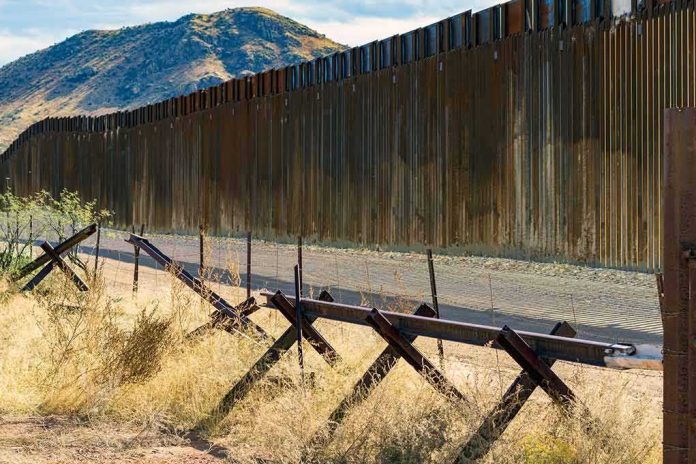
The Supreme Court’s stay in the Big Bend border-wall case is not a final word on walls; it is a forceful reminder that Congress armed the executive with unusually broad power to move fast at the border—and that courts will generally stand aside while that machinery runs.
At a Glance
- The Court lifted a lower-court halt, allowing construction to resume while litigation continues.
- Federal law empowers DHS to waive environmental and related requirements to expedite border projects; the Court leaned on that framework.
- The order emphasizes the government’s compelling interests in border security and integrity during construction.
- The ruling is interim; it does not resolve whether the specific waivers and project footprint ultimately comply with law.
What the Court Actually Did—and Why It Matters
In an unsigned order, the Supreme Court stayed a district court injunction that had halted border-barrier and road work in far West Texas, including segments near Big Bend National Park. That procedural move carries concrete consequences: crews can resume building while the case winds through the lower courts. The justices framed the stay around two interlocking premises. First, Congress has spoken with unusual clarity about accelerating border infrastructure; second, courts’ role is accordingly constrained during that acceleration. On the facts as presented, the injunction impeded the government’s ability to pursue its compelling interests in border security and integrity, so the stay issued.
This is not an endorsement of every waiver DHS signed, nor a merits ruling on the project’s lawfulness. It is a recognition that the relevant statutory scheme prioritizes speed and that the equities of delay—lost time on roads, barriers, and surveillance support—cut in the government’s favor at the interim stage. The distinction matters. A stay decision signals posture and power, not a final legal conclusion.
The Legal Mechanism: Expedited Authority and Waivers
The backbone here is federal statute that channels border construction into an expedited track. Congress authorized the Homeland Security Secretary to waive legal requirements—including environmental and historic-preservation obligations—when the Secretary determines that waivers are necessary for expeditious construction. The Court’s order reflects that allocation of authority, highlighting Congress’s clear preference for speed over the environmental and conservation harms asserted by challengers in this posture.
Two practical consequences flow from that structure. First, the executive’s determination to move quickly receives substantial deference when a court assesses whether to pause a project mid-stream. Second, avenues for judicial intervention are narrowed; reporting on the order captured the justices’ view that federal law sharply limits courts’ power to second-guess the government’s decision to build now and litigate later in this setting. As a result, challengers must do more than show potential environmental damage; they must overcome Congress’s chosen priority and a statutory design that curtails delay.
Scope and Stakes on the Ground
The project does not consist of an isolated fence segment. Accounts describe a program of roughly 300 miles of barriers and roads within the broader Big Bend Sector, which spans more than 500 miles of border, with associated surveillance and access infrastructure to make patrols viable in austere terrain. The Big Bend region is geologically and ecologically distinctive—canyons, desert mountains, the Rio Grande corridor—so construction entails heavy equipment, grading, and access roads that amplify the footprint beyond the steel itself. That scale is one reason both sides pressed hard: the government for operational continuity; opponents for a halt before damage spreads.
The government’s national-security rationale, as captured in the stay filings and order summaries, centers on border integrity and the operational need to interdict crossings and contraband in remote areas where terrain impedes response times without roads and physical barriers. While those are familiar DHS interests, the public record in this case—at least in contemporaneous reporting—does not supply sector-level apprehension figures, interdiction data, or engineering analyses tailored to Big Bend’s unique topography. That evidentiary gap doesn’t doom the government at the stay stage given the statute’s design, but it leaves room for sharper factual testing on the merits.
Environmental and Cultural Objections: Serious, But Not Decisive at the Stay Stage
Opposition is both organized and specific. Environmental groups, local guides, and preservation advocates allege that bulldozing, roads, and blasting could irreparably scar desert mountainsides, fragment wildlife corridors, and damage historic resources—including an adobe church in Ruidosa—while constraining public access to the river. A coalition of lawmakers urged DHS to rescind the waivers, warning of altered river hydrology, heightened flash-flood risk, and harm to local economies and biodiversity. These are not abstract anxieties; some reports describe footage of native vegetation removed in habitat for endangered species.
As a legal matter, however, those harms collide with the waiver authority Congress granted. If the Secretary lawfully invoked that authority, the usual environmental process obligations fall away. That is precisely why the challengers focus on whether DHS exceeded its statutory limits or failed to comply with any remaining procedural predicates. The current record available publicly does not reproduce the Secretary’s specific waiver instruments, administrative findings, or maps; that makes it difficult for observers to assess validity, but it also explains why the Court, facing a record oriented to emergency relief, declined to let an injunction halt a congressionally expedited program pending fuller merits development.
How We Got Here: A Long Arc of Delegation and Deference
Congress’s decision to give DHS sweeping waiver power at the border predates the current dispute and reflects decades of frustration with bottlenecks in siting and building. When courts encounter stay requests in that context, they frequently align interim relief with the expected merits trajectory; empirical work has shown correlations between stay votes and justices’ anticipated merits positions, which helps explain why temporary orders often feel like previews of where a case is likely headed without being formal holdings. The Big Bend order sits squarely in that tradition: respect the statute’s acceleration mandate now, adjudicate the finer points later.
That longer arc also contains a live policy debate about whether physical barriers deliver returns that justify their fiscal, environmental, and social costs. The research literature is mixed across contexts; some studies find material deterrent effects from fences, others see limited or offsetting benefits once flows adapt. The Court, however, is not refereeing that social science. It is applying a statute that front-loads executive discretion in a domain Congress deliberately insulated from protracted procedural delay.
Supreme Court Lets Trump Resume Border Wall Work in Big Bend National Park
The court, in an 8-1 unsigned order, lifted a Texas judge’s block on construction across the remote Big Bend region, saying Congress favoured speedy…https://t.co/rcyHnBAZL2#Politics #World #BigBend pic.twitter.com/tXnRaVSDAC— The Hourly News (@the_hourlynews) November 10, 2026
What to Watch Next: Merits, Maps, and Measurement
Three questions will determine the eventual outcome. First, the statute: challengers will press whether DHS stayed within Section 102’s waiver bounds—what, exactly, was waived; why; and on what administrative record. That turns on documents and determinations not yet widely public. Second, the footprint: precise maps, segment plans, and hydrologic and cultural-resource assessments will clarify where construction interfaces with parklands, private property, and historic sites. Third, performance: sector-specific data on crossings, interdictions, response times, and post-construction effects—paired with terrain-aware comparisons to surveillance-only alternatives—will either substantiate or erode the case for barriers in this geography.
Bottom Line
The Supreme Court’s stay gives President Trump’s administration the operational continuity it sought and underscores a legal reality often lost in rhetoric: at the border, Congress has already done much of the weighing. Until a court says DHS overstepped that delegation, speed prevails over process. The merits fight ahead will be about statutory limits and administrative rigor, not whether Big Bend is special—everyone agrees it is—but whether the law, as written, allows the government to build there anyway.
Sources:
townhall.com, scotusblog.com, texastribune.org, wsj.com, wtrf.com, heraldonline.com, fox7austin.com, ksat.com, cbsnews.com, abc6onyourside.com, sciencedirect.com, aeaweb.org