
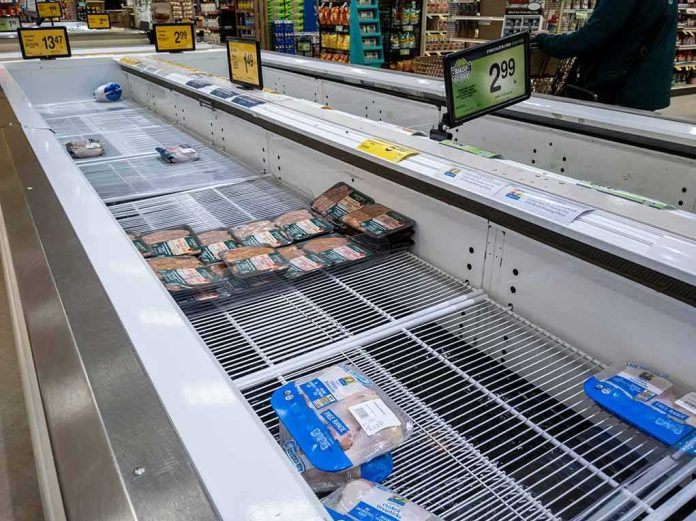
When a government crosses the Rubicon of public, unit-level attribution for a destructive cyber operation, it is signaling more than blame; it is establishing the pretext and pathway for retaliation. France’s decision to formally attribute a coordinated sabotage campaign against supermarket refrigeration systems to an Islamic Revolutionary Guard Corps–affiliated unit puts food security, industrial control system risk, and interstate cyber deterrence on the same stage.
At a Glance
- France formally attributed October attacks on supermarket refrigeration controllers to Iran’s IRGC-linked Shahid Kaveh unit, calling the operation sabotage at national scale.
- More than 700 retail sites were hit overnight, causing fires and food losses estimated in the tens of millions of euros, and triggering a criminal probe with international warrants.
- Prosecutors cite Iranian-linked network infrastructure and Farsi-language artifacts; authorities describe a modus operandi characteristic of Shahid Kaveh.
- Paris has threatened consequences and is coordinating at the European level, elevating the incident from technical breach to state-on-state confrontation.
What France says happened and why it matters
French authorities state that during the night of October 11–12, a coordinated campaign remotely manipulated industrial refrigeration controllers across more than 700 retail locations. Temperatures were driven into unsafe ranges, leading to equipment damage, at least several fires, and food spoilage. France’s Ministry for Europe and Foreign Affairs publicly attributed the operation to Iran and—crucially—identified the executing unit as Shahid Kaveh, affiliated with the IRGC’s electronic and cyber center. The declared material impact was not subtle: Paris put losses in the tens of millions of euros, framing the incident as an attack on national interests and the security of the French people.
This is the kind of ICS-targeting event many security professionals have warned about: an adversary skipping data theft and going straight to physical effect via supervisory control and data acquisition (SCADA)–adjacent equipment. In grocery logistics, where narrow temperature windows mean the difference between safe food and waste, manipulating setpoints can cascade into spoilage and fire risks quickly. The French description fits the pattern—simultaneity, common device families, and operational outcomes consistent with forced heating cycles—rather than sporadic, opportunistic intrusions.
From attribution to legal action: the prosecutorial track
Public attribution was paired with law enforcement movement. Paris prosecutor Laure Beccuau announced a judicial investigation on suspicion of organized cybercrime conducted in the interest of a foreign power, specifically Iran. Prosecutors requested international arrest warrants for the head of the Shahid Kaveh unit and two deputies—an assertive step that implies investigators associated named individuals with technical or tasking roles in the operation. As a legal theory, tying sabotage to a foreign power elevates the matter beyond routine cybercrime; it situates the case at the intersection of national security and criminal accountability.
What has surfaced publicly from the investigative side underscores the state’s claim. Reports, relaying prosecutors, reference communications in Farsi and IP addresses tied to terminals located in Iran, as well as a modus operandi investigators consider characteristic of Shahid Kaveh. Those artifacts are the sort of mid-tier indicators—language, infrastructure, and TTPs (tactics, techniques, and procedures)—that, when combined with classified signals and human intelligence, often underpin government confidence levels in attribution.
Mechanics of the attack: how industrial cold chains become targets
Refrigeration controllers in retail environments are often networked for centralized monitoring, energy optimization, and maintenance, with remote access provided for vendors and managed service firms. These conveniences create an attack surface: exposed interfaces, weak authentication, legacy firmware, and flat internal networks bridging corporate IT and store-level operational technology. An adversary who gains access to fleet management portals or directly to device interfaces can change temperature setpoints, disable alarms, or force defrost cycles—actions that can overheat compressors, trip breakers, or ignite components. France’s account of simultaneous manipulation across hundreds of sites suggests the attackers reached a shared control plane or exploited a widely deployed configuration, rather than breaching stores one by one.
The operational signature described—overnight timing, synchronized setpoint changes, subsequent equipment damage—is consistent with deliberate sabotage, not extortion. That matters for response: sabotage aims at economic and psychological effect, and in a food supply context it scores both. Tens of millions in losses are not only a line item for insurers and retailers; they also test public confidence in everyday infrastructure.
Shahid Kaveh and IRGC linkage: what is publicly asserted
France went further than most governments by naming an alleged executing unit. The foreign ministry statement and aligned briefing identify Shahid Kaveh as an offensive cyber unit within the IRGC’s electronic and cyber center. Media coverage has emphasized that investigators see the unit’s methods reflected in the operation and that the targeting aligns with an Iranian state interest to impose cost on European economies amid broader geopolitical frictions. While the public record does not include an organizational chart or prior adjudicated cases tying Shahid Kaveh to specific past operations, France’s step of pairing diplomatic attribution with prosecutorial warrants indicates authorities believe they can connect individuals to command roles inside that apparatus.
This tiered picture—technical indicators, operator identity, and state responsibility—is how modern cyber attribution is built. Technical artifacts point to infrastructure and tools; investigative leads, intelligence, and behavioral patterns map to operators; strategic context and unit affiliation drive state responsibility. France’s declarations traverse all three layers and do so in a way that commits Paris diplomatically and legally to that conclusion.
Iran has rejected what it described as "baseless accusations" that it was behind a cyberattack targeting commercial refrigeration units in hundreds of grocery stores across France last month. https://t.co/otkz40Nybh
— CBS News (@CBSNews) November 10, 2026
Consequences and next steps: deterrence, defense, and liability
France has warned of consequences, including European-level sanctions, summoning Iran’s ambassador and signaling coordination with partners. The logic is deterrence by clarity: make explicit that destructive operations on civilian infrastructure—food logistics included—invite cross-domain responses. Whether such signaling restrains future activity depends on Tehran’s cost-benefit calculus and on the credibility of follow-through. In parallel, the judicial track, while unlikely to produce near-term arrests, internationalizes the case and constrains travel and finance for named actors.
For operators of cold chains and other industrial control environments, the lesson is sober and immediate. Inventory your externally reachable interfaces, segment networks between corporate IT and store-level OT, enforce strong authentication and vendor access controls, and accelerate patching on controller firmware—especially for remote management modules. Build and test playbooks for rapid setpoint rollback and safe shutdowns; sensor data without command authority will not save inventory. Retailers that executed such measures swiftly limited losses; those that discovered brittle access pathways learned the expensive way why OT governance belongs on the board agenda.
Where the public record stands
France has placed a clear marker: an IRGC-linked unit, Shahid Kaveh, conducted a large-scale sabotage operation on French soil by manipulating supermarket refrigeration controllers, causing fires and extensive spoilage; prosecutors opened a national security–framed case and sought warrants for alleged unit leaders. Media accounts, drawing on official briefings, describe Iranian-linked infrastructure and Farsi-language artifacts, consistent with investigators’ portrait of the perpetrators’ methods. On the policy side, Paris is aligning diplomatic pressure, legal instruments, and defensive guidance to convert attribution into consequence. That is how states try to reset norms—by naming, shaming, and sanctioning, then hardening what was shown to be soft.
Sources:
redstate.com, aljazeera.com, cbc.ca, nbcnews.com, rfi.fr, diplomatie.gouv.fr, uk.finance.yahoo.com, uk.diplomatie.gouv.fr, en.ara.cat