The presidency can function without a press secretary for a time; the harder question is what gets lost when the institution that evolved to translate a sprawling executive branch into usable information is replaced, even temporarily, by the president’s own voice.
At a Glance
- President Trump says he is in no hurry to appoint a new press secretary and has operated without one since Katie Zacharia’s five-day tenure ended.
- He told the New York Post the administration “hasn’t required” a press secretary thus far and that he has candidates in mind, without naming them.
- Major outlets reported the role was expected to remain vacant for the near term, indicating a tolerated operating model rather than a brief staffing gap.
- Zacharia’s exit — and contested characterization of it — sharpened attention on how the White House communicates in the absence of a designated spokesperson.
What Happened: A Deliberate Pause, Not a Lapse
After Katie Zacharia’s five-day stint at the podium ended in mid-October, President Trump made clear he did not intend to rush a replacement. In a subsequent interview, he described the role as unnecessary for the moment, said he had “several candidates” in mind, and cast himself as, in effect, his own spokesperson. The position remained unfilled in the weeks that followed. The through-line across mainstream coverage was not uncertainty; it was continuity: the vacancy continued by design, not by accident. The Post quoted Trump’s rationale; NBC News reported it was highly unlikely a new press secretary would be selected soon; CNN noted no successor was imminent at the time of Zacharia’s departure.
The exit itself drew unusual attention because of its speed and on-the-record presidential involvement. As reporters pressed the issue, Trump publicly told Zacharia she did not have to continue in the role — a direct, personal intervention that short-circuited any slow-rolling institutional handoff. Wire services and global broadcasters captured that moment in real time, anchoring the timeline of events and underscoring that the subsequent vacancy flowed from a choice the president owned.
How the Press Secretary’s Office Came to Matter
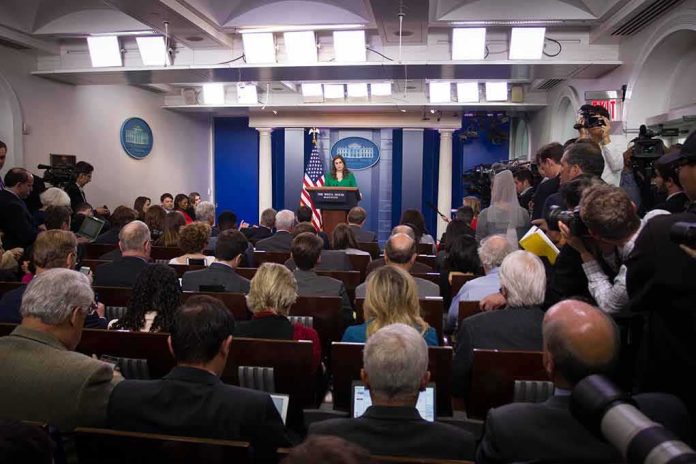
The United States did not always have a press secretary, but over the twentieth century the post matured into a pivotal node that both speaks and listens: articulating presidential policy while channeling the press corps’ questions back into the bureaucracy for answers. Herbert Hoover’s 1929 appointment of George Akerson is commonly marked as the office’s formal beginning, though functional predecessors existed; by midcentury, the role entailed coordinating messaging across agencies, managing access, and holding regular briefings that set timing, topics, and expectations for coverage. Histories and reference works converge on this institutional scope: the press secretary is not simply a face at the lectern but an organizer of information flow from the executive branch to the public.
That organizational muscle is why vacancies matter. The job aggregates expertise from policy shops, the National Security Council, the Counsel’s Office, and departmental public affairs teams; it decides when to put a principal on camera and when to issue written guidance; it arbitrages competing priorities and embeds a cadence the press can rely on. A president can speak directly — and many do, with increasing frequency — but the architecture around the press secretary exists to make the rest of the machine legible.
Trump’s Operating Model: Personalized Communication, Again
President Trump has long favored direct communication — first through social media and rallies, then through press conferences when events warranted — and he is explicit about his comfort stepping into the messenger role. That predisposition aligns with the current pause: if the principal insists on being the narrator, the marginal utility of a formal spokesperson falls. Scholarship on the Trump years documents that oscillation between mediated and unmediated channels; when the president wants to set the agenda himself, he often does so without an intermediary.
The practical corollary is straightforward: fewer traditional briefings and more presidential exchanges in hallways, on the South Lawn, or at open-press events, with policy clarifications issued ad hoc by senior aides rather than funneled through a daily podium ritual. Whether that is efficient depends on your vantage point. It can be faster and more politically coherent because the decider is the communicator. It can also be brittle: without the press office’s routinized cross-checks, contradictions linger longer and agency voices collide before they harmonize.
The Zacharia Interlude and Its Aftermath
Katie Zacharia’s brief tenure intensified scrutiny for two reasons. First, the compressed timeline — five days from debut briefing to departure — guaranteed saturation coverage. Second, the manner of exit invited divergent characterizations: Trump’s public suggestion that she need not remain in the job sat alongside subsequent statements from Zacharia that she was not fired. The precise personnel action aside, the news value for the communications beat was the same: the podium would be empty for a while, by presidential preference. Associated Press, BBC, Business Insider, CNN, Politico, and NBC all documented the sequence and its immediate consequence — a vacancy with no clear end date.
One brief caveat belongs here: while Trump said the White House had not required a press secretary and that he had candidates in mind, he declined to identify them and no formal White House staffing directive was published in the reporting cited. The core facts, though, are uncontested in the coverage — the role was open, and the president signaled he was content to leave it that way for now.
What Changes Without a Press Secretary
Remove the designated spokesperson and three things typically shift. First, cadence: daily briefings give way to episodic encounters, often pegged to events rather than a communications plan. That means fewer predictable opportunities for wide-ranging questions and more leader-focused exchanges that ride the news of the day. Second, coordination: agencies still talk, but the clearinghouse function weakens. Answers may arrive in parallel rather than in chorus, increasing the burden on reporters to reconcile inconsistencies. Third, accountability logistics: embargoes, on-background guidance, and transcript pipelines often slow or fragment without a single office owning them. Studies of briefing-room agenda setting have shown how topics elevated at the podium cascade into nightly newscasts; thinning that conduit does not mute the presidency, but it changes the mix of what gets amplified.
There are trade-offs. Personalized communication can feel authentic and decisive; it also concentrates risk. A misstatement by a press secretary can be walked back as staff error, but when the president is the primary messenger, corrections carry higher political cost. Conversely, when the president is clear about priorities, the absence of an intermediary can eliminate friction and message drift. The right model depends on the administration’s tolerance for spontaneity versus its need for synchronized execution.
How This Compares to Past Practice
Historically, prolonged vacancies in the press secretary position are unusual but not unprecedented; more common are stretches with fewer briefings, a practice that ebbs and flows with strategy and circumstance. Across administrations, the office’s influence rises when policy complexity is high and interagency choreography matters, and it recedes when a president chooses to speak frequently and directly. Trump has toggled between those poles before, leaning into unmediated channels in normal politics and expanding formal briefings during acute crises when the advantages of coordination outweigh the allure of spontaneity.
In that sense, the current pause is less a rupture than a reversion to a favored style. The institutional question — how long can the White House run this way without sacrificing transparency and coherence — is empirical. It will be answered by the volume and clarity of guidance that reaches the public, the responsiveness to press inquiries, and the number of issues that require post hoc cleanup. The presidency affords latitude in how to communicate; history suggests the structure around it exists for reasons that reassert themselves when complexity returns.
Sources:
nypost.com, faithfulherald.com, yahoo.com, aol.com, businessinsider.com, us.cnn.com, politico.com