
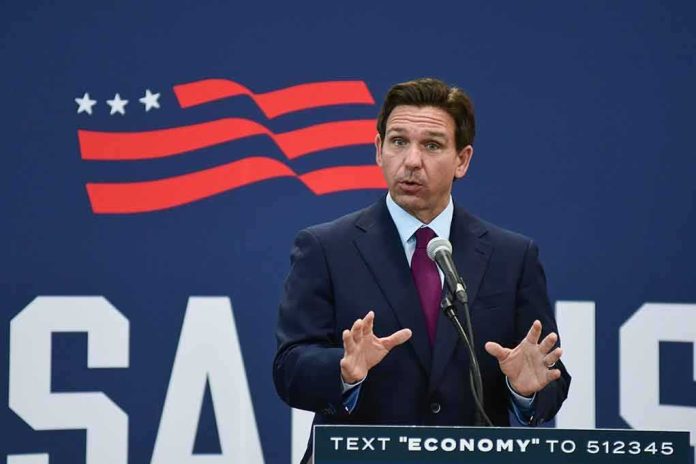
In American politics, a well-timed book is less a literary event than a strategic instrument—an on-ramp to the next conversation, the next coalition, the next race. Reports that Florida Governor Ron DeSantis is quietly working on a new book fit that pattern precisely and, given his calendar, matter beyond Florida.
At a Glance
- Axios reports DeSantis is developing a book, citing two sources; multiple outlets echoed the account.
- DeSantis is term-limited and expected to leave office in January 2027, making new publishing a timely platform move.
- He has authored two prior political books, consistent with using publishing to frame ideology and biography.
- The project is already linked to 2028 speculation; DeSantis has not ruled out reassessing national ambitions after leaving office.
What’s Been Reported, and Why It Resonates
Axios reported that two sources say DeSantis is quietly working on a book, a project positioned by the outlet as a platform-setting exercise that naturally stokes 2028 talk given his impending exit from the governor’s office. Mediaite and Political Wire summarized the report soon after, reinforcing the central claim without adding separate sourcing. The governor’s team has not confirmed the project; public details such as a contract, publisher, or timetable have not surfaced. Even so, the claim is significant because it maps cleanly onto how politicians—especially would-be presidential contenders—prepare their arguments before the next cycle.
The timing is logical. DeSantis is expected to leave office in January 2027; a book finished or launched as he transitions out would let him define a governing philosophy, recap a Florida record, and test lanes inside the Republican coalition before donors and activists reset for 2028. That he has not foreclosed future national ambitions only tightens the connection between a discrete publishing project and a broader strategy.
How Political Books Function in the Pre-Campaign Phase
In modern presidential politics, publishing is part audition, part agenda-setting. Candidate literature tends to fall into two archetypes: the “introduction” volume that packages biography and motive, and the “manifesto” that stakes policy ground and signals governing priorities. Both formats are designed to do four jobs at once—codify the message, demonstrate discipline, produce earned media, and justify a national tour under the rubric of a book rollout. As reporting on prior cycles shows, prospective contenders across parties have used books to establish identity and ideas well before formal filings ever appear.
This political subgenre works because it aligns incentives. Publishers get a recognizable brand and built-in news hooks; politicians get a long-form instrument for narrative control. Even critics of the form—which often skews didactic and thinly reported—concede its ubiquity and utility: the books need not be bestsellers to succeed as political devices, only durable enough to anchor interviews, town halls, donor salons, and op-ed arguments through the pre-season of a national race.
Where DeSantis Fits: Track Record and Message Real Estate
DeSantis has used books before to translate his politics into program: an early ideological statement during the Obama-era debates and a 2023 volume that framed his Florida tenure as a model for conservative governance. That history makes a new project unsurprising and clarifies its likely purpose. A post-governorship book would offer a vehicle to reconcile lessons from Tallahassee with national priorities—on executive power, cultural regulation, public-health federalism, immigration enforcement, education policy, and the bureaucracy’s scope—areas where his gubernatorial tenure has already supplied raw material.
Practically, a book is also message real estate. It allows the author to dictate sequencing: principle first, record second, coalition third, contrast last. It keeps the candidate—declared or not—out of pure reaction mode and creates a reference text for surrogates and allied media. If DeSantis intends to evaluate a 2028 bid after leaving office, a manuscript ready for a 2027 release would place him in stride for the invisible primary’s debates over ideology, electability, and governing seriousness.
The Evidence Base and Its Limits—Without Overreading Them
The public record to date rests on Axios’s two-source report, amplified by secondary outlets; it does not include a disclosed publisher, contract, or title. That is common in early-stage projects. The consequential facts are straightforward: reputable political media have reported the effort exists; DeSantis’s calendar makes a publication window strategically useful; and he has not ruled out reassessing national ambitions after his term ends.
It is also true that political media often inflate a single scoop into a broader narrative through repetition, a familiar dynamic in pre-campaign coverage. The operative caution, then, is not to alchemize a book into a candidacy; historically, the presence of a manuscript is a necessary but insufficient condition for a run. The signal here is preparatory, not dispositive.
How To Read the Next Signals
Books are catalysts when they coincide with measurable infrastructure. For readers tracking whether this is prelude to a 2028 move, the tells are concrete: appearance of a publishing deal in disclosures; a tour schedule targeted to early-state media markets; policy chapters that harden into white papers; renewed relationships with national operatives; and donor convenings that look more like coalition architecture than retail sales. If those elements follow a publication, the book has become more than a text—it has become the chassis of a campaign.
Conversely, if the project resolves into a retrospective or an issue-specific argument without staffing, travel cadence, or fundraising velocity, it will have served a more bounded purpose: consolidating a gubernatorial legacy and preserving leverage inside the party’s debate without triggering the demands of a national run. Political books are effective precisely because they keep both lanes open until the author chooses.
Two DeSantis headlines in one morning: he rules out the Supreme Court ("potted plant"), and Axios says he's writing a book. Kalshi has him at 89% to run in 2028. Stories like this read better with the odds sitting right next to the quote. https://t.co/dlffpp9i49
— Polyembed (@polyembed) November 23, 2026
Bottom Line
Based on current reporting, DeSantis is developing a new book as his Florida term winds down—an unsurprising, strategically timed move that gives him a long-form platform to define ideas and leverage attention while he gauges 2028. In the American system, books are both message and mechanism; they don’t declare candidacies, but they do prepare the ground. Watch the infrastructure that follows the manuscript—that, more than the title on the cover, will tell you what comes next.
Sources:
mediaite.com, politicalwire.com, dailyfoxnews.com, newsbreak.com, 2028tracker.com, esquire.com, theatlantic.com, link.springer.com