The fight that erupted in Bartow, Florida was never really about whether a Muslim cleric could pray at a city meeting — the law settled that question decades ago — it was about who gets to decide what “neutral” looks like when faith, patriotism, and public ceremony collide in the same room.
Key Points
- On November 16, 2026, the Bartow City Commission formally listed Imam Sajid R. Bhuiya of Masjid Al Nur Mosque on its agenda to deliver the opening invocation, a routine civic function historically filled by Christian clergy.
- A portion of the crowd shouted him down with chants of “USA,” “This is a Christian nation,” and a recited Lord’s Prayer before officials restored order and let him finish.
- The city attorney reportedly told the imam the invocation slot is open to all faiths and consistent with the Constitution — a position well-supported by decades of Supreme Court precedent on legislative prayer.
- Citizens Defending Freedom, the group behind the organized response, insists it has a right to challenge religious messaging it finds incompatible with American founding principles, while disavowing the cruder insults some attendees hurled.
- The Freedom From Religion Foundation has used the episode to demand Bartow abandon invocations altogether — a reminder that controversies like this one often end not with clearer rules, but with institutions retreating from the practice entirely.
What Actually Happened at the Podium
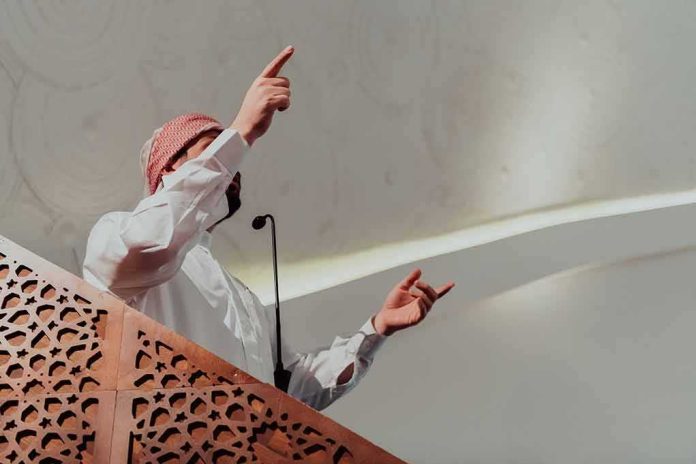
The sequence is not seriously in dispute. Bhuiya was called to the podium at the start of the meeting, as scheduled, to deliver an invocation that drew on the Quran’s call to mutual recognition across “peoples and tribes” and asked commissioners for wisdom, fairness, and compassion toward the community. Before he got far, attendees began chanting “USA,” telling him “you’re not Michigan,” and reciting the Lord’s Prayer in unison to drown him out. Commissioners called for order, the room quieted enough for him to continue, and the invocation was completed and followed by the Pledge of Allegiance.
That the prayer was finished matters. It establishes, on the available record, that city officials used their control of the meeting to protect the scheduled speaker rather than to curtail him — the opposite of what a viewpoint-discriminatory government would do. Whatever one makes of the shouting, the city did not cave to it.
The City’s Legal Footing Is Stronger Than the Outrage Suggests
Bhuiya says the city attorney told him directly that while the invocation tradition in Bartow has historically been Christian, “the opportunity is open to all faiths,” and that this arrangement is “consistent with the United States Constitution”. That is not spin; it tracks the Supreme Court’s actual doctrine. In Marsh v. Chambers and again in Town of Greece v. Galloway, the Court held that legislative prayer — distinct from prayer in public schools — is constitutionally permitted precisely because it is woven into the nation’s founding-era practice, so long as the government does not exploit the opportunity to proselytize for one faith or disparage another. A rotating invocation open to clergy of any tradition is the textbook version of a policy that survives that test; a policy that quietly excluded non-Christian clergy would not.
What the public record does not yet show — and what distinguishes an airtight case from a merely plausible one — is the city’s written invocation policy, its selection history, and whether Muslim or other non-Christian clergy had ever previously been invited. Bartow officials have since stated publicly that “all faiths” are welcome at the podium, but a one-line reassurance after a controversy is a weaker proof than years of evenly applied practice would be. Until the underlying agenda packets, minutes, and selection logs are produced, the city’s defense rests on its word rather than its paper trail — a gap worth closing, not a reason for suspicion in itself.
Why the Christian Response Cannot Be Waved Away as Mere Bigotry
Citizens Defending Freedom, the organization that mobilized attendees, drew a sharp line between the principle it claims to defend and the ugliest things said in the room. Its spokesman argued the group has “every right to challenge teachings we believe conflict with human dignity, equality, religious liberty and America’s founding principles,” while explicitly disavowing “disrespectful remarks made by two or three individuals” as not representative of the group. That is a coherent, rights-based position — Americans have always been free to show up at public meetings and voice disagreement, including through competing prayer, and the First Amendment protects that counter-speech as surely as it protects the invocation itself. Reciting the Lord’s Prayer in response to an invitation one objects to is lawful dissent; it becomes something else only when it crosses into drowning out a speaker the government has lawfully placed on its own agenda, or into the ethnic jeers — “go back where you came from” — that some attendees also shouted and that the organizing group itself condemned.
That distinction is the crux of the whole episode. A citizen’s right to object to government-sanctioned religious speech is real and important; a heckler’s ability to nullify another citizen’s lawfully scheduled turn at the microphone is not the same right, and the video record shows officials treating it as such by restoring order rather than removing the imam.
In Bartow, Florida, a Muslim invocation speaker at a city council meeting was *repeatedly* interrupted by Christian zealots who screamed out the Lord's Prayer.
One deranged activist later told the council, "These people do not belong here." pic.twitter.com/JySWZWCW4c
— Hemant Mehta (@hemantmehta) November 19, 2026
The Likely Casualty: The Practice Itself
Episodes like this rarely end with a tidier policy; they tend to end with institutions abandoning the practice that caused the friction. The Freedom From Religion Foundation moved quickly, condemning the disruption as a free-speech failure while simultaneously urging Mayor Tanya Tucker and the commission to stop opening meetings with prayer altogether. That is the pattern seen in similar disputes nationwide and even abroad — Canada’s Supreme Court, facing comparable friction, simply barred municipal prayer outright rather than police its content. If Bartow follows that path, the lesson future officials draw may not be “we successfully included a new faith,” but “inclusion invited chaos, so we eliminated the opportunity for everyone.” That would be an ironic outcome for a controversy that began with a city trying, by its own account, to extend an existing civic tradition rather than narrow it.
Sources:
pembrokepinesflnews.com, clickorlando.com, hoodline.com, tampabay28.com, yahoo.com, x.com, wfla.com, thecitrustea.com, foxnews.com, almonline.org, law.cornell.edu