When dozens of anti-immigration-enforcement protesters can storm a Christian church service, force worship to stop, and still walk away from state charges, something is deeply broken in Minnesota’s justice system.
Story Snapshot
- St. Paul’s city attorney refused state charges against anti–immigration-enforcement protesters who disrupted a worship service, citing “insufficient” evidence under Minnesota law.[1]
- Federal prosecutors, by contrast, have pursued serious civil-rights charges over the same incident, saying congregants were forced to flee the building.
- A chief federal judge separately said the government had shown no crime by journalist attendees, underscoring confusion over who did what inside the church.
- The clash exposes a wider crisis: political prosecutors narrowing public-order cases even when faith communities are clearly targeted and intimidated.[3][4]
What Happened Inside the St. Paul Church
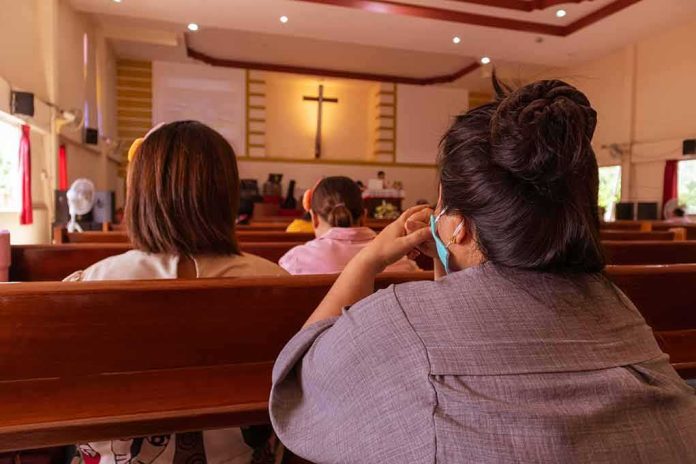
On a Sunday in St. Paul, Minnesota, anti–immigration-enforcement demonstrators marched into Cities Church during an active worship service, chanting political slogans down the aisle and targeting the pastor over his work with federal immigration authorities.[1] According to the United States Attorney’s Office for the District of Minnesota, the disruption escalated to the point that the pastor and congregation were “forced to terminate the Church’s worship service,” and congregants fled the building. That official case description confirms a direct, intentional interruption of religious exercise, not a peaceful protest on public property.
Attorneys for the church argued that the absence of smashed windows or broken pews did not mean laws were respected, emphasizing that intimidation and forced cancellation of worship are themselves harms.[1] Federal case materials describe charges framed as conspiracy to deprive rights and interference with religious exercise, signaling that prosecutors view the event as a civil-rights violation aimed at silencing a congregation’s ability to worship freely.[2] For many churchgoing Americans, the core facts alone—storming a sanctuary and stopping prayer—are enough to raise the alarm about escalating hostility toward people of faith.
Why Minnesota Prosecutors Said “No” to State Charges
Despite the video evidence and detailed federal allegations, the St. Paul City Attorney’s Office announced it would not file any state charges against the protesters involved in the church disruption.[1] City Attorney Irene Kao stated that “current evidence is insufficient to meet that standard for criminal charges under Minnesota state statutes,” a line that has since become a lightning rod for criticism from religious-liberty advocates.[1] State officials have not publicly identified any exonerating footage; instead, they have pointed to the technical need to meet each element of specific state crimes beyond a reasonable doubt.
Legal analysts note that this is part of a familiar pattern where local prosecutors decline public-order cases that many citizens see as obvious, especially when protests align with progressive causes.[3][4] In Minnesota, that pattern is compounded by a broader political climate that has often treated disruptive “direct action” as a protected expression rather than a punishable offense, unless clear physical violence or major property damage occurs.[3][4] For worshippers who had to flee their own church, the message sounds stark: if the attack is ideological and the target is a conservative-leaning congregation, the state may simply stand down.
Federal Cases, Don Lemon, and Confusion Over Evidence
At the federal level, the same incident has generated a complex tangle of cases, including high-profile scrutiny of former television anchor Don Lemon and a producer who were present as journalists.[2] Chief Judge Patrick Schiltz of the United States Court of Appeals for the Eighth Circuit sharply criticized an emergency bid to arrest Lemon, ruling that prosecutors had not shown evidence that Lemon or his producer committed any crime or conspired with protesters.[1] The judge stressed that the worst conduct clearly alleged against the group as a whole involved “yelling horrible things” in church, and he rejected the idea that mere presence or reporting equaled conspiracy.[1]
Even so, the broader federal case file shows that other protesters are still accused of a coordinated effort to deprive worshippers of their religious rights by storming the sanctuary and halting the service.[2][4] That combination—federal charges for some defendants, judicial pushback on evidence for others, and absolute state-level declination—has understandably frustrated both federal prosecutors and the faith community.[4] To many conservatives, it reinforces the sense that the justice system bends over backward to accommodate left-wing activism, while downplaying real harms to churches, families, and the constitutional promise of free exercise of religion.
Sources:
[1] Web – Minnesota Gonna Minnesota: Prosecutors Say No Evidence Against Church …
[2] Web – ICE protesters who interrupted church service won’t face state charges
[3] YouTube – Minnesota judge rejects charges against Don Lemon over anti-ICE …
[4] YouTube – Minnesota Lawyer Defends Protest at Church Whose Pastor Is Top …