Power at a maritime chokepoint is never the same thing as title to it; in the Strait of Hormuz, rhetoric about “control” collides with a settled legal regime and a stubborn reality of contested capabilities.
At a Glance
- No country “owns” the Strait of Hormuz; it is an international strait where ships and aircraft enjoy a protected right of passage under the law of the sea.
- President Trump’s on-record claim that the United States has “total control” is political signaling; experts and diplomats broadly reject the idea that any single actor exercises exclusive control.
- Iran and Oman hold sovereignty over their respective territorial seas bordering the strait, but that sovereignty is constrained by the non-suspendable regime of transit (or, at minimum, protected passage).
- In practice, the strait’s leverage turns on who can escort, delay, or disrupt traffic—not who can declare it their territory.
What “control” means in a strait used for international navigation
The Strait of Hormuz meets the legal definition of an international strait: a narrow corridor connecting one part of the high seas or an exclusive economic zone to another and used for international navigation. In such straits, the governing regime is transit passage—continuous, expeditious movement that coastal states cannot suspend or convert into a permission-based toll road. That framework is not semantic; it is the hard constraint on any state purporting to “own” or unilaterally license passage through Hormuz. Maritime-law specialists, including those writing from policy institutes and law journals, consistently describe Hormuz this way: sovereign territorial seas exist on either bank, yet the corridor itself is open to protected navigation by all flags, civilian and military alike.
This is why sweeping assertions of exclusive control land with lawyers and mariners as rhetoric, not rulemaking. The regime divides what coastal states may do—set traffic separation schemes, promulgate safety and anti-pollution measures—from what they may not: halt transit wholesale, discriminate by flag for the mere act of passing, or claim title to the waterway. Those categories reflect decades of state practice and codification; they are designed to keep global commerce flowing through a handful of narrow arteries on which whole economies depend.
What was actually asserted—and how it stacks up against the record
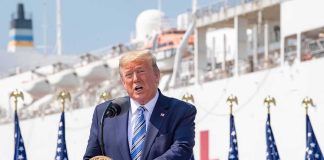
President Trump stated that the United States has “total control” over the Strait of Hormuz and that “we own it,” framing an American-led naval presence as a “wall of steel.” The comments are specific and on the record; they are not paraphrase or rumor. Yet when weighed against law and capability, the claim of total or proprietary control does not hold. Analysts with operational backgrounds and former diplomats have said plainly that no one is in “total control” of Hormuz—neither Washington nor Tehran possesses the degree of dominance the phrase implies.
Iranian authorities, for their part, routinely counterclaim the strait is under Tehran’s “control and management,” even threatening to require permission for transits. Those statements collide with the same legal wall as any American claim of ownership: neither side can lawfully turn Hormuz into a national canal. When senior Iranian figures restate permission claims, they draw swift pushback from maritime bodies and capitals for attempting to transform a global commons corridor into a national license regime.
Sovereignty, passage rights, and the recurring confusion
The confusion is durable because two ideas coexist. First, sovereignty: Iran and Oman undeniably control their respective territorial seas—out to 12 nautical miles—where domestic law applies in most respects. Second, the straits regime: that sovereignty is limited by protected passage for ships and aircraft moving through a channel used for international navigation. Put simply, coastal states may regulate for safety and environmental protection, but they cannot close the door to transit or convert the waterway into a pay-to-pass checkpoint. Maritime-law scholars distill it this way: there is sovereignty on the banks, but not ownership of the corridor itself.
The United States is not a party to UNCLOS, a fact Iran sometimes cites to argue transit provisions cannot be invoked. That claim misreads how much of the straits regime reflects customary international law—rules observed broadly enough by states to bind even non-parties. In practice, major navies, including the U.S., assert and exercise passage rights on that basis. The net effect is consistent: whether you lean on treaty text or custom, Hormuz functions as an international strait where navigation cannot lawfully be halted for politics alone.
De jure versus de facto: capability, coercion, and the limits of force
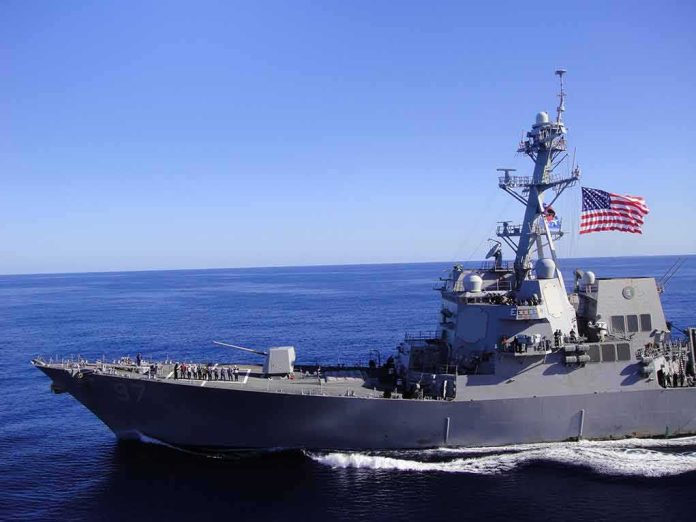
Legal status settles title; it does not settle leverage. The practical question is who can escort, delay, harass, or threaten shipping, especially under crisis conditions. Here, both the United States and Iran possess meaningful, if different, toolkits. The U.S. can surge naval and air assets to screen convoys, interdict threats beyond the strait’s mouth, and impose costs on violators. Iran can launch drones and missiles from the littoral, deploy fast-attack craft in swarms, lay mines, and selectively detain or board ships in its near waters. Neither toolkit produces unassailable dominance across the full seaway. That is why seasoned observers describe Hormuz as contested space, not an exclusive domain.
Because capability is mutual and the geography unforgiving—a narrow, traffic-dense channel—military presence yields deterrence and friction, not title. Naval blockades, if asserted, are judged by their effectiveness and lawfulness; they do not convert a strait into the blockader’s territory. Even when one side temporarily suppresses the other’s operations, the residual capacity to disrupt remains. Hence the expert consensus: claims of “total control” overstate what force can achieve against a capable coastal adversary at close range.
🇺🇸 Meanwhile…
Donald Trump:
“After we finish defeating Iran … pretty soon I’ll be declaring the Hormuz Strait a territory of the United States.”
Yes. He actually said it.
The Strait of Hormuz is one of the world’s most important international waterways, bordered by Iran and… pic.twitter.com/FdQHVL76gk
— GMan | GMan’s Chronicle (@FAB87F) August 14, 2026
Why this matters beyond legal niceties
Language about “control” signals bargaining power in crises: who can impose delay, who can guarantee passage, and at what price—diplomatic or financial. Markets listen. Shippers reroute or accept higher insurance premiums. Regional states hedge by investing in bypass pipelines and export terminals outside the Gulf. But none of these adjustments retroactively bestow sovereignty over Hormuz, and none eliminate the strait’s centrality overnight. As long as a significant share of Gulf crude and LNG seeks the shortest route to blue water, the equilibrium remains the same: law protects movement; capability contests it at the margins.
For governments, the discipline is twofold. First, align rhetoric with law to keep coalition support and avoid handing adversaries an easy legal counter-narrative. Second, align operations with risk—convoys, defenses-in-depth, and rules of engagement that protect passage without escalating to measures that would undermine the very regime that keeps the world’s sea lanes open. For coastal states, the incentive runs the other way: test the boundaries with administrative hurdles and selective enforcement while avoiding formal closures that would trigger collective pushback. The result is a narrow legal channel framed by wider political gamesmanship.
Bottom line: what holds and what does not
Three judgments endure beyond the headline. One, title is settled: the Strait of Hormuz is not U.S. territory, nor Iran’s, nor anyone else’s; it is an international strait subject to protected passage. Two, exclusivity is illusory: neither Washington nor Tehran possesses uncontested control across the corridor; capabilities offset, and geography compresses advantage. Three, words matter: when top leaders claim ownership or permission regimes in Hormuz, they speak past the law and risk confusing publics, markets, and partners about what navies and courts will actually support. Power in a chokepoint is real, but it is power to secure or to spoil—not to annex.
Sources:
youtube.com, opiniojuris.org, reuters.com, inss.org.il, qil-qdi.org, rsisinternational.org, aljazeera.com, theguardian.com, bloomberg.com