
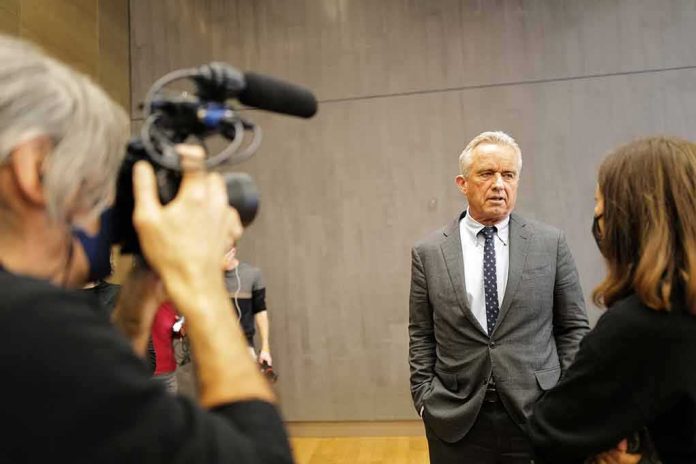
When a sitting Health and Human Services secretary keynotes a conference hosted by the organization he previously led, the speech is only half the story; the other half is what such an appearance signals about policy priorities, institutional trust, and the boundaries of official conduct.
At a Glance
- HHS Secretary Robert F. Kennedy Jr. delivered the keynote at Children’s Health Defense’s Washington, D.C. conference, formally reengaging with a group he once led.
- The event was publicly scheduled for the Grand Hyatt Washington on September 17, 2026, with Kennedy listed on the program.
- Coverage described the appearance as Kennedy’s first overt alignment with CHD since assuming the HHS portfolio, heightening attention to ethics norms around official speaking.
- Beyond the podium, the stakes center on how “health freedom” politics intersect with federal health policy and the guardrails that govern officials’ outside engagements.
What Happened: A Cabinet Secretary Returned to a Familiar Stage
Children’s Health Defense (CHD) hosted a one-day “CHD in DC” conference at the Grand Hyatt Washington, listing the date, venue, and programming in advance. The organization’s schedule identified Robert F. Kennedy Jr. as a featured speaker, and contemporaneous reporting framed his address as the event’s keynote in the nation’s capital. Outlets focused in particular on the fact pattern—Kennedy, in his official role as HHS secretary, addressing an organization he founded and long championed—because the alignment of speaker, stage, and portfolio is rare in modern federal health politics and invites close scrutiny of policy direction and institutional posture toward a movement that casts itself as a critic of mainstream public health.
Previews and day-of coverage emphasized that the appearance amounted to an explicit reembrace of CHD’s community and priorities since Kennedy took office, rather than a cursory drop-by or perfunctory greeting. That framing matters because keynote status, by design, connotes endorsement of salience if not of every proposition in the host’s ecosystem. In Washington, the symbolism of the slot often travels farther than any single line in the transcript.
Why the Venue Matters: Signaling, Policy, and the “Health Freedom” Frame
Public health disputes do not occur in a vacuum; they are prosecuted through institutions, identities, and claims on credibility. CHD has positioned itself for years at the core of “health freedom” politics—skeptical of vaccine mandates, sharply critical of regulatory agencies, and insistent on expanding the definition and salience of vaccine injury. A cabinet official’s decision to center such a venue elevates those debates inside the federal conversation, at least symbolically. Reported themes around chronic disease burdens, food systems, and regulatory transparency are not new to Kennedy’s repertoire, but delivery from the CHD dais creates a convergence between long-standing advocacy and the machinery of federal health policy.
That convergence is precisely why federal ethics regimes focus so much energy on outside speaking. The Office of Government Ethics’ guidance for officials contemplating conference appearances asks two deceptively simple questions: what is the purpose of the conference, and who controls its agenda? The answers are meant to illuminate the risk that an official’s presence will be construed as preferential access or institutional endorsement, and to trigger safeguards around compensation, identification, and use of official position. The rules are prophylactic; they exist not merely to prevent wrongdoing, but to protect public confidence that federal power is not quietly leveraged for private platforms.
The Guardrails: What Federal Ethics Rules Require at Events Like This
The ethics architecture for executive-branch speaking is granular. Officials may address non-federal conferences in an official capacity, but they cannot accept honoraria or outside compensation—including paid travel—tied to their official duties, and they must avoid using public office to confer unfair advantage on a private entity. Agencies commonly require preclearance, written approval, and careful scripting of how the official is identified on programs and from the podium. These are not niceties; they are enforceable elements of the Standards of Ethical Conduct and related criminal and administrative provisions.
OGE’s interpretive materials and agency checklists push planners and principals to confront potential conflicts head-on: Are there financial interests between the official and the host? Is the topic within the official’s job scope such that the speech is “part of official duties,” triggering the honoraria ban? Will the event’s marketing position the official’s title in a way that implies endorsement? The goal is not to shut down engagement, but to ensure it is appropriately bounded—transparent, uncompensated, and consistent with the agency’s mission. When the host is an advocacy organization the speaker formerly led, those questions become more—not less—salient.
The Message Landscape: Chronic Disease, Food Systems, and Agency Trust
Kennedy’s advocacy has long paired two assertions: that chronic illness in American children is unacceptably high and that policy orthodoxy—across food, environment, and pharmaceuticals—has grown too credulous toward industry. Reporting from the event and related coverage highlighted claims about the role of ultra-processed foods and environmental exposures in pediatric disease trends, along with calls for regulatory transparency and accountability. Those themes are familiar to CHD audiences and sit within broader debates about the balance between precaution and evidence thresholds at FDA, CDC, and NIH. Whether one embraces the movement’s specific causal account or not, the policy throughlines—reduce conflicts, publish data, police revolving doors—are legible, durable, and administrable within the federal toolkit.
From an institutional perspective, the practical question is how far such rhetoric migrates into rulemaking, guidance, or funding priorities. Cabinet speeches do not rewrite the Code of Federal Regulations, but they can set signals for advisory-committee appointments, grant emphases, and enforcement posture. In that sense, a keynote to this particular audience functions as a directional beacon: expect pressure on disclosure norms, data transparency, and perceived regulatory capture, alongside sharpened skepticism toward mandates as a policy instrument.
RFK Jr. Promises More Policy Changes, Vaccine Injury Focus In Speech To CHD https://t.co/uhbUA1Q0Cf
— InsideHealthPolicy (@InHealthPolicy) September 17, 2026
The Broader Pattern: When Outside Ties Collide with Public Office
American politics repeatedly revisits a recognizable pattern: officials with prior leadership roles in advocacy or industry reenter those networks from the vantage point of public office. The optics can overshadow substance, but the substance—how the official handles conflicts, disclosures, and decision rights—ultimately carries the day. Ethics guidance anticipates this by separating identity from action: previous affiliation does not disqualify an official from speaking, but it does heighten the need for guardrails around compensation, branding, and preferential treatment. Applied rigorously, those rules protect both the public interest and the official’s ability to engage constituencies across the spectrum.
What to Watch Next: From Symbol to Policy
Keynotes are signals, not statutes. The measure of this appearance will be whether and how HHS operationalizes the themes it elevated in front of CHD’s audience—data access provisions, stronger conflict-of-interest hygiene in scientific advisory work, food and environmental health initiatives that target pediatric outcomes, and adjudication processes for alleged vaccine injuries that prioritize due process and scientific rigor in equal measure. Each can be pursued within existing law; each also invites contestation about evidence standards and risk tolerance. That is where the next phase of this story will be written—not on a stage, but in the Federal Register and in the composition of the expert bodies that guide it.
Sources:
facebook.com, childrenshealthdefense.org, statnews.com, nbcnews.com, thekennedybeacon.substack.com, economictimes.indiatimes.com, politicalwire.com